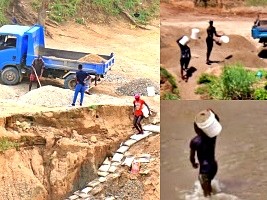
During a reforestation initiative close to the shared border wall separating the Dominican Republic and Haiti, senior environmental officials from the Dominican Republic have sounded the alarm on widespread unauthorized sand mining operations taking place along the Haitian bank of the Massacre River.
Armando Paíno Henríquez, the Dominican Republic’s Minister of Environment and Natural Resources, publicly outlined the scale of the ongoing activity this week, noting that unlicensed extraction has been a persistent problem for years. According to Henríquez, teams of Haitian workers travel to the river regularly, harvesting tons of sand manually with basic buckets before stockpiling the material on riverbanks. The mined sand is then loaded onto commercial trucks and distributed to buyers across northern Haiti for construction and other uses.
In his remarks, Henríquez emphasized that the illegal activity is concentrated on the Haitian side of the waterway, placing it formally under Haitian jurisdiction per international border agreements. To address the issue, his ministry has already initiated coordination with Dominican Foreign Minister Roberto Álvarez, and is preparing a formal briefing to share with Haitian national authorities, even amid well-documented institutional instability and governance gaps in Haiti currently.
The ministry’s first step toward resolving the crisis will be to open diplomatic discussions with Haitian officials, to lay out the full scope of the unregulated extraction and its cross-border consequences. Henríquez stressed that while the environmental harm is being generated on Haitian territory, the negative impacts spill over to communities on both sides of the border, including the Dominican border city of Dajabón and surrounding regions.
Uncontrolled large-scale sand mining fundamentally alters the Massacre River’s natural riverbed, he explained. The activity triggers severe riverbank erosion, disrupts critical aquatic and riparian ecosystems, and dramatically increases the risk of catastrophic flooding for low-lying settlements on both sides of the international border. Without coordinated intervention from both governments, Henríquez warned, the environmental damage will only worsen over time, putting local communities and shared natural resources at growing risk.