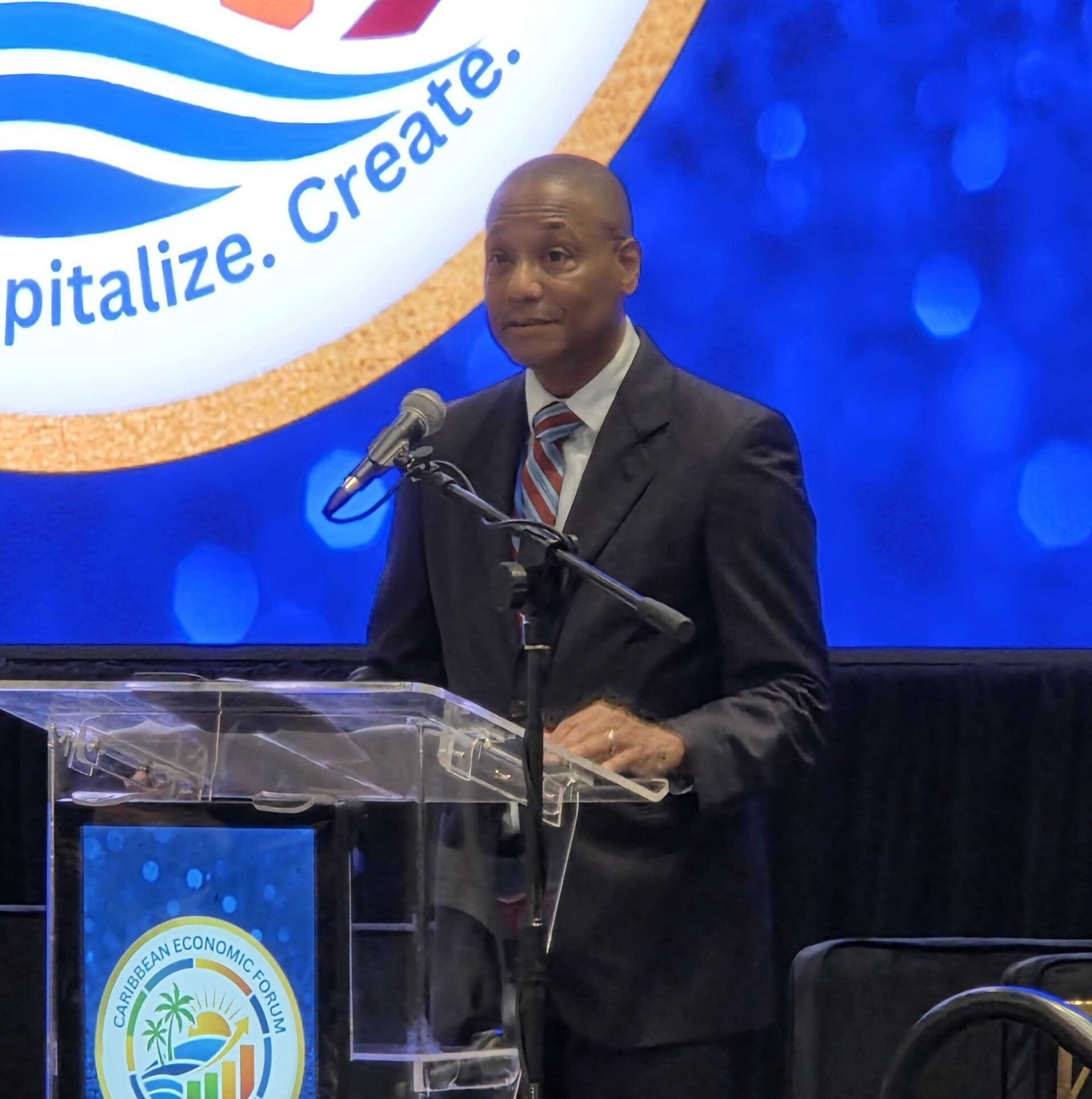
On Thursday, a cross-sector coalition of Caribbean regional leaders and major global investors issued a clear call to action: Caribbean governments must break long-standing patterns of aid dependence and aggressively pivot toward mobilizing private sector capital to drive inclusive, sustained growth. Opening the high-stakes inaugural Caribbean Economic Forum (CEF) — a gathering that unites global investment firms, national government officials, and leading multilateral financial bodies — organizers laid out an ambitious core goal: to reframe the Caribbean from a patchwork of fragmented small markets into a cohesive, globally competitive, and investable asset class.
Clinton White, founder of Counselor Global Solutions and co-convenor of the CEF, delivered the opening welcome remarks, drawing on his decades of experience working and living in the region during his tenure covering Caribbean economies for the now-disbanded U.S. Agency for International Development. White pointed to Barbados’ decades-long track record of economic resilience as a powerful case study for what small Caribbean states can accomplish when they embrace strategic economic transformation. “After gaining independence in 1966, this 166-square-mile island completely rewrote its economic story: it moved from a system almost entirely reliant on sugar exports to a diversified economy powered by tourism, international financial services, education, and a fast-growing innovation and sustainability sector,” White explained. “That transformation proves small states can deliver extraordinary outcomes when they set clear, ambitious goals.”
White traced the origins of the forum back to a 2020 partnership he forged with CEF Executive Director Kiran Maharaj, USAID, and the Trinidad and Tobago Chamber of Industry and Commerce. The founding principle of that collaboration, he noted, is that no government can deliver large-scale economic transformation on its own. “We all acknowledge that development assistance still plays a critical role in the region, but we also recognize that aid alone will never be enough to tackle the full scale of the Caribbean’s opportunities and challenges,” White said in his address. “Aid can kickstart change, but only private investment can sustain it. Grants can build institutional capacity, but private capital builds entire industries, generates long-term jobs, and rewrites economic trajectories for entire communities.”
White’s opening arguments drew heavily on data from the newly published *Caribbean Development Dynamics 2026* report from the Organisation for Economic Co-operation and Development (OECD), which frames the Caribbean as standing at a defining crossroads for development. The report confirms that nearly 80% of all current investment flowing into the Caribbean already comes from the private sector. With that in mind, White argued, the region’s top challenge is no longer convincing global investors of the Caribbean’s inherent value — it is removing structural barriers to channel existing investor interest into high-impact, transformative sectors that deliver broad-based growth. Key priority sectors he identified include renewable energy, climate-resilient sustainable tourism, the blue economy, digital transformation, and artificial intelligence innovation.
“At the end of the day, this forum is not about us — it’s about the next generation of Caribbean people,” White emphasized. “Our goal is to build economies where young people don’t feel forced to leave their home islands to find opportunity. The choices we make in this room will determine whether the next generation inherits a region defined by vulnerability, or one defined by resilience, innovation, and shared prosperity for all.”
Following White’s remarks, CEF co-founder Gregory Hill, who also serves as Managing Partner at ACERO Capital, took the stage to challenge attendees to set aside generic conference rhetoric and focus exclusively on tangible financial execution. Hill pushed back against the long-held international narrative that frames the Caribbean as a collection of isolated, economically vulnerable small states, instead positioning the region as one of the world’s most strategically important untapped investment frontiers.
“Let me be completely blunt and clear from the start: this is not just another regional development conference,” Hill told assembled delegates. “We are not here to talk — we are here to work, we are here to collaborate, and we are here to deliver actual results. We did not gather just to discuss what development could look like; we are here to finance it. So bring your checkbooks.”
Hill argued that the Caribbean economy can no longer afford endless cycles of diagnostic reports and policy discussions that never translate to on-the-ground action. He noted that the combined balance sheets of the global institutional investors and financial bodies represented at the forum total roughly $25 trillion — creating an unprecedented opportunity to close the long-standing gap between abundant global capital and the pipeline of viable, high-impact local projects across the Caribbean.
Over the course of the forum, discussions will center on four core strategic pillars: accelerating the region’s energy transition, building climate-resilient infrastructure, advancing food security through agricultural modernization, and growing the Caribbean’s creative economy. To deliver scaled investment across these sectors, Hill argued, the region needs a modernized financial framework that leverages blended finance structures to reduce risk for private sector entities entering the market.
Hill also called for a fundamental shift in how the success of multilateral development banks and development finance institutions operating in the Caribbean is measured. He proposed that these entities should be evaluated primarily by their ability to mobilize and deploy private capital into productive regional assets, rather than by the total volume of independent loans or grants they disburse.
“Success will not be measured by how eloquent our speeches are today,” Hill said. “Success will only be measured by the formal mandates we sign, the partnerships we lock in, the projects that get actual funding, the businesses that expand, and the jobs that are created for Caribbean people. If we get this right, future generations will look back and see that this was the moment the Caribbean stopped viewing itself as a collection of independent, isolated, fractured economies — and started acting as a unified, investable asset class that delivers shared prosperity for all.”