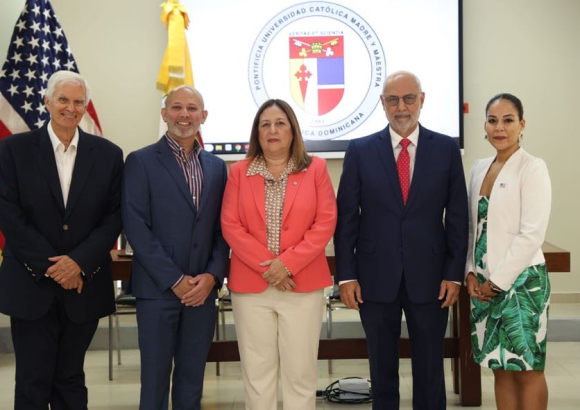
A collaborative keynote conference hosted by the U.S. Embassy in Santo Domingo and the Pontifical Catholic University Madre y Maestra (PUCMM) has convened a diverse cross-sector audience of academics, researchers, university students, and public policy specialists to explore the far-reaching legacy of U.S. independence across the Hispanic Caribbean region.
Leading the core discussion at the event was historian Javier Alemán Iglesias, who delivered a comprehensive breakdown of the multifaceted political, economic, and social transformations that U.S. independence set in motion for Caribbean societies. He also examined how these historical shifts have shaped the long-standing bilateral dynamics between the United States and nations across the Hispanic Caribbean. Alemán Iglesias’ address was framed as a central activity of the Freedom 250 initiative, a multi-event project created to mark the 250th anniversary of the signing of the U.S. Declaration of Independence. The initiative is designed to spark inclusive public dialogue around core principles including freedom, national self-determination, democratic governance, and grassroots civic engagement.
After the conclusion of Alemán Iglesias’ keynote address, the historian joined a follow-up panel discussion alongside two leading Dominican scholars: sociologist Fernando Ferrán and political scientist Flavio Darío Espinal. The panel centered on unpacking the enduring economic, social, and political ripple effects of historical independence movements across the Caribbean basin and the broader Americas, drawing connections between 18th and 19th century shifts and modern regional dynamics.
This conference marks the centerpiece of Alemán Iglesias’ three-day visit to the Dominican Republic, held from June 16 to 18, which is sponsored by the U.S. State Department’s official American Lecturers Program. Beyond the main public conference, Alemán Iglesias participated in a full schedule of closed-door workshops, smaller targeted lectures, and collaborative working meetings with local academics and researchers. All activities during the visit are aligned with broader goals of expanding bilateral educational exchange, strengthening academic ties between the two nations, and encouraging more nuanced, in-depth analysis of the deep historical connections linking the United States, Puerto Rico, and the Dominican Republic.