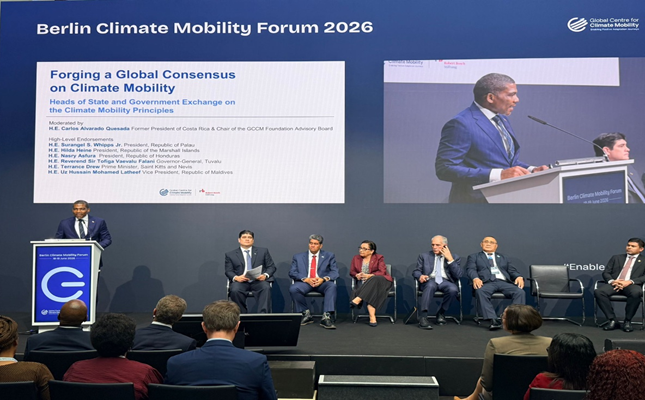
In a high-profile gathering of global leaders in Berlin on June 18, 2026, Prime Minister Dr. Terrance Drew of St. Kitts and Nevis delivered a passionate, principled address at the opening of the Berlin Climate Mobility Forum, calling for systemic climate justice, equitable cross-border collaboration, and the centering of local community voices in crafting global climate solutions.
Drew joined fellow heads of state and government from climate-vulnerable nations including Palau, the Marshall Islands, Honduras, Tuvalu, and the Maldives for the forum’s High-Level Exchange on Climate Mobility Principles. The session, organized by the Global Centre for Climate Mobility (GCCM) in partnership with the Robert Bosch Stiftung, aimed to build unified global consensus around climate displacement, adaptive migration, and resilience-building strategies.
Speaking to an audience of international policymakers, development partners, climate researchers, and civil society delegates, Drew framed climate change as an inherently moral and justice issue, pointing to the extreme inequity faced by Small Island Developing States (SIDS). These low-emission nations contribute just a tiny fraction of global greenhouse gas output, yet face some of the most catastrophic and life-altering impacts of a warming planet. To illustrate this gap, Drew shared the example of a local Caribbean fisherman who watches his livelihood erode as sea levels rise, ocean temperatures warm, and native marine ecosystems shift beyond recognition.
Crucially, Drew emphasized that vulnerable nations are not seeking handouts or sympathy from the global community. “We are not seeking charity, we are not seeking pity. We are seeking justice and partnership, which are fundamental to dealing with these issues,” he stated.
Rewriting the dominant narrative around climate mobility, Drew argued that movement driven by climate change should not be framed as a failure of community resilience. Instead, it should be recognized as a legitimate adaptive strategy that allows people to preserve their dignity, livelihoods, and social bonds amid a growing global crisis. While international funding and technical expertise play an important supporting role, Drew stressed that lasting, effective solutions can only grow out of local knowledge and alignment with on-the-ground realities.
He shared a cautionary example from the Caribbean, where a top-down climate recommendation developed without local input nearly missed critical cultural and economic context that would have made the policy unworkable. That experience, Drew said, reinforced a clear lesson: any climate initiative implemented at the local level must meaningfully include local community stakeholders. “It will be considered arrogant to say that local people, who have been living there for hundreds of years, who had developed solutions, and who had adapted to that climate and who had local solutions to any issue, that [they] would not be good enough to include them in your solution,” he argued.
Drew further noted that robust climate mobility policies must prioritize the protection of indigenous and local cultural identity, traditional livelihoods, and fundamental human rights, while strengthening national resilience and security. He commended the GCCM for its ongoing collaborative work with vulnerable nations including St. Kitts and Nevis, highlighting the organization’s focus on supporting community-led adaptation and locally designed climate responses. The ongoing partnership between the GCCM and local stakeholders on the island of Nevis, he said, serves as a successful model for how global partnerships can empower, rather than override, local action.
The prime minister also called for a fundamental shift in how climate financing is structured, urging global funders to align investments more closely with local needs and priorities. This alignment, he explained, ensures that vulnerable communities are empowered to address their own climate challenges, rather than being further displaced by misaligned external initiatives.
Closing his address, Drew reaffirmed St. Kitts and Nevis’ unwavering commitment to international climate cooperation, calling for greater global solidarity to confront what he called one of the defining challenges of the 21st century. “It is partnerships like these that keep me optimistic, that keep me hopeful. Partnerships like these tell us what is possible. We just have to work together,” he said.