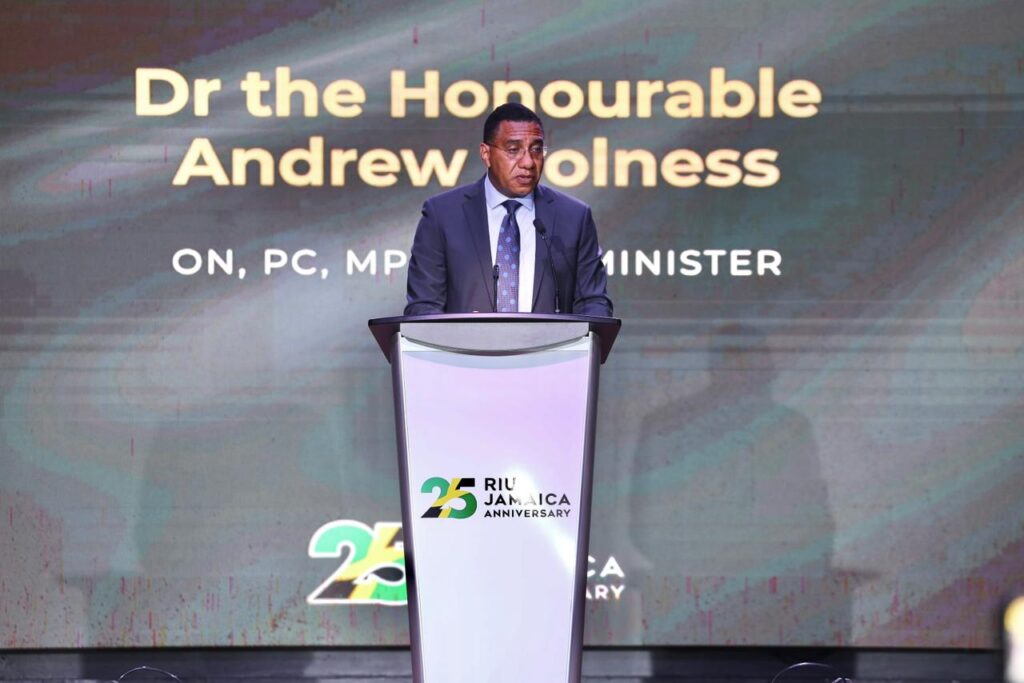
ST JAMES, Jamaica — Against the backdrop of intensifying global economic competition, Jamaican Prime Minister Dr. Andrew Holness has laid out a bold new national vision: to reorient Jamaica’s long-standing role as a net exporter of skilled labor into a sought-after destination that draws and retains top global talent, a shift he says is non-negotiable for unlocking sustained, long-term economic growth.
Holness shared his strategic framework Thursday evening during keynote remarks at the 25th anniversary gala of global hotel chain Riu Hotels & Resorts, held in Montego Bay. In his address, he framed the global race for skilled workers as the defining challenge of the 21st century, a competition that now outpaces even the historic rivalry for foreign capital and access to natural resources.
“Nations across the world are vying for tourist arrivals, competing for direct investment, and courting new business operations,” Holness told assembled guests and industry stakeholders. “But the fiercest competition of all is for talent. That is the ultimate contest shaping economic success in the modern era.”
For nearly two centuries, Holness noted, Jamaica has built a legacy of supplying highly skilled workers to economies across North America, Europe and beyond. Today, that dynamic must change, he argued: the country must simultaneously create local economic opportunities that encourage native Jamaican skilled workers to stay at home, while building an environment that attracts talented professionals from around the globe.
“For almost 200 years, we have positioned Jamaica as a net exporter of talent,” he said. “If our economy is to grow and expand, we now must reposition ourselves to be a net receiver of talent that powers our growing industries.”
The prime minister emphasized that migration, tourism and foreign direct investment are often treated as separate policy silos, but they are ultimately driven by the same core factors that lead people and companies to select one country over another.
“A tourist picks where to spend their vacation, an investor chooses where to deploy their capital, a business selects where to set up operations, a skilled worker decides where to build their career, and a family chooses where to put down roots for the future,” he explained. “All of these decisions increasingly hinge on the same fundamentals: personal safety, effective governance, efficient public services, global connectivity, and access to meaningful economic opportunity.”
Nations that win in this new competitive landscape, Holness argued, are those that successfully establish themselves as “destinations of choice.” He pointed to Singapore, Dubai and Switzerland as leading examples of countries that have intentionally built policy and regulatory environments that draw consistent investment, retain skilled workers, and foster long-term sustainable economic activity.
Against that global backdrop, Holness positioned Jamaica’s $10 billion-plus tourism industry as the linchpin of the country’s strategy to become a talent magnet. Tourism, he said, acts as the critical first entry point that connects global audiences to the country’s potential.
“Tourism is far more than just an standalone industry,” he said. “It is most often the world’s first introduction to our country. It shapes global perceptions, builds confidence among outside stakeholders, and showcases everything Jamaica has to offer. Tourism is the gateway to investment-led development.”
Successful long-term tourism investment, Holness explained, creates a self-reinforcing positive cycle: first, international visitors gain first-hand familiarity with Jamaica, that experience builds confidence in the country’s stability and potential, that confidence draws new foreign investment across sectors, and those new investments create the high-quality opportunities that retain local skilled workers while drawing talent from overseas.
“Opportunity is what retains and attracts talent,” he said. “Instead of our most skilled Jamaicans leaving to pursue careers abroad, they stay here and contribute directly to growing our economy. At the same time, our growing opportunities draw talented people from across the world to come and work here. That diversity strengthens our own local workforce, raises standards, and allows us to expand the range of high-value services we offer globally.”
The prime minister tied this strategic vision to the Jamaican government’s ongoing policy agenda, noting that current investments in core infrastructure, public safety, affordable housing, public service delivery, and human capital development all share the same overarching goal: strengthening Jamaica’s appeal as a place where people want to live, work and build futures.
“All of these investments are part of one unified national mission: to make Jamaica a place of choice,” he said. “A place where people want to visit, where businesses want to invest, where talented people want to build their careers, where families want to live, and where future generations can thrive.”
Alongside outlining his national strategy, Holness used the occasion to commend Riu Hotels & Resorts for its 25 years of operations and partnership in Jamaica. He framed the Spanish hotel chain’s consistent, growing investment in the island as an early vote of confidence that validates Jamaica’s current strategic path.
“In many ways, Riu’s 25 years in Jamaica proves that we are already on the right track,” Holness said. “The confidence Riu placed in Jamaica 25 years ago has been rewarded, and the confidence Jamaica placed in Riu as a partner has also been rewarded.”
“To the entire Riu family and team, thank you for your partnership, your investment, and your belief in Jamaica,” he added. “Congratulations on 25 years of outstanding contributions to Jamaica’s tourism sector.”
Following his remarks, the prime minister met and spoke with Riu Hotels & Resorts team members at the Montego Bay gala venue.