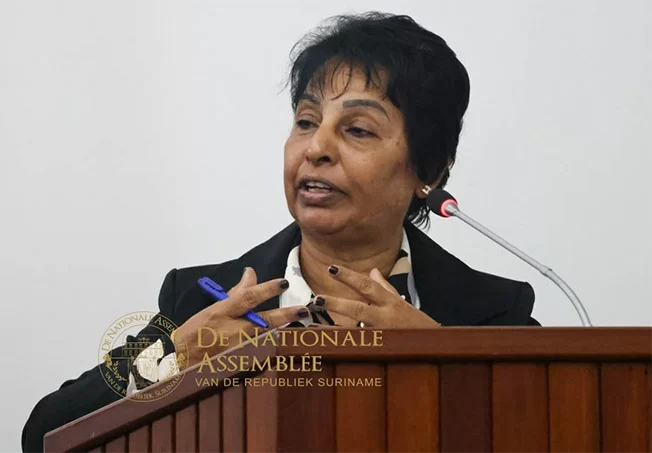
During ongoing parliamentary deliberations over the 2026 draft national budget in Suriname, lawmakers from multiple political factions have united behind a urgent call to raise the country’s universal old-age pension, the Algemene Oudedagsvoorziening (AOV), arguing that the current benefit level leaves thousands of elderly residents unable to cover basic living costs. The debate has also brought renewed scrutiny of ongoing irregularities linked to the country’s purchasing power support grant (KKV), with parliament demanding official clarity from the government on an active investigation into mismanagement of the program.
Harriët Ramdien, a member of parliament from the ruling VHP party, laid out the stark economic reality facing pensioners during the session. Ramdien noted that Suriname’s official poverty threshold already surpassed 7,000 Surinamese dollars (SRD) in 2025, yet elderly residents who rely solely on state support receive a combined total of just 5,000 SRD per month from the AOV and KKV grants combined. She urged the government to immediately raise the base AOV benefit to a minimum of 7,000 SRD, with additional incremental increases planned once public finances allow for further expansion of social spending.
Jerrel Pawiroredjo, leader of the opposition NPS faction, threw his full weight behind the proposal, emphasizing that elderly Surinamese rank among the most vulnerable groups in the country. Many can no longer work to generate supplementary income due to age, he explained, leaving them completely dependent on government support. To illustrate the severity of the crisis, Pawiroredjo shared a firsthand anecdote of an elderly woman who waited hours at an ATM for her AOV deposit, only to be unable to afford bus fare home after the transaction went through.
Raymond Sapoen, a lawmaker from the NDP party, acknowledged that no member of the National Assembly opposes raising social benefit rates, but called for responsible fiscal planning to avoid destabilizing national public finances. Sapoen stressed that the government must outline a clear, achievable timeline for increases not just for AOV, but also for the universal child benefit (AKB) and general social assistance, tying any expansion of spending to verifiable available fiscal space.
VHP parliamentarian Hakiem Lalmohamed added another layer of concern to the debate, highlighting unannounced cuts to KKV benefits for dozens of residents in the Commewijne district that were implemented without any official explanation. He called on the administration to publicly share the reasoning behind these cuts and immediately restore support to eligible recipients who lost their benefits improperly. Lalmohamed also joined the call for an AOV increase, noting that pre-election pledges had led many elderly Surinamese to expect a monthly benefit of at least 8,000 SRD.
By the close of the latest budget deliberation, multiple assembly members had formally called on the national government to release a transparent update on the feasibility of increasing AOV and other core social assistance programs, setting the stage for further negotiations as the draft budget moves through the legislative process.