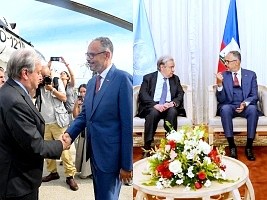
In a high-profile, unannounced brief trip to Haiti on June 16, 2026, United Nations Secretary-General António Guterres touched down in Port-au-Prince after flying in via UN helicopter from the neighboring Dominican Republic’s capital, Santo Domingo. Guterres was first greeted at Toussaint Louverture International Airport by Haiti’s Prime Minister Alix Didier Fils-Aimé, who framed the surprise visit as a clear demonstration of the international community’s unwavering solidarity with the Haitian people amid the country’s ongoing political and security crisis.
Following the airport welcome, Prime Minister Fils-Aimé hosted Guterres and his full diplomatic delegation at Haiti’s National Palace, where senior members of the Haitian cabinet joined the working discussions. The two sides centered their talks on four core priorities that sit at the heart of Haiti’s path out of crisis: the rapidly evolving on-the-ground security situation, national efforts to rebuild institutional stability, the strengthening of fragile state agencies, and the roadmap for restoring democratic governance through the holding of free, inclusive, and internationally credible general elections.
After the closed-door discussions, Guterres publicly acknowledged the incremental but meaningful progress that Haitian national authorities have made in recent months to curb widespread gang violence that has displaced hundreds of thousands and paralyzed large swathes of the country. He specifically praised the bravery and relentless commitment of frontline Haitian security forces, including the Haitian National Police (PNH), the Armed Forces of Haiti (FAd’H), and the specialized Gang Suppression Force (GSF) that has led recent anti-gang operations.
The UN chief also used the visit to reaffirm the world body’s long-term commitment to Haiti, stating that the United Nations will continue to provide critical political, logistical, and humanitarian support to help the country consolidate recent security gains, deliver much-needed aid to vulnerable populations, and work toward a lasting, comprehensive resolution to the multi-layered crisis that has gripped the Caribbean nation for years.