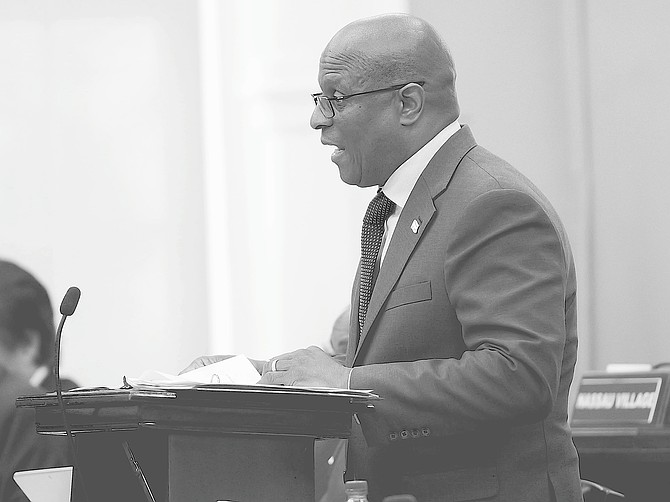
Bahamas’ main opposition leader Michael Pintard is pressing the ruling Davis administration to launch a formal commission of inquiry into explosive allegations that proceeds from international drug trafficking were laundered through public sector contracts, arguing that recently unsealed U.S. court documents connected to accused drug figure Eric “Player” Gardiner have raised questions too grave for the government to sweep under the rug.
Speaking during his address on the national budget yesterday, Pintard called for public funding to support an independent probe that will examine claims of systemic corruption, alleged ties between domestic actors and transnational drug trafficking networks, money laundering facilitated through government-awarded contracts, and potential complicity by sitting public officials or members of the country’s armed forces.
Paper trails linking corporate entities to Gardiner have already drawn public scrutiny. Top Notch Builders, a construction firm that corporate records connect to Gardiner, secured a public-private partnership contract to build the Eight Mile Rock Government Complex just months ahead of the 2017 Bahamian general election. A second affiliated firm, Complete Construction, was later tapped as the primary contractor for the high-profile Carmichael Village affordable housing development project, one of the government’s major public welfare infrastructure initiatives.
The controversy escalated after U.S. court filings referenced an un-named individual only identified as “Politician 1”, who is alleged to have held meetings with people central to the drug trafficking investigation inside a parliamentary facility. To date, neither U.S. court documents nor any Bahamian regulatory or law enforcement agency has publicly revealed the identity of this individual, fueling widespread public speculation.
Pintard emphasized that the allegations carry significant weight because they are rooted in formal international legal proceedings, and cannot be dismissed as mere political grandstanding by the opposition. He also pointed out a clear contradiction in the ruling administration’s public response to the scandal: while senior government officials have attempted to downplay the controversy as insignificant, the Royal Bahamas Police Force has publicly committed to launching its own investigation into the claims.
“For those who have tried to write this off as a nothing burger, the fact that the Royal Bahamas Police Force itself has committed to carrying out a full investigation directly contradicts that claim,” Pintard stated. “In fact, it directly rebuffs the Minister of Foreign Affairs, who has already dismissed this entire controversy as a nothing burger.”
According to Pintard, the independent inquiry should prioritize two core goals: confirming whether the un-named politician referenced in U.S. court documents exists, and uncovering any other individuals who may be involved in the alleged corrupt activities. He also issued a direct challenge to the Davis administration, demanding full transparency around all public contracts awarded to companies that are now the subject of scrutiny over the laundering allegations.
Pintard added that the government has a responsibility to disclose not only the full details of contracts connected to the firms tied to Gardiner, but also all public contracts linked to any other companies that have raised red flags for corruption or illicit activity.
Despite his sharp criticism of the administration’s handling of the scandal and its overall fiscal policy, Pintard confirmed that the opposition will back the country’s overall national budget, though it will register opposition to specific pieces of legislation tied to the spending plan.
He went on to criticize the government’s proposed budget as fundamentally unrealistic, arguing that steep, repeated tax hikes have placed unbearable financial pressure on ordinary Bahamian households, while increased government spending has failed to deliver tangible, visible improvements to core public services including infrastructure, healthcare, education, and sanitation.
Pintard noted that collections from the country’s Value Added Tax (VAT) have grown substantially under the current administration, and calculated that total tax revenue collected under the current government has reached approximately $12.5 billion, while total public spending over the same period has hit roughly $17.4 billion. He argued that the wide gap between massive government spending and the lack of meaningful progress on core public services only reinforces the urgent need for greater governmental accountability and the independent inquiry into the corruption and money laundering allegations that have dominated recent national political discourse.