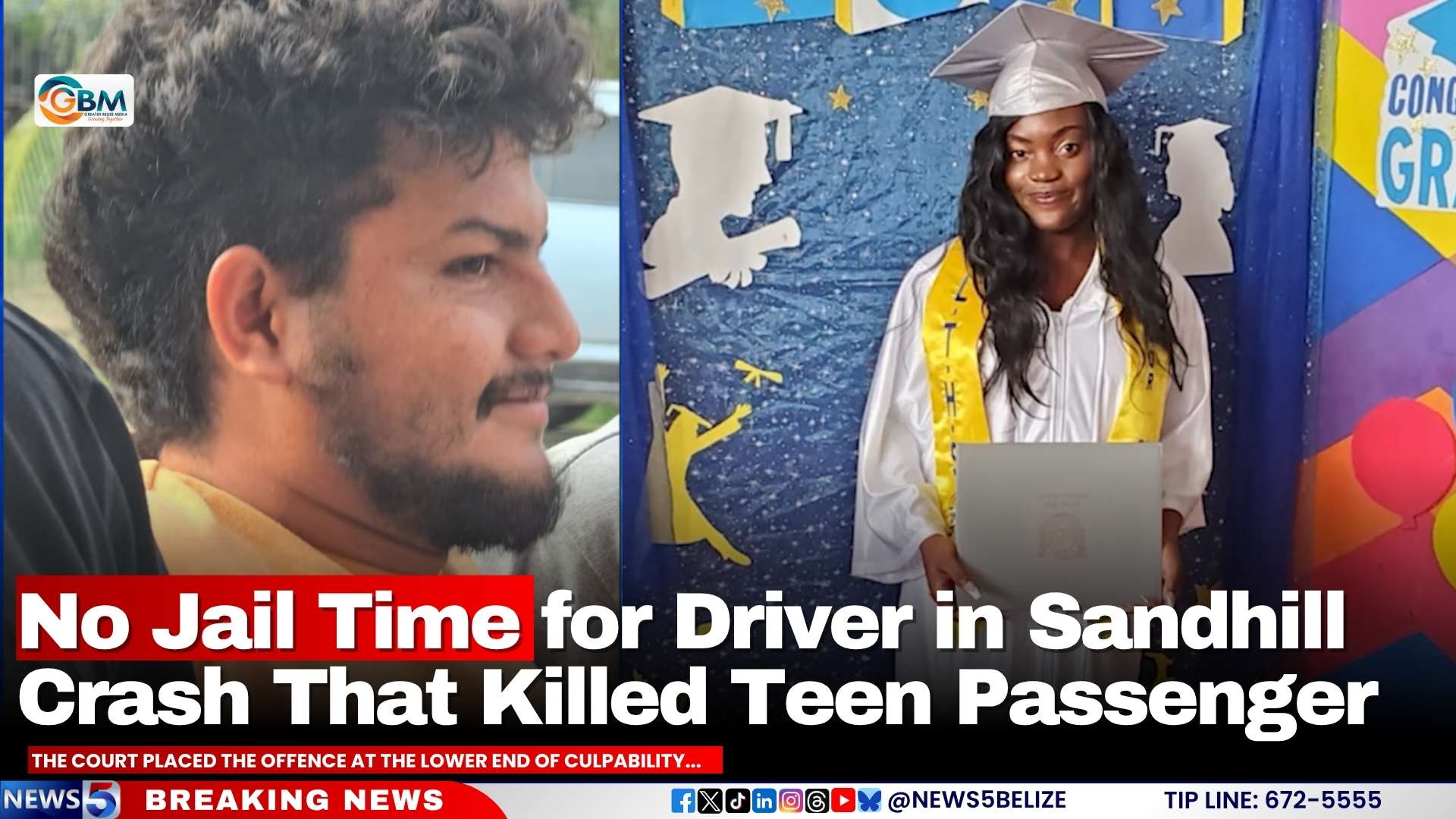
Two years after a fatal car crash on Belize’s Philip Goldson Highway claimed the life of 18-year-old aspiring nurse Denia Rowland, a High Court judge has delivered a non-custodial sentence that has brought a somber close to one of the country’s high-profile road fatality cases.
Oscar Galindo Jr., a 23-year-old construction worker, pleaded guilty earlier this year to a charge of causing death by careless conduct, admitting his role in the April 2024 crash that killed Rowland, his passenger, between Miles 17 and 18 near Sandhill Village. In his sentencing decision, Justice Derick Sylvester ruled that Galindo would avoid prison time on the condition that he pays $5,000 in compensation to Rowland’s mother, Erica Garnett. Payments will start on July 1 at a rate of $400 per month, with a deadline of July 2027 for full repayment. Should Galindo default on this agreement, the judge ruled, an automatic six-month prison sentence will take effect.
The agreed-upon facts of the crash date back to a night of socializing between Galindo, Rowland and a group of friends. After traveling from Ladyville to Sandhill Village, the group began returning to Belize City when Galindo encountered unexpected danger while navigating a curve. Galindo told investigators he was temporarily blinded by the high beams of an oncoming vehicle, causing him to lose control of the pickup truck he was driving. The vehicle veered onto loose roadside gravel and overturned, throwing Rowland from the cab. The teen suffered fatal injuries in the incident.
Galindo was formally indicted on the charge on January 14, 2026, and entered an immediate guilty plea – a step the court identified as a major factor in the decision to forgo prison time. Crown Counsel Maria Nembhard-Santana led the prosecution, while defense attorney Oscar Selgado represented Galindo.
In an emotional victim impact statement delivered to the court, Garnett opened up about the irreversible grief of losing her daughter, who had been balancing work and sixth-form college coursework while pursuing her dream of becoming a nurse. She described the shock of learning of Denia’s death, a moment that still haunts her daily life. “I will never forget the moment my younger daughter told me that Denia had died. I was in complete shock,” she said. “I often think about the last words my daughter said to me and the beautiful dress she was wearing the last time I saw her. Every time I see the color pink, it reminds me of Denia.” Remarkably, even amid her profound sorrow, Garnett told the court she holds no malice toward Galindo. “Although I carry deep sadness and grief because of my daughter’s death, I do not hold any malice in my heart. I simply wish that my daughter was still here with us today,” she said.
For his part, Galindo struggled to articulate the depth of his remorse to the court, saying he could not find words to capture the pain he has carried since the crash. “I cannot find the proper words to express my true sorrow and personal grief that I hold for the families of the deceased and to the families of the survivors and to the survivors themselves,” he said. He issued a humble plea for forgiveness from everyone affected by the crash, adding that he prays for the Rowland family every night before he sleeps. “Every night before I sleep, I pray for those affected and I ask God to forgive me, and I also ask him to grant strength to the grieving family and friends to overcome their loss, and the strength to forgive me,” he said.
Galindo’s family also testified to his character, telling the court that the 23-year-old has been consumed by guilt since the night of the crash. His mother, Carmela Galindo, said he breaks down crying when discussing the incident, and she confirmed that he is truly remorseful for the harm he caused. His sister, Indira Johanna Galindo, echoed that testimony, confirming that Galindo has consistently expressed deep sorrow over Rowland’s death.
In outlining his sentencing reasoning, Justice Sylvester placed Galindo’s culpability for the crash at the lower end of the scale, setting an initial starting sentence of six months in prison. That was reduced to two months after accounting for the core mitigating circumstance of the incident: the crash stemmed from a momentary impairment by oncoming headlights, rather than intentional or deliberately reckless driving.
The court did note one key aggravating factor: Galindo had a blood alcohol level above the legal limit on the night of the crash. Justice Sylvester ruled, however, that this was far outweighed by a long list of mitigating factors. These include Galindo’s clean prior criminal record, his full cooperation with law enforcement investigators, and the genuine remorse documented in a Social Inquiry Report completed for the case.
When combined with Galindo’s early guilty plea and the Crown’s recommendation that compensation be used as an alternative to custody, these factors were enough to justify a fully non-custodial sentence, the judge ruled.