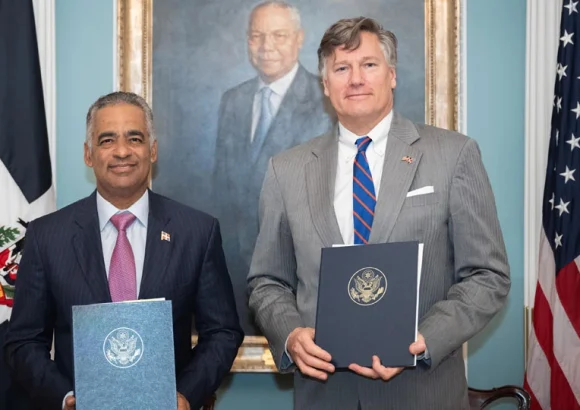
In a significant step forward for bilateral energy collaboration, the United States and the Dominican Republic have formalized a new partnership in the civilian nuclear sector through a recently signed memorandum of understanding in Washington, D.C. The agreement, crafted to deepen cross-border cooperation, is set to advance shared goals of bolstering regional energy security, driving technological advancement, and expanding mutually beneficial economic relations between the two nations.
The signing ceremony brought together top officials from both governments: U.S. Under Secretary of State Christopher Landau signed on behalf of the United States, while Joel Santos, the Dominican Republic’s Minister of Energy and Mines, represented his country. According to official statements from the U.S. State Department, the MOU lays out a structured framework for future collaborative work focused exclusively on the peaceful applications of nuclear technology. A core priority embedded in the agreement is upholding rigorous global standards for nuclear safety, operational security, and non-proliferation, ensuring all activities align with international regulatory norms.
Senior officials from both sides emphasized that the new partnership underscores a shared commitment to building deeper ties in the civilian nuclear space. It also opens the door to exploring new collaborative opportunities that will support long-term energy diversification strategies and inclusive economic growth in the Dominican Republic and across the broader Caribbean region.
The State Department highlighted that nuclear technology delivers a broad array of critical benefits across civilian sectors beyond power generation. These life-enhancing and development-focused applications include improved medical diagnostics, more accessible advanced cancer treatment, more productive agricultural practices, and cutting-edge scientific research. The framework agreement is expected to clear the path for targeted joint projects and knowledge-sharing technical cooperation in each of these high-impact areas in the coming years.
Importantly, authorities have clarified that the memorandum does not grant immediate authorization for the transfer of nuclear materials, specialized equipment, or sensitive technology. Instead, it functions as a foundational platform for ongoing dialogue, relationship-building, and the development of potential future initiatives centered on civilian nuclear energy and innovative nuclear technology applications.
For bilateral relations between the U.S. and the Dominican Republic, the signing marks a measurable new milestone in energy cooperation. It also draws attention to the expanding role that advanced low-carbon technologies play in advancing sustainable development and strengthening energy resilience across Caribbean nations, many of which face growing challenges from energy price volatility and climate change.