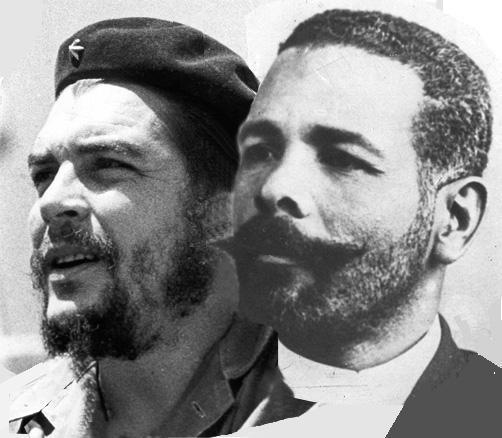
Across the sweep of history, chance often weaves together remarkable threads of shared destiny. For the Cuban people and much of Latin America, the annual arrival of June 14 is no random date on the calendar: it marks the shared birthday of two of the region’s most iconic revolutionary leaders, born 83 years apart and thousands of kilometers apart, who now hold a place of honor in the pantheon of Latin American independence.
Antonio Maceo, born in 1845 in San Luis, Santiago de Cuba, and Ernesto “Che” Guevara, born in 1928 in Rosario, Argentina, never crossed paths in life. Yet their ideological visions and life trajectories converged on the same core goal: a fully free, sovereign Cuba, and a politically and economically united Latin America free from foreign interference.
Though the two men came from drastically different material backgrounds, their upbringings equally forged the unyielding character that would define their revolutionary work. Maceo was born to small mixed-heritage farmers – a Venezuelan father and Cuban mother – who raised 12 children and instilled in them a deep love for their land and a fierce hatred of the colonial institution of slavery. Che, by contrast, grew up in a comfortable, intellectual middle-class Argentine household, surrounded by books and progressive thought. His father, Ernesto Guevara Lynch, held deeply progressive political views, while his mother Celia de la Serna nurtured his critical thinking, introducing him to the work of Karl Marx and Pablo Neruda from a young age.
Neither man inherited leadership; they earned their standing through deliberate choice and consistent action. At just 23 years old, Maceo joined Cuba’s Ten Years’ War against Spanish colonial rule in 1868. With no prior military training or rank, his raw courage and sharp tactical mind allowed him to rise quickly through the ranks to become lieutenant to revolutionary general Máximo Gómez. Multiple battle wounds, and his iconic refusal to accept a compromised surrender deal with Spanish forces at the Protest of Baraguá, cemented his reputation as the “Bronze Titan,” a leader who never wavered in his commitment to independence until he fell in battle in December 1896 at the age of 51, machete still in hand.
For Che, a trained doctor, his revolutionary convictions were forged on the road during his famous cross-continental motorcycle trip with friend Alberto Granados, where he witnessed firsthand the systemic poverty and exploitation that plagued working people across Latin America. He would go on to join the Cuban liberation struggle from 1956 to 1959, rising from serving as the doctor on board the Granma expedition yacht to commander of the Rebel Army, leading the decisive, legendary battle for Santa Clara that sealed the revolution’s victory. After the revolution, he carried his fight for global liberation to other regions of the world, first in Africa and then to Bolivia, where he was killed in 1967 at just 39 years old, rifle still at his side.
Across more than a century, the overlapping values of Maceo and Che stand as a mirror held through time, reflecting a shared unwavering commitment to revolutionary principle. Maceo famously declared, “I understand no other word than freedom,” while Che wrote, “Our freedom and its daily sustenance are the color of blood and are filled with sacrifice.” Three core principles united the two leaders across their different eras: leadership by example, unwavering internationalism, and absolute rejection of any negotiation or mediation with colonial and imperial enemies.
Both men fought on the front lines alongside their troops, sharing the same hunger, danger and hardship without claiming special privilege. Maceo fought first for Cuban independence, and his commitment to regional liberation extended to supporting the independence struggles of Santo Domingo and Puerto Rico. Che, who traveled to Cuba from his native Argentina carrying the experience of continental poverty, rejected the idea that national solidarity ends at a border. He became Cuban by choice, by sacrifice and by the struggle for liberation, and carried the revolutionary fight to the Global South, holding fast to his conviction that “humanity is the homeland of man.” Even when cornered by enemy forces in Bolivia’s Quebrada del Yuro, facing execution at the hands of Bolivian Rangers backed by the CIA, he remained unflinching, telling his executioners, “Calm down and aim well. You are going to kill a man.” Though his body was mutilated after death, his image and ideology have spread across every continent, inspiring new generations of activists.
Today, as Cuba faces an intensifying U.S. economic blockade, as global media campaigns work to distort and caricature the legacy of Latin American revolutionaries, and as political discourse increasingly frames compromise and resignation as “maturity,” the parallel lives and shared values of Maceo and Che emerge as both a reminder of what is possible and a call to action. Their lives prove that true greatness is measured not by wealth or power, but by the justice of the cause for which one is willing to fight and die.