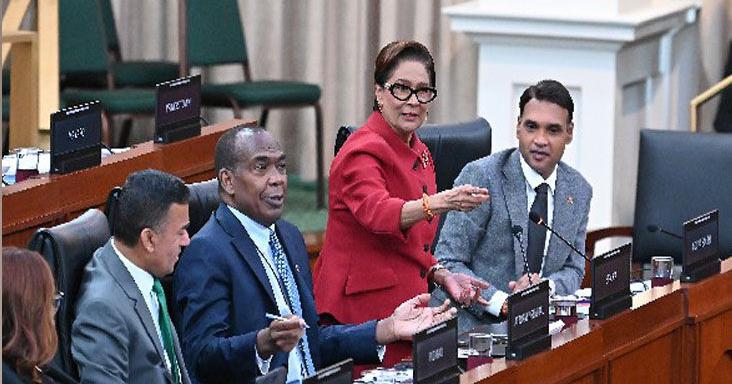
A political firestorm has erupted in Trinidad and Tobago after Attorney General John Jeremie made explosive parliamentary claims about a self-identified elite group called the “1%”, prompting Prime Minister Kamla Persad-Bissessar to publicly back her cabinet minister while standing firm on the government’s commitment to equal application of the law across all citizens.
Jeremie first sparked controversy during Wednesday’s parliamentary session, when he confirmed that the United States government has revoked visas for multiple members of the “1%”, citing U.S. security intelligence assessments of the group’s activities. The Attorney General went on to describe the 1% as a loosely organized criminal-linked group that has accumulated outsized influence over the nation’s economy, alleging it flourished unchecked during the previous administration of the People’s National Movement (PNM). He claimed the group controls major economic sectors, has unfettered access to hundreds of thousands of dollars in monthly foreign exchange through revolving credit arrangements—even as ordinary citizens struggle to secure just $200 in foreign currency for personal travel—and directly funded, infiltrated, and influenced the opposition PNM, which he claimed acts as the group’s willing political proxy.
Jeremie also told parliament his investigation into the matter was triggered after a journalist from Guardian Media Ltd, which he claimed is owned by the 1% group, first questioned him about the revoked visas. Though he initially ignored the inquiry, he said multiple members of the group later visited his office to confirm their U.S. travel privileges had been revoked. He noted that U.S. intelligence agencies have advanced surveillance and analysis capabilities, and the visa action followed the U.S. government’s determination that the individuals’ activities made them ineligible for entry to the country.
Addressing questions from the *Express* newspaper one day after Jeremie’s remarks, the Prime Minister pushed back against growing criticism and defended the Attorney General’s statements, stressing that her administration’s core commitment to equal justice leaves no room for exceptions for wealthy or well-connected groups. “Pursuant to the maxim ‘Justice is blind’ the law applies equally to every citizen, regardless of their financial status, social standing, political connections, or influence,” Persad-Bissessar stated.
She clarified that Jeremie’s core message was a simple reaffirmation that no individual or collective group stands above Trinidad and Tobago’s laws. “Whether criminal elements identify themselves as the ‘Sixx’, the ‘Seven’, the ‘1%’, or by any other name, they are all subject to the laws of Trinidad and Tobago and will be treated accordingly by the justice system,” the Prime Minister added. Persad-Bissessar emphasized there would be no special treatment or immunity for any person, no matter their wealth, social status, or political ties.
The Prime Minister also made clear that the Trinidad and Tobago government plays no role in the U.S. visa application or revocation process, noting that local law enforcement’s only responsibility is to ensure national laws are applied evenly to all people living in the country. She pushed back on premature speculation about the scope of the case, saying “We will review the data at time to make appropriate decisions. It’s too early to speculate. All law-abiding citizens have nothing to fear.”
In a pushback against claims that the 1% is defined by a single ethnic identity, Persad-Bissessar confirmed the group includes members from multiple ethnic communities across the nation. She also revealed a major breakthrough in the long-running fight against transnational crime and money laundering: the state has secured foreign assistance to trace billions of U.S. dollars that were illegally moved out of Trinidad and Tobago over the past two decades.
The Prime Minister detailed the breadth of the alleged illegal activity, saying “Some current and former high-ranking officials of local banks facilitated the sale of massive amounts of foreign currency to local businesses which was then transferred to foreign accounts linked to cartels and also used to purchase real estate holdings and businesses in collaboration with cartels.” She added that billions of dollars worth of illegal narcotics have transited Trinidad and Tobago over the past 25 years, with no clear accounting for how these drug shipments were paid for. “The State is finally getting assistance to deal with drug trafficking and money laundering and we will let the chips fall where they may,” Persad-Bissessar said, signaling the government’s willingness to pursue all individuals involved regardless of their standing.