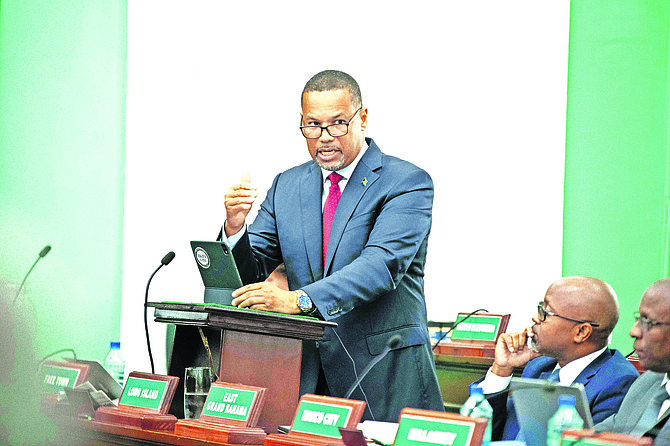
A fiery confrontation has erupted in Bahamian parliamentary budget debates, as Long Island Member of Parliament Dr Andre Rollins has launched intensified scrutiny over multi-million dollar government contracts awarded to a construction firm tied to a convicted US narcotics trafficker, calling for full disclosure of any campaign donations the trafficker may have made to the governing Progressive Liberal Party (PLP) over the past decade.
At the center of the controversy is Top Notch Builders, a company that was granted a $35 million public-private partnership (PPP) contract to build the Eight Mile Rock administrative complex just 24 hours before the May 2017 general election. Public corporate registry documents from The Bahamas directly link Eric Gardiner, a man previously convicted of drug trafficking charges in the United States, to the firm, where he is listed as president and a director. Corporate filings further show that Top Notch Builders owns Complete Construction, the developer behind the current administration’s flagship Carmichael Village affordable housing initiative, which launched during the previous legislative term.
In a surprising reveal, current Finance Minister Michael Halkitis has confirmed he previously held a director position at Top Notch Builders, though he maintains he stepped down from the role in 2021, citing disruptions caused by the COVID-19 pandemic.
Dr Rollins dedicated the bulk of his budget debate address to pressing for clear answers about the awarding process for the Eight Mile Rock contract. He is demanding confirmation of which government official approved the deal, whether the contract was put out for mandatory competitive bidding, and whether Gardiner has ever contributed to PLP campaign coffers. “Who in the government knew what, and when did they know it?” Rollins asked lawmakers. “Was the project open to a competitive bidding process, and if not, why not? Which minister of government was responsible for signing off on the terms of the agreement?”
Additional context around the case dates back to a plane crash on a previous Election Day, when U.S. rescue teams recovered Gardiner alongside ten other survivors. Authorities reported Gardiner was carrying $30,000 in cash at the time of the crash, and multiple survivors were observed wearing clothing and accessories branded with PLP branding. Dr Rollins argues Bahamian voters have a right to know whether Gardiner made any campaign donations to the PLP after the 2017 awarding of the Grand Bahama contract.
“This is important because it would help to explain why a company he is alleged to be a beneficial owner of would receive unusually favourable contractual terms by public contract,” he explained. “It would also help us to investigate which government ministers had direct involvement in the issuance of that eight mile rock government complex contract to Top Notch.”
Dr Rollins also alleged that a controversial “poison pill provision” was written into the PPP contract, designed to make the agreement impossible for a new administration to cancel. He claimed that when the Minnis administration took office in 2017, officials would have been required to pay the full value of the contract, including all accrued principal and interest, if they chose to terminate the deal.
“It’s unbelievable that any government would not have done its due diligence on the principal of Top Notch Builders,” he said. “And with a principal who has been already convicted of narcotics trafficking by the United States of America to get $50.6m in government money means… if one was so minded or had that amount of money to wash or clean, it would be a very convenient way to do so.”
Broadening his critique to public-private partnership arrangements as a whole, Dr Rollins warned that without mandatory public disclosure and robust oversight, PPPs can easily be exploited as vehicles for money laundering. He added that full, nationwide implementation of the Freedom of Information Act would significantly improve government transparency and accountability by creating a verifiable public paper trail for all state contracts.
The debate quickly devolved into a heated parliamentary exchange after Dr Rollins opened his remarks with sharp criticism of the role of big money in Bahamian politics and alleged procedural exploitation in the House of Assembly. Fox Hill MP Fred Mitchell repeatedly raised points of order arguing Rollins’ comments were not relevant to the budget debate, a position that was later upheld by House Speaker Patricia Deveaux.
The back-and-forth escalated into a public clash between Dr Rollins and Speaker Deveaux, with both accusing the other of undermining The Bahamas’ democratic institutions. At one tense point, Dr Rollins warned the Speaker to be cautious, saying he did not want to see her suffer a negative health incident. “You could never,” Speaker Deveaux shouted in response. “Ten of you. Ten just like you could not bring my health event. Be careful. Boy look here. Don’t do that.”