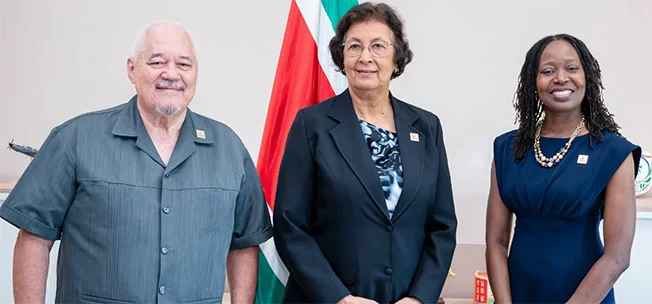
Suriname’s government has announced plans to expand existing cooperation with the Caribbean Disaster Emergency Management Agency (CDEMA), a regional body focused on climate and disaster resilience, to boost the nation’s preparedness for extreme weather events including floods, high wind events and other natural disasters. The announcement came out of a formal meeting Tuesday between Suriname President Jennifer Simons and CDEMA Director Elizabeth Riley.
Riley traveled to the Surinamese capital for the talks, joined by Jerry Slijngard, coordinator of the National Coordination Center for Disaster Reduction (NCCR), Suriname’s national disaster management authority. The delegation met with President Simons at the President’s Cabinet, where discussions centered on what support Suriname can access through the CDEMA regional network across three core areas: disaster risk management, climate resilience, and emergency crisis response.
Speaking via Suriname’s Communication Service (CDS), Slijngard outlined that the meeting served two key purposes: first, to update the president on CDEMA’s core mandate and operating structure, and second, to lay out pathways for deeper bilateral engagement. “This was not just an introductory meeting,” Slijngard explained. “It was also an opportunity to map out the targeted support CDEMA can provide to Suriname as we develop and strengthen our national disaster management framework.”
Talks also covered the ongoing joint work program between CDEMA and NCCR, which currently focuses on capacity-building activities including specialized training for first responders, large-scale disaster simulation exercises, development of updated national response plans, and public awareness campaigns to educate communities on disaster preparedness.
Director Riley emphasized during the discussions that like its neighboring Caribbean nations, Suriname has faced a rising frequency of extreme weather events driven by climate change in recent years. Specific challenges highlighted during the meeting included repeated destructive flooding in Suriname’s interior regions and growing infrastructure damage from severe wind storms.
Riley noted that Suriname stands to gain significantly from regional knowledge sharing, pointing to proven disaster risk reduction techniques that have already been successfully implemented across other CDEMA member states. One example discussed during the meeting was improved engineering methods for anchoring roof structures to buildings, a modification that has been shown to drastically reduce wind damage during tropical storms.
In addition to discussing future support for Suriname, Riley also publicly recognized the nation’s longstanding solidarity within the regional CDEMA network. “When fellow member states face devastating natural disasters, Suriname has always stepped forward with rapid assistance,” Riley said. “This consistent show of solidarity is deeply valued across our entire CDEMA community.”
At the close of the meeting, both Simons and Riley reaffirmed their shared commitment to deepening bilateral and regional cooperation, with the overarching goal of boosting Suriname’s national climate and disaster resilience, ensuring the country is better positioned to respond to future natural disasters and climate-related hazards.