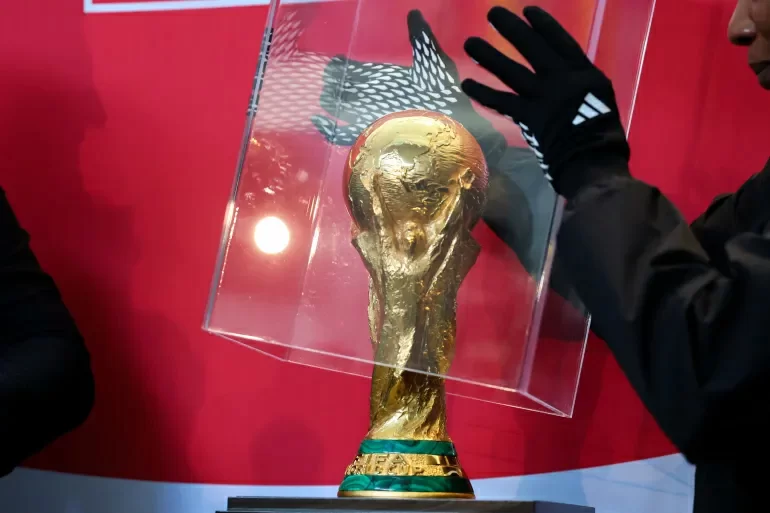
The 2026 FIFA World Cup, the most ambitious iteration of men’s football’s flagship global tournament, is set to kick off this Thursday after years of planning, qualifying campaigns and pre-tournament warm-up matches, as 48 of the world’s best national teams prepare to compete for the sport’s most coveted prize.
Breaking multiple records before a single ball is even kicked, the 2026 edition marks a historic first for the competition: for the first time in World Cup history, matches will be hosted across three nations – Canada, Mexico and the United States. The expanded format, which grew from the 32-team bracket used for the past four tournaments, will see 104 matches played across 16 host cities, with a total prize pool that also hits an all-time high. While FIFA projects that the tournament will break the 1994 World Cup’s 3.5 million spectator record – an edition also hosted by the U.S. – slow ticket sales have raised questions about lower-than-expected public interest so far.
As fans across the globe count down to kickoff, we’ve compiled the most notable historical and 2026-specific statistics to set the stage for the month-long spectacle.
### Historical Standings and Records
When it comes to all-time World Cup titles, no nation has dominated the competition quite like Brazil. The South American powerhouse has claimed five world championships (1958, 1962, 1970, 1994, 2002) and remains the only country to have qualified for every iteration of the tournament since its launch in 1930. Across its history, Brazil has reached seven finals and 11 semi-finals. Germany and Italy trail Brazil with four titles apiece, though Italy will be absent from the 2026 tournament, marking the third consecutive World Cup the Azzurri have failed to qualify. Only Germany remains in contention to add another title to its trophy case this year.
Individually, Brazilian legend Pelé holds the record for the most World Cup titles won by a player, claiming gold three times in 1958, 1962 and 1970. Two of his 1958 and 1962 teammates, Bellini and Castilho, share two titles, while former Brazil captain Cafu also won two titles in 1994 and 2002.
For all-time tournament scoring, Germany’s Miroslav Klose sits atop the leaderboard with 16 goals across 24 matches over four World Cup appearances. He is followed by Brazil’s Ronaldo (15 goals), Germany’s Gerd Müller (14), France’s Just Fontaine (13), Argentina’s Lionel Messi (13), France’s Kylian Mbappé (12) and Pelé (12). The record for most goals scored in a single tournament belongs to Just Fontaine, who netted 13 goals across just six matches at the 1958 World Cup in Sweden.
### 2026 Tournament Specifics
For the 2026 edition, the records for the youngest and oldest competing players are already notable. Mexico’s Gilberto Mora will be just 17 years and 240 days old when the tournament kicks off on June 11, making him the youngest player in this year’s field. Mora made his senior national team debut at just 16 years old, and is one of 22 players under the age of 20 competing in this year’s tournament. At the opposite end of the spectrum, Scotland’s goalkeeper Craig Gordon, who will make his World Cup debut at 43 years and 162 days old, is the oldest player in the 2026 field. The all-time record for oldest World Cup player remains with Egypt’s Essam El Hadary, who played at the 2018 World Cup at 45 years old.
Seven players aged 40 or older are competing in 2026, including Portugal’s Cristiano Ronaldo (41), Mexico’s Guillermo Ochoa (40), Germany’s Manuel Neuer (40) and Croatia’s Luka Modrić (40). Ronaldo also holds another notable 2026 distinction: with an estimated net worth of $1.4 billion according to Forbes, he is the wealthiest player in the tournament, and the first professional footballer to reach the billion-dollar milestone, thanks to lucrative endorsement deals and his contract with Saudi club Al-Nassr.
This year’s tournament also sees four nations make their World Cup debut: Cape Verde, Uzbekistan, Jordan and Curaçao. This marks the highest number of first-time qualifiers since the 2006 World Cup. In total, 891 players across all squads will be competing in their first World Cup. Among these debuting nations, Curaçao stands out as the smallest country to ever qualify for the World Cup, with a total population of just 158,000.
When it comes to squad age demographics, Ivory Coast boasts the youngest average squad age at 25.48 years, while Colombia has the oldest at 29.98 years. Six nations – Cape Verde, DR Congo, Ivory Coast, Curaçao, Senegal and Uruguay – have selected squads made up entirely of players plying their trade at foreign clubs, while Qatar and Saudi Arabia sit on the opposite end of the spectrum: 25 of their 26 squad members play in domestic leagues.
Argentina’s Lionel Messi holds the record for the most World Cup appearances by any player, with 26 matches across five tournaments between 2006 and 2022. He is closely followed by Germany’s Lothar Matthäus (25 appearances) and Miroslav Klose (24 appearances).
In terms of club representation, England’s Manchester City has more players at the 2026 World Cup than any other club, with 19 representatives. They are followed by Bayern Munich (18), Paris Saint-Germain and Arsenal (16 each), FC Barcelona (15), and Manchester United, Crystal Palace, Atlético Madrid and Al Hilal (12 each). In total, players from 71 national associations across all continents are competing, with Europe contributing 35, Asia 14, South America 8, North and Central America 7, Africa 6 and Oceania 1.
The 2026 World Cup’s total prize pool also hits a new record of $727 million, far surpassing the $440 million total offered at the 2022 World Cup in Qatar. The tournament champions will take home $50 million, compared to the $42 million received by 2022 champions Argentina. Even the lowest-ranked finishing teams will receive a minimum of $10.5 million each.
As the world prepares for a month of world-class football, the 2026 World Cup is already shaping up to deliver unmatched drama, passion, and unforgettable moments that will define the next chapter of global football. The wait is almost over – the biggest World Cup in history is finally upon us.