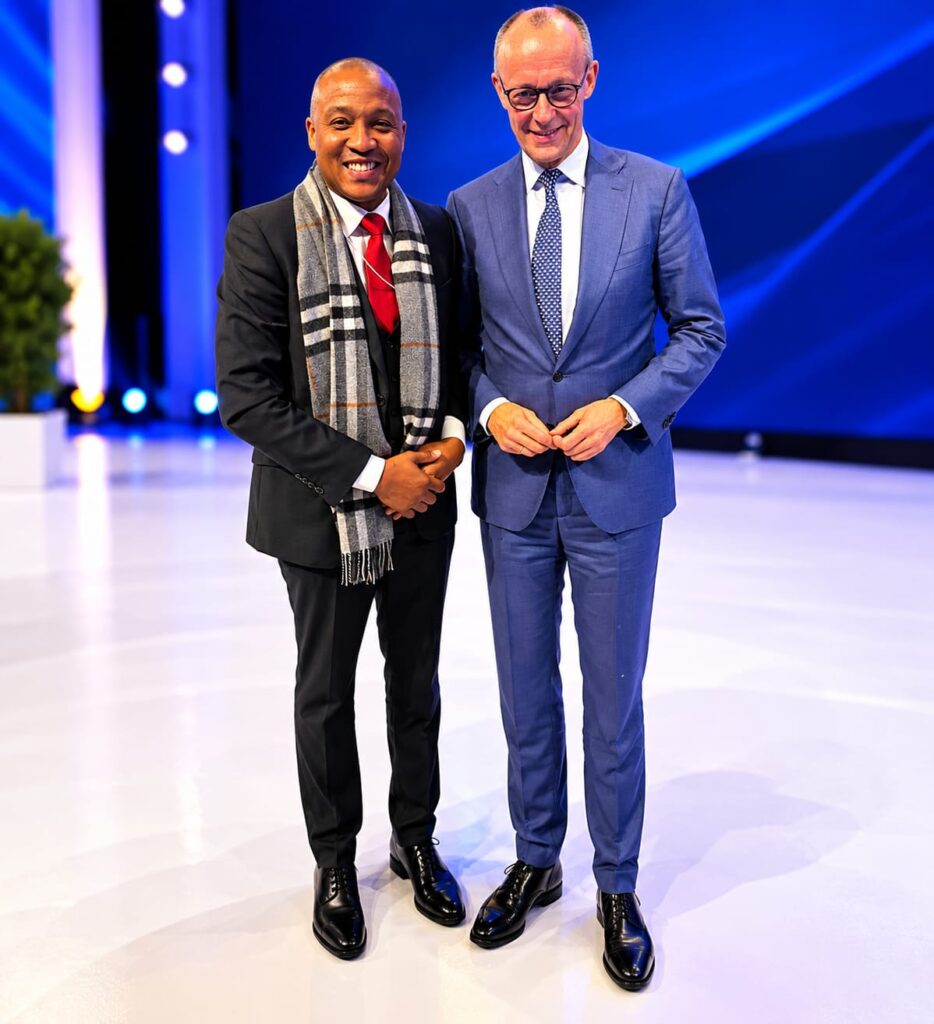
KINGSTON, Jamaica — For years, Paul Simpson’s high-profile meetings with global political and business leaders at major international forums were largely dismissed as elite-level networking for the top Jamaican financial executive. Today, those connections have emerged as a core pillar of Cornerstone, Simpson’s financial group, as it guides subsidiary Barita into a sweeping new era spanning digital banking, asset management, real estate development, cross-regional growth and technology-driven financial services. The group frames these long-standing engagements as a deliberate knowledge-gathering exercise: studying how larger, faster-growing economies built the systems Jamaica needs to compete in the modern global economy.
As the founder, president and chief executive officer of Cornerstone, Simpson’s years of photos alongside leaders in technology, payments, infrastructure, industrial development and economic policy tell a quiet story of strategic planning. For the group, the value of these interactions has never been just exclusive access — it is firsthand exposure to cutting-edge ideas, institutional frameworks and scalable execution models that will shape Barita’s next chapter.
This new era stretches far beyond Barita’s historic identity as a traditional investment house. Cornerstone’s bold vision reimagines Barita as an integrated platform operating at the intersection of finance, technology, capital markets, real estate and regional development. The group’s central wager is that a homegrown Jamaican financial institution can build a strong local foundation, learn from global best practices, and ultimately compete successfully across the broader Caribbean and Latin American marketplace.
Technology sits at the heart of this transformation. One of Simpson’s most notable engagements was a meeting with Elon Musk, the visionary entrepreneur behind SpaceX, Tesla and xAI, and co-founder of PayPal. For Simpson, the meeting carried two layers of relevance. First, on a national level, he thanked Musk for Starlink’s critical role in restoring communications across Jamaica in the wake of Hurricane Melissa, when reliable connectivity was essential for disaster relief, recovery coordination and emergency response.
The second relevance was deeply strategic. Long before Musk became a global household name for electric vehicles, space exploration and artificial intelligence, he helped build PayPal — the fintech pioneer that revolutionized digital payments and proved how technology could rewrite the rules of global money movement. That history resonates directly with Cornerstone, as the group’s own digital banking ambitions revolve around the same core question: how can technology cut friction from financial services, making transactions faster, more affordable and accessible to underserved populations?
To advance this goal, Cornerstone has established technology operations based in Miami, positioning the group closer to the top talent, strategic partners and innovation ecosystems that are reshaping payments, banking, AI, customer experience and digital transformation globally. “Our view has always been that Jamaica and the Caribbean should not be bystanders in the next wave of financial technology,” Simpson explained in an interview. “We have to build relationships with the people and ecosystems shaping the future, understand the technologies transforming global banking and payments, then apply those lessons to solve real problems for our people.”
This focus on learning from global peers also drives Simpson’s engagement across Latin America. In one widely shared photo, Simpson appears alongside Edgar Amador Zamora, Mexico’s secretary of finance and public credit. The connection is strategic: Mexico has emerged as one of Latin America’s most dynamic fintech markets, with rapid growth in digital payments, digital banking, financial inclusion and technology-enabled financial services. For Cornerstone, Latin America is more than a neighboring region — it is a living market laboratory.
Many of the challenges Barita’s digital banking platform is designed to address in Jamaica are shared across much of Latin America and the Caribbean: large populations of underserved customers, exorbitant transaction costs, heavy economic dependence on remittance flows, limited access to formal banking services, and small businesses desperate for faster money movement solutions. “Many of the challenges we are seeking to solve are not unique to Jamaica,” Simpson noted. “Across Latin America and the Caribbean there are millions of people who remain underserved by traditional financial institutions, millions more who depend on remittances, and countless businesses seeking faster, more efficient ways to transact.”
That reality has pushed Cornerstone to think beyond a Jamaica-only business model. “As we build our platform, we are not only thinking about Jamaica. We are thinking about how technology can create a more connected financial ecosystem across the wider region,” Simpson said.
While the Mexico connection focuses on financial inclusion and regional scale, Simpson’s engagement with German leaders highlights another critical pillar of Cornerstone’s strategy: economic competitiveness. A photo of Simpson with German Chancellor Friedrich Merz underscores the group’s interest in Germany, a country long renowned for its industrial leadership, engineering excellence, renewable energy transition and consistent technological innovation. For Jamaica, these themes are particularly urgent, as the country grapples with long-standing constraints including high energy costs, infrastructure gaps, low productivity, inefficient logistics and weak global competitiveness. Cornerstone’s interest in these issues extends beyond financial services, especially as the group expands its real estate and infrastructure development footprint.
Simpson emphasized that the core value of these engagements lies in learning how advanced economies have approached long-term structural economic transformation. Another high-profile meeting, with Turkish President Recep Tayyip Erdoğan, offers a distinct set of lessons for large-scale infrastructure delivery, a priority as Cornerstone expands into real estate development.
Over the past two decades, Türkiye has undertaken one of the world’s most ambitious infrastructure build-outs, spanning transportation networks, affordable housing, logistics hubs, energy projects, ports, airports and urban renewal. For Cornerstone, Türkiye’s experience offers a clear blueprint: how emerging economies can plan and execute large-scale projects efficiently. That expertise is directly relevant as Cornerstone grows its real estate division, which already holds a portfolio of strategic land parcels earmarked for residential, commercial, industrial, tourism and infrastructure developments. Bernhard Stocker, a recently appointed industry veteran, will lead the group’s real estate development arm.
Cornerstone has also spent years cultivating partnerships with Turkish construction, engineering and infrastructure firms, with the goal of adapting global best practices in project execution and construction management to the needs of Jamaica and the wider Caribbean. “As we look at Jamaica’s future, we believe there is tremendous value in studying countries that have successfully transformed their economies through infrastructure investment and disciplined execution,” Simpson said. “Türkiye’s experience demonstrates what can be achieved when long-term vision is matched with the ability to deliver.”
Taken together, these high-profile connections map out the full outline of Cornerstone’s new growth playbook. Musk represents technology, digital payments, artificial intelligence and connectivity. Mexico points the way toward financial inclusion and regional digital banking scale. Germany offers lessons in industrial competitiveness, energy transition and innovation. Türkiye provides a model for infrastructure delivery and large-scale development.
The common thread running through all these engagements is Simpson’s core argument: Jamaica and the Caribbean cannot build their next phase of economic growth in isolation. This philosophy is the driving force behind Barita’s ongoing transformation. The group is shifting away from a conventional, narrow financial services model to build a far broader integrated platform that unites banking, investments, technology, real estate and regional ambition.
Even with this clear strategic vision, the greatest hurdle remains execution. Relationships with global leaders and institutions open doors to ideas, capital and technical expertise, but they do not guarantee customer adoption, profitable projects or successful regional expansion. The ultimate test will be whether Cornerstone can translate its global exposure into tangible local products, investable projects and measurable value for both customers and shareholders.
That makes the next phase of Barita’s development far more than a story of regulatory approvals, acquisitions or photo opportunities. It will ultimately be defined by whether a Jamaican-born financial group can turn global connections into a sustainable, leading Caribbean platform — and whether the bold ambition behind the headlines can be converted into real, on-the-ground results.