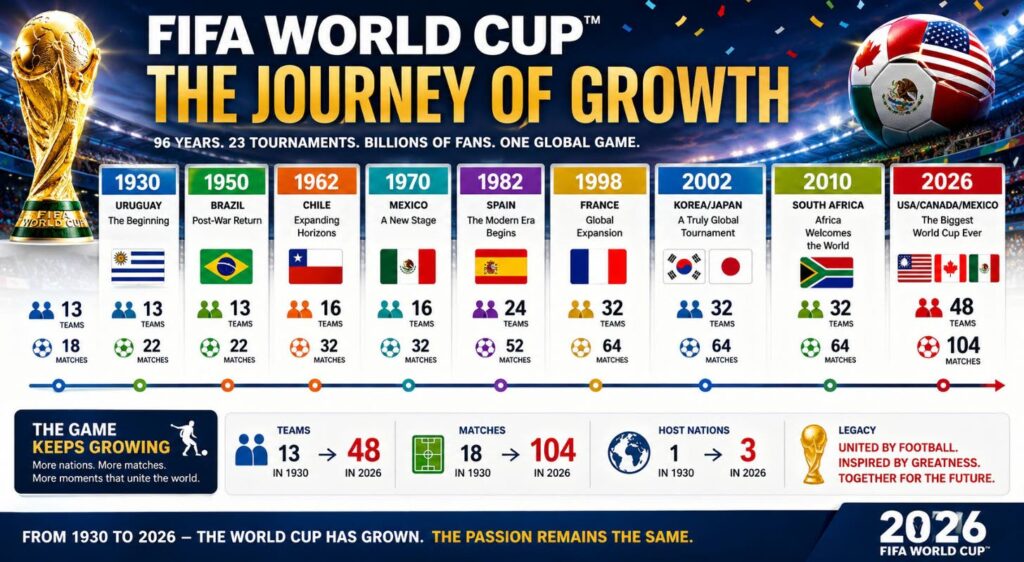
When the 2026 FIFA World Cup kicks off across North America, it will make history as the first edition of football’s biggest global tournament to welcome 48 competing nations. The expansion, a years-long flagship pledge of FIFA President Gianni Infantino dating back to shortly after he took office in 2016, is reshaping the very fabric of the World Cup — opening doors for long-overlooked underdog nations while sparking fierce debate over whether the changes will erode the high-stakes tension that has defined the competition for decades.
Infantino has long framed the expansion as more than a simple adjustment to tournament format: it is a mission to turn the World Cup into a truly inclusive global celebration, rather than a competition dominated by a handful of traditional powerhouses. For most of the tournament’s history, that criticism has held weight. From its early decades through the 16-team era, European and South American nations monopolized nearly all qualifying spots, leaving African, Asian and North American confederations with barely any representation. Even after expansion to 24 teams in 1982 and 32 teams in 1998, the imbalance persisted: 13 European nations qualified for the 2022 Qatar World Cup, while just five African nations secured spots, despite Africa being home to more than 50 FIFA member associations.
The new 48-team format rebalances distribution of spots without stripping places from existing European qualifiers, boosting Europe’s total from 13 to 16, while Africa now claims 10 spots, Asia nine, South America and the North/Central American and Caribbean Confederation (Concacaf) six each, plus an additional spot for Oceania representative New Zealand. Most notably, the expansion clears a path for dozens of smaller nations to qualify for their first ever World Cup finals, opening a once-in-a-generation opportunity that many could only dream of before.
Among these first-time qualifiers is tiny Caribbean island nation Curaçao, home to a population of just 160,000 — less than the capacity of many large European club stadiums. “Once every decade or every four years, a small country gets to spring a surprise,” said Curaçao head coach Fred Rutten, who told reporters he is already planning to pull off major upsets against the tournament’s traditional giants. Cape Verde, Jordan and Uzbekistan will also make their World Cup debuts in 2026, and the new format even gives these underdogs a far better shot at advancing beyond the group stage.
Under the revised structure, the 48 teams are split into 12 groups of four, with the top two from each group plus the eight highest-ranked third-place teams advancing to a new 32-team knockout round. That means a single win in the group stage can often be enough to progress, a far lower bar than the 32-team format where only group winners and runners-up moved on. It is this change that has ignited the fiercest criticism from long-time football observers.
Proponents, including FIFA’s head of global football development Arsène Wenger, argue the expansion is a natural step for a sport that continues to grow across every continent. “It’s a natural evolution. We want to make football global all over the world,” Wenger stated late last year, noting that 48 teams still represent less than 25 percent of FIFA’s 211 member associations, making it a far from unmanageable expansion.
But critics warn the lower bar for advancement will eliminate the do-or-die tension that has produced some of the World Cup’s most iconic moments. In the 2022 Qatar World Cup, eventual champion Argentina suffered a shocking opening defeat to Saudi Arabia, throwing the team into a panic that turned into one of the most dramatic title runs in tournament history. Similarly, traditional giants Germany were eliminated in the group stage in both 2018 and 2022, producing heart-stopping drama for fans. Many analysts argue these upsets and early exits will become a thing of the past, as big teams can afford an early loss and still advance comfortably.
Beyond the lost tension, the expanded format also adds extra strain on players, who already navigate a packed calendar of club and international competitions. The tournament now requires any team that wins the title to play eight matches, one more than the seven required under the 32-team format, with the 2026 tournament set to be played in the heat of a North American summer, raising the risk of fatigue and injury for top players who already compete dozens of times a season for their clubs.
“The biggest problem with this is not really the quality, it’s the dilution of spectacle in the first round with eight third-placed teams to go through,” explained Jonathan Wilson, acclaimed author of *The Power and the Glory: A New History of the World Cup*, arguing the longer group stage could test fans’ patience and encourage more conservative, defensive play as top teams look to avoid injury and secure advancement without risk. Despite the criticism, top managers including England head coach Thomas Tuchel say teams are already adjusting to the new format, focusing primarily on navigating the expanded group stage safely to reach the knockout rounds.
As the 2026 tournament approaches, the debate continues: is this the moment the World Cup finally becomes the truly global event it has always claimed to be, or has FIFA traded the competition’s signature drama for broader representation? Only matches on the pitch will answer that question.