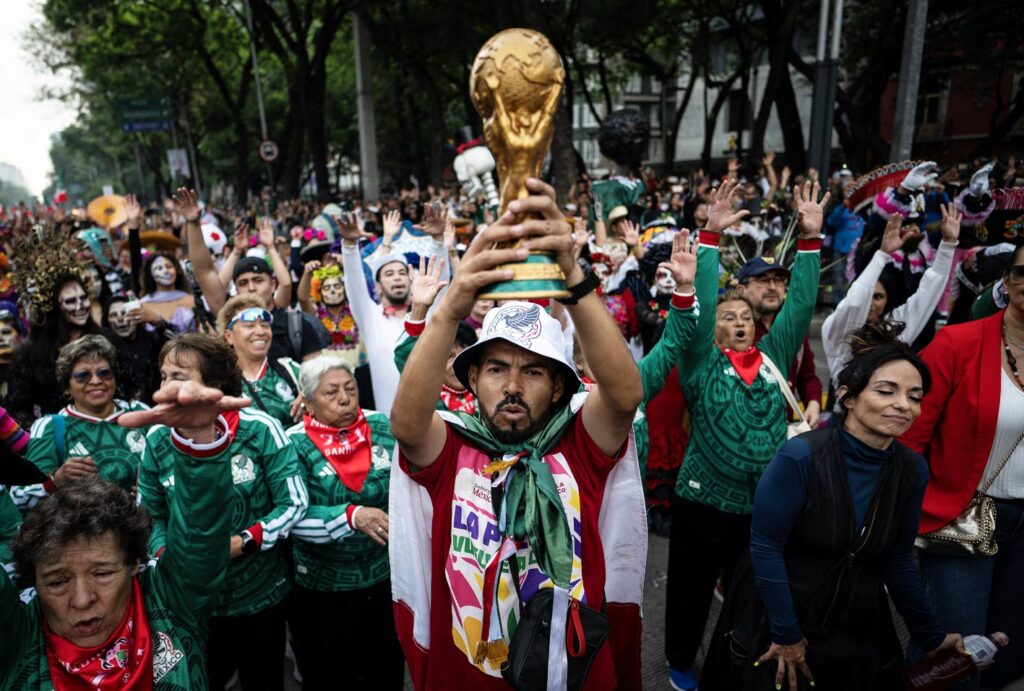
MEXICO CITY — As the 2026 FIFA World Cup prepares to kick off Thursday, global football’s governing body is betting the tournament’s timeless global appeal will overcome mounting public anger over exorbitant ticket costs, tense political currents in the United States, and the lingering shadow of Middle East conflict. This edition makes history as the first World Cup co-hosted by three countries — the United States, Canada, and Mexico — drawing a record 48 competing nations and expected to attract millions of traveling fans. It is also the largest and most logistically challenging iteration of the tournament ever organized.
The opening match will kick off at Mexico City’s legendary Estadio Azteca, where co-host Mexico will face South Africa to launch the nearly six-week event. The tournament will conclude with the final match on July 19 at MetLife Stadium, the 82,500-seat venue in New Jersey.
Football fans around the world are already fixated on the season’s biggest unanswered questions. Will 38-year-old Lionel Messi cement his widely debated legacy as the greatest player of all time by leading Argentina to a back-to-back World Cup title? Can his long-time rival 41-year-old Cristiano Ronaldo defy age to lift Portugal to its first-ever World Cup championship? Or will Harry Kane lead England to end a 60-year drought, delivering the nation’s second major international title following its solitary 1966 World Cup win?
FIFA President Gianni Infantino has aggressively promoted the tournament, touting it as “the greatest show that the planet has ever seen”. But his unbridled optimism has collided with fierce public skepticism in the months leading up to kickoff, as persistent concerns over affordability, political friction, and global conflict have overshadowed pre-tournament celebrations.
The most dramatic point of contention has been the unprecedented spike in ticket prices, which sparked a widespread global backlash that has left FIFA and Infantino struggling to defend their pricing model to the public. For comparison, the highest face-value ticket for the 2022 World Cup final hovered around $1,600. For 2026, FIFA’s priciest face-value final ticket reaches a staggering $32,970. This dramatic price inflation runs across all 104 tournament matches: despite widespread reported demand for the event, many seats remain unsold on secondary resale platforms.
Even Donald Trump, the U.S. president and a public ally of Infantino, has publicly pushed back on the costs. He expressed surprise when informed that tickets for the U.S. men’s national team’s opening match against Paraguay — the first World Cup match to be held on U.S. soil — carry a $1,000 price tag. “I wouldn’t pay it either, to be honest with you,” Trump told the *New York Post*.
Beyond sticker shock for fans, critics have raised alarms that the tense political climate in the United States could cast a pall over the global tournament. Human Rights Watch argues that Trump’s administration’s crackdowns on immigration, public protest, and press freedom could shape this World Cup as an event defined by “exclusion and fear”.
Those concerns gained new traction this week when FIFA removed Somali referee Omar Artan from the tournament roster after U.S. authorities denied him entry to the country. Artan was set to make history as the first Somali match official to officiate at a World Cup finals, but he was turned away upon arrival at Miami International Airport Saturday. FIFA confirmed it could not reverse the decision and announced Artan would be cut from the 52-person referee team.
The February joint U.S.-Israeli military strikes against Iran have also created ongoing uncertainty, as Iran is scheduled to play three group stage matches in the United States, starting with an opener against New Zealand on June 15. Trump initially prompted outcry by suggesting Iran should withdraw from the tournament for their own “life and safety”, before later walking back the controversial comment.
In response to the tensions, Iran has relocated its team base camp from Tucson, Arizona to Tijuana, Mexico, where the squad arrived early Sunday. While Iranian players retain the right to travel in and out of the U.S. for their scheduled matches, approximately 15 Iranian administrative and management staff have been denied visas by U.S. authorities. Iranian officials have decried the move as “deliberate and discriminatory treatment”.