Against a backdrop of growing Caribbean vulnerability to extreme weather driven by climate change, the National Office of Disaster Services (NODS) of Antigua and Barbuda is moving forward with an ambitious plan to construct a purpose-built disaster shelter, pending final sign-off from the national Cabinet. The 19-million-USD facility, dubbed NODS LEAF, is designed to deliver safe, dignified refuge for hundreds of residents during major weather events, filling a critical gap in the country’s disaster preparedness infrastructure.
At a public unveiling event held last Friday, local architect Colin John Jenkins presented the official conceptual design for the new shelter, which is engineered to withstand the strongest category five hurricanes — the most powerful classification of Atlantic tropical cyclones that have devastated Caribbean communities repeatedly in recent years. Unlike generic emergency evacuation spaces that are often repurposed from schools or community centers, NODS LEAF was planned from the ground up to meet the full range of needs of displaced populations. Its amenities will include separate private and family accommodation units, dedicated medical treatment areas and facilities for people with special needs, a commercial-grade kitchen and food processing zone, administrative offices and staff quarters, a children’s play and recreation area, an isolated quarantine space for infectious disease outbreaks, and a flexible multi-purpose hall that can be adapted for non-emergency community use when not activated for disasters.
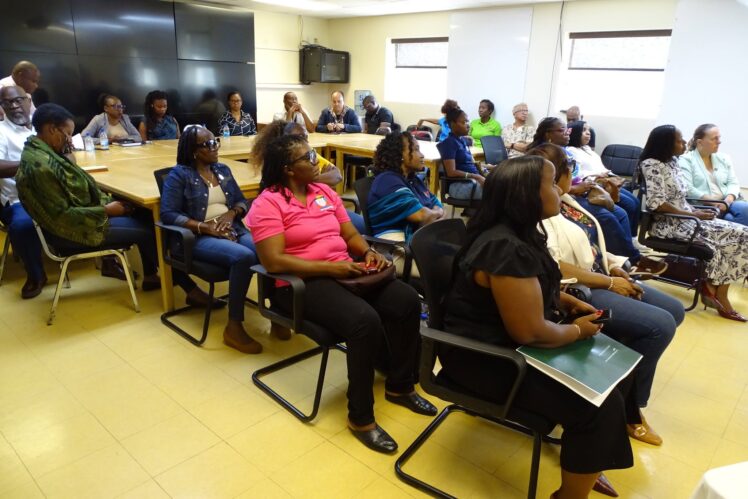
The development of the shelter’s conceptual plans and grant proposal was made possible through funding from the European Union’s Building Resilience of CARIFORUM States to Disaster Risk and Climate Change Impacts (BRICS) programme, an initiative that is implemented regionally by the Caribbean Disaster Emergency Management Agency (CDEMA). Key stakeholders in attendance at the design unveiling included CDEMA Executive Director Elizabeth Riley, Permanent Secretary Sarah Stuart of Antigua and Barbuda’s Ministry of Social and Urban Transformation, a senior European Union representative, and the Director of CARIFORUM.
The shelter announcement coincided with a packed schedule of regional disaster cooperation meetings led by CDEMA leadership across Antigua and its sister island Barbuda over recent days. Prior to the design unveiling, Riley participated in a BRICS project Steering Committee meeting on Thursday, where members reviewed progress on resilience-building initiatives rolling out across the Caribbean sub-region. She also held talks with members of Antigua and Barbuda’s Cabinet to align on national disaster management priorities.
On Friday, following the shelter design event, Hon. Kiz Johnson, Minister of State in the Ministry of Social and Urban Transformation, joined Riley and NODS Deputy Director Craig Cole for a formal signing ceremony for a new five-year Country Work Programme. The framework document will guide all national disaster management activities in Antigua and Barbuda for the remainder of the decade, aligning local priorities with regional resilience goals.
Over the weekend, the CDEMA delegation traveled to Barbuda to continue discussions with local leaders, meeting with John Mussington, Chairman of the Barbuda Council. Talks centered on the ongoing long-term recovery from 2017’s Hurricane Irma, a category five storm that caused catastrophic damage to nearly all infrastructure on Barbuda and displaced most of the island’s population. The delegation also toured Barbuda’s Disaster Management Office and inspected recently completed renovation works to upgrade the island’s emergency facilities. NODS has been partnering with the Barbuda Council for years to strengthen comprehensive disaster management protocols and infrastructure on the island, with the new national work programme set to accelerate these efforts.