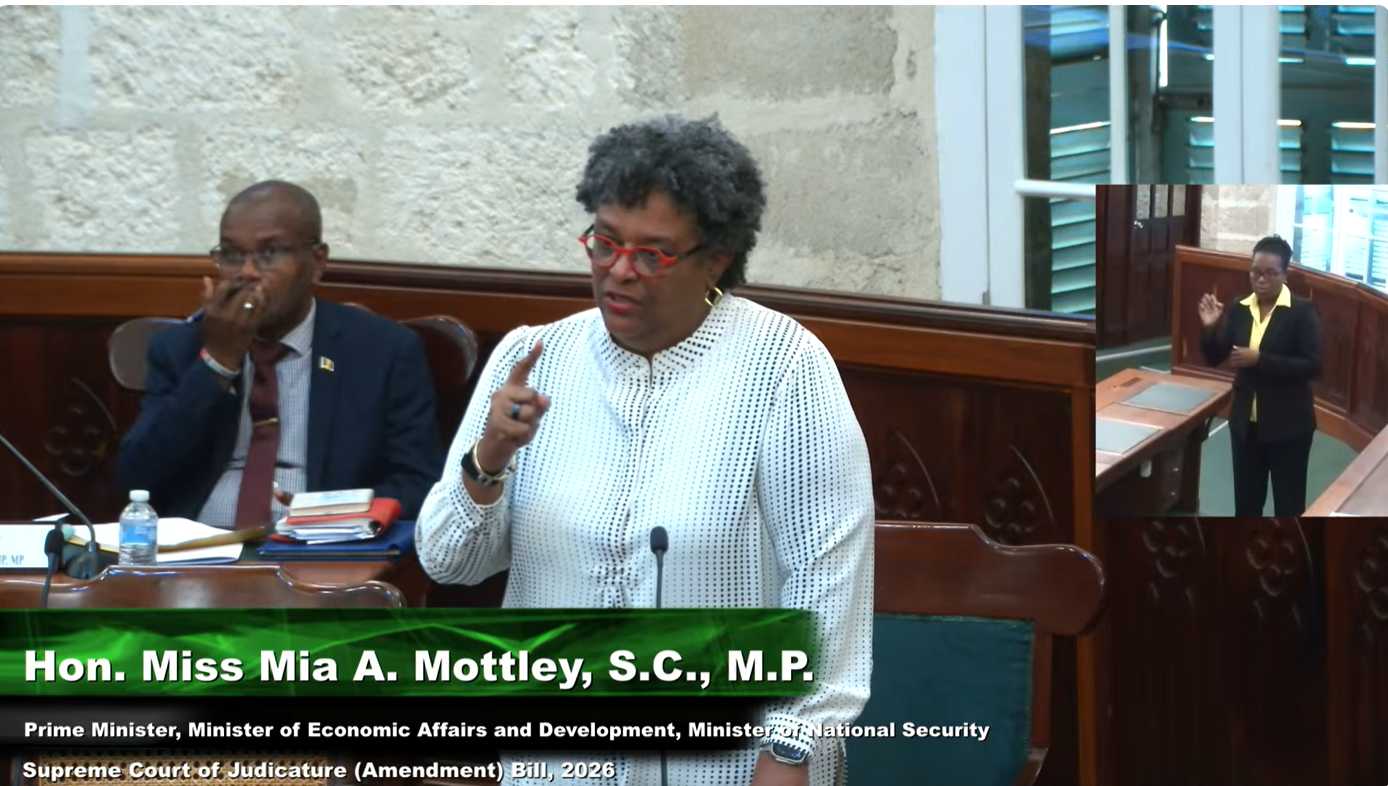
Barbadian Prime Minister Mia Mottley has announced sweeping new plans to establish a specialized, fast-track gun court as the centerpiece of the government’s aggressive new strategy to curb the country’s growing illegal firearm crisis, promising zero tolerance for all gun-related offenses under newly proposed judicial reform legislation.
Speaking in the House of Assembly this week while defending the Supreme Court of Judicature (Amendment) Bill, Mottley emphasized that unregulated firearms remain the single greatest criminal threat facing the island nation, framing the proliferation of illegal guns as an existential scourge that requires targeted, urgent action beyond incremental judicial expansions. The bill, first advanced by the former attorney general, forms a core part of the administration’s broader push to modernize Barbados’ outdated criminal justice system.
Mottley outlined that when her government took office in 2018, the High Court Criminal Division operated with just two judges. Through targeted resourcing, that number has now climbed to eight, with further plans to add two more judicial positions. Even with these significant staffing increases, however, the prime minister stressed that expanding general judicial capacity alone has not been enough to reverse the rising tide of illegal firearm-related violence. This gap, she argued, makes the creation of a dedicated, specialized gun court an unavoidable necessity.
Under the proposed structure, the new gun court system will operate two separate dockets: one to process new firearm cases immediately, and a second dedicated exclusively to clearing the country’s massive backlog of pending gun-related matters. Mottley gave a clear directive that all new cases should be heard within three months, with a target of resolving most cases entirely within just four to six weeks from the time charges are filed. No firearm case, she insisted, should take longer than three months to move from charging to a final hearing.
The prime minister noted that most illegal gun possession cases are far less procedurally complex than other serious offenses such as murder, aggravated wounding, or drug trafficking. Typically, these cases only require testimony from a ballistics expert, the law enforcement officer who recovered the weapon, and a small number of corroborating witnesses to confirm chain of custody and prove illegal possession. This simplicity, she argued, makes rapid processing entirely feasible for a specialized court focused solely on firearm offenses.
A core principle of the new policy, Mottley explained, is that swift justice is the most effective form of crime prevention. For years, offenders have operated under the dangerous perception that Barbados’ judicial system moves too slowly to impose meaningful consequences for illegal gun possession. The new court will dismantle this mentality, ensuring that every person caught carrying an unlicensed firearm faces rapid, visible punishment, sending a clear message to communities across the country that illegal gun carrying will not be tolerated.
Mottley also addressed the long-standing issue of case backlogs, noting that her administration inherited more than 10,000 pending cases when it took office. Progress on clearing this backlog was halted for more than two years by widespread COVID-19 pandemic disruptions to court proceedings and jury trials. To get back on track, the government plans to establish a dedicated three-person unit focused exclusively on reducing backlogs, with a commitment to deploy additional resources after a six-month operational review if needed. Mottley also proposed creating a specialized plea bargaining unit within the Office of the Director of Public Prosecutions, noting that recent plea bargaining reforms have already begun to deliver positive results in reducing case congestion.
The zero-tolerance approach will extend not only to unlicensed firearms, but also to strict oversight of ammunition and legally licensed gun owners, including members of shooting clubs. Mottley stressed that a firearm is functionally useless without ammunition, requiring rigorous accountability for every round sold or used. All ammunition, she insisted, must be fully accounted for by shooting clubs and licensed owners to prevent diversion of ammunition into the illegal market to unlicensed users, in violation of national law.
Mottley emphasized that the fight against gun violence cannot be left exclusively to law enforcement and judicial bodies, calling for a whole-of-nation collective effort to remove illegal guns from communities. She appealed directly to parents, cultural practitioners, and all members of the public to play an active role in steering young people away from involvement in gun crime, warning that participation in illegal gun activity almost always leads to drastically shortened lives.
Urging parents to monitor their children’s activities closely, Mottley delivered a stark warning about the irreversible harm of gun violence. There is no room for mercy after the fact, she noted: while a parent whose child is convicted of gun offenses can still visit them in prison, families of those killed by gun violence are left only with photographs and memories, with no way to reverse the loss. She also called on the public to share information about illegal firearms through anonymous channels including Crime Stoppers, highlighting that human intelligence remains one of the most critical tools for solving and preventing gun crime.
Mottley confirmed that the government has asked local police to outline any additional resources they need to ensure they can prepare and file gun cases for court in the shortest possible timeline. Reaffirming the administration’s unwavering commitment to eliminating unlicensed guns from Barbados, the prime minister said that the legitimate use of force is the exclusive prerogative of the state’s law enforcement agencies — and no private individual has the right to carry or use an illegal firearm. The new dedicated gun courts, she said, will entrench this principle and bring long-overdue stability to communities shaken by gun crime.