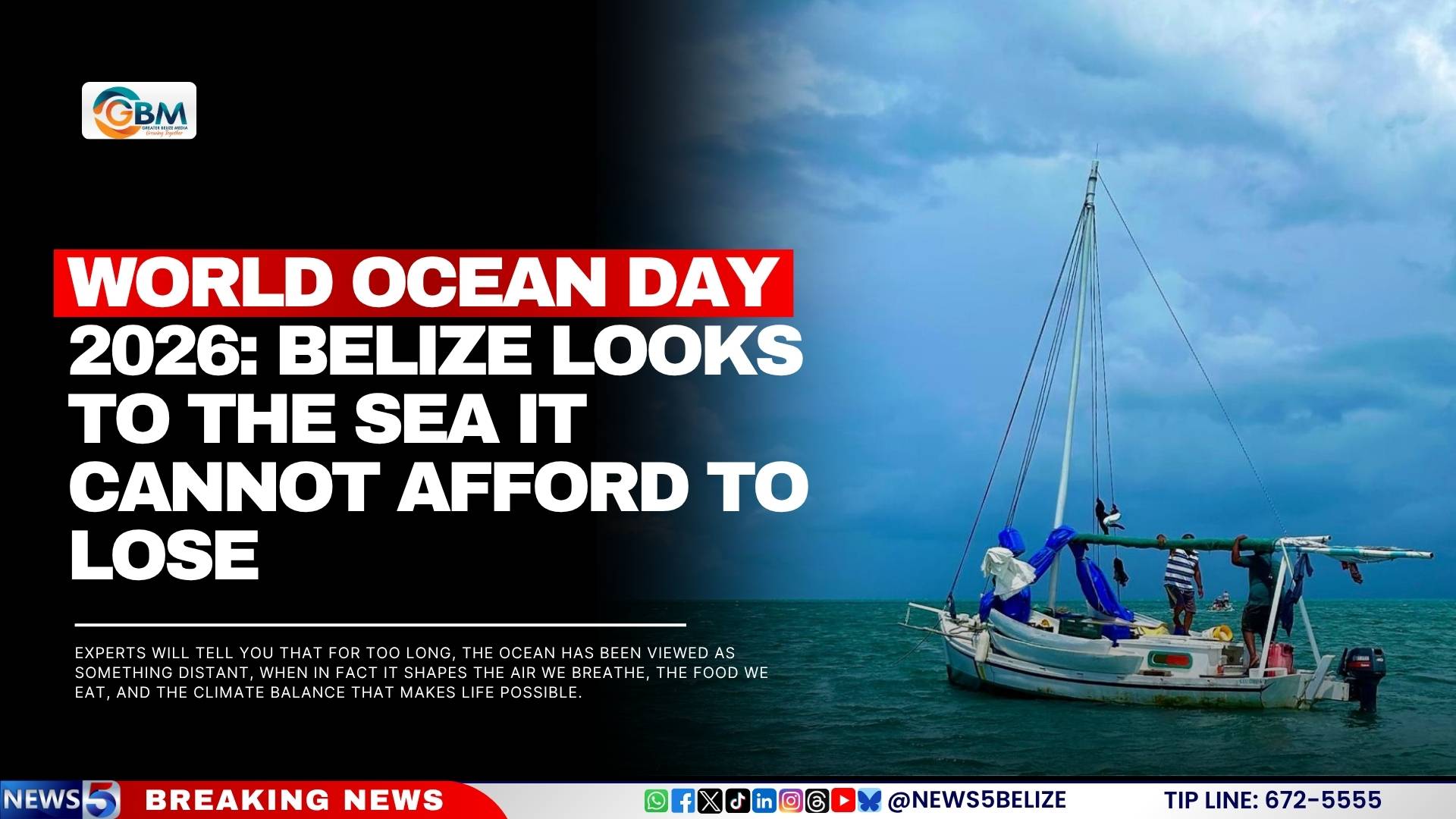
As the world marks World Ocean Day 2026 on June 8, the global conversation around reimagining humanity’s relationship with the ocean hits particularly close to home for the small Central American nation of Belize, where the sea is not just an ecosystem — it is the foundation of national survival. This year’s official theme, “Reimagine: Beyond the World We Know, a New Relationship with Our Ocean,” calls for a fundamental shift in how societies view and interact with marine spaces, moving beyond the long-held narrative of the ocean as an infinite resource for extraction to one of reciprocal stewardship.
For most of the world, the ocean’s importance is often framed as a distant, abstract global public good: it produces half the oxygen we breathe, regulates the global climate, and feeds billions of people. But for Belize, that connection is immediate, woven into every aspect of economic, ecological and daily life.
Jacinta Gomez, Campaign and Policy Director at Oceana Belize, notes that the 2026 theme aligns perfectly with the organization’s ongoing on-the-ground work. “I really like this theme because it invites everyone to rethink the way they look at the ocean,” Gomez explained. “For years we have seen it as a resource that we can extract from. There are exploitative industries, and so it invites us to look at the ocean as something that really sustains us.” This transition from extraction to stewardship is exactly what World Ocean Day 2026 aims to inspire globally.
At the center of Belize’s bond with the ocean is the Belize Barrier Reef, the largest barrier reef system in the northern hemisphere. Stretching more than 300 kilometers along the country’s coastline, the reef forms a complex interconnected ecosystem of living corals, ring-shaped atolls, carbon-absorbing mangrove forests, coastal lagoons and nutrient-rich estuaries that support thousands of species of marine life, many of which are found nowhere else on Earth.
The reef is also the backbone of Belize’s economy. Tourism remains the single largest pillar of national GDP and employment, and the world-famous reef draws hundreds of thousands of visitors annually for diving, sport fishing, snorkeling and immersive eco-tourism experiences. Since the early 2020s, Belize has built its national development strategy around a sustainable blue economy model, linking environmental protection directly to long-term growth. International financial institutions have repeatedly praised the country for integrating marine conservation, sustainable fisheries management, and climate-resilient coastal infrastructure into its national growth plan.
But behind the international recognition and policy progress, the Belize Barrier Reef faces severe, growing threats that put its future — and Belize’s future — at risk. The 2024 Mesoamerican Reef Report Card, which surveyed 110 reef sites across the country, rated Belize’s reef system in overall poor health, giving it an average Reef Health Index score of just 2.5 out of 5. Climate change stands as the single largest threat to the system, driving ocean warming and acidification that stresses corals and causes widespread bleaching. It is followed by agricultural and industrial run-off from inland activities, overfishing, illegal unregulated marine activities, and environmental damage from unmanaged tourism. Infectious coral diseases, particularly Stony Coral Tissue Loss Disease, have also emerged as a growing crisis, with researchers confirming warming ocean waters are accelerating the spread of the deadly pathogen.
Against this backdrop, local conservation organizations are marking World Ocean Day 2026 with a mix of urgency and hope. Fragments of Hope, a Placencia-based nonprofit that runs one of the most successful and celebrated reef restoration projects in the entire Caribbean, released a statement balancing celebration of the reef with a renewed call for action. “For us here at Fragments of Hope, every day is a reminder of how much we depend on the ocean and how much there is still worth protecting,” the organization said. “Here’s to the reefs, the fishers, the divers, the scientists, the communities, and everyone doing their part to keep our ocean healthy for generations to come. Today we celebrate the ocean that connects us all and everyone working tirelessly to protect it.”
The Healthy Reefs for Healthy People Initiative, a regional partnership working to protect the Mesoamerican Reef system, echoed that call for collective action in its World Ocean Day message. “By working together, we can restore what has been lost, protect what remains, and ensure that future generations inherit a thriving ocean and a stable climate,” the initiative said. For Belize, where losing the reef means losing the foundation of the nation, that collective effort is not an environmental cause — it is an existential priority.