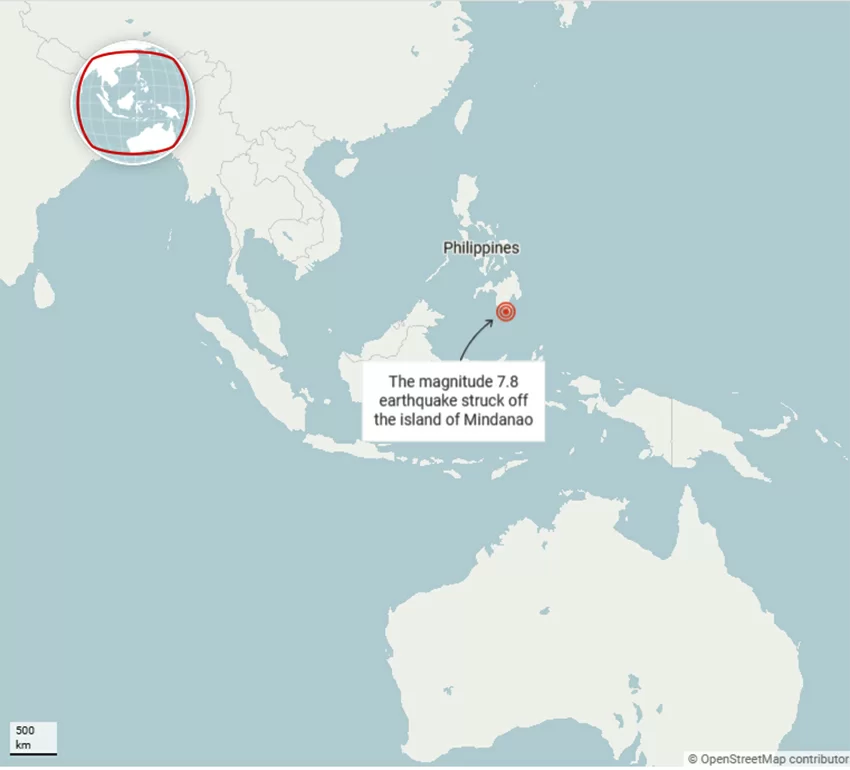
A powerful 7.8-magnitude earthquake hit the Philippines early Monday morning, leaving at least 15 people dead, destroying multiple structures, and prompting temporary tsunami warnings across parts of Asia. The U.S. Geological Survey recorded the main tremor hitting just before 7:40 a.m. local time off the coast of Mindanao, the country’s second-largest island. In the hours after the initial shock, the Philippine Institute of Volcanology and Seismology (PHIVOLCS) confirmed that more than an hour of continuous aftershocks followed the main quake.
The hardest-hit area is General Santos, a coastal city in southern Mindanao home to 722,000 residents. PHIVOLCS rated the seismic event as “very powerful” on its internal intensity scale, with on-the-ground footage shared on official social media showing catastrophic structural damage. One viral clip captured the total collapse of a three-story building that housed a popular Jollibee fast-food outlet, sending a massive cloud of dust and debris billowing into surrounding streets. Additional reports confirm shattered windows, collapsed roofs, and partial structural failures across multiple neighborhoods in the city.
Local police confirmed that a large section of St. Elizabeth Hospital in General Santos suffered severe structural damage, forcing emergency workers to evacuate all patients and staff. Medical operations have been temporarily moved outdoors away from the unsafe main building, disrupting care for hundreds of residents in the area.
Eyewitness accounts paint a picture of widespread chaos as the quake struck. Sister Mary Ann Blanco Rhudy, a staff member at Notre Dame of Dadiangas University in General Santos, described the disorienting experience of the tremor: “Cars were shifting uncontrollably back and forth on the road, luckily they did not collide with one another. Trees swayed so violently that many branches broke off, and several buildings on our campus have partially collapsed.”
The earthquake fell on what was scheduled to be the first day of the new school year across the country, impacting an estimated 3.2 million students and 128,000 teachers and education staff in affected regions. Philippine President Ferdinand Marcos Jr. quickly mobilized national emergency response agencies, including the Bureau of Civil Protection and the National Disaster Risk Reduction and Management Council, and issued an immediate order to close all schools in impacted areas.
“Ensuring the safety of our children is our top priority,” Marcos said in a public statement following the disaster.
In the immediate aftermath of the quake, tsunami warnings were issued for the Philippines, Indonesia, and other coastal territories across Southeast Asia. Most of these warnings have since been lifted as threat levels have decreased, but a tsunami advisory remains in effect for Japan’s southern coast and outlying islands. Authorities in Japan are urging residents to stay away from coastlines and river mouths until further updates confirm the threat has passed.
As of Monday midday local time, rescue teams are still working to clear debris, locate missing people, and provide emergency aid to displaced residents in the hardest-hit areas of Mindanao.