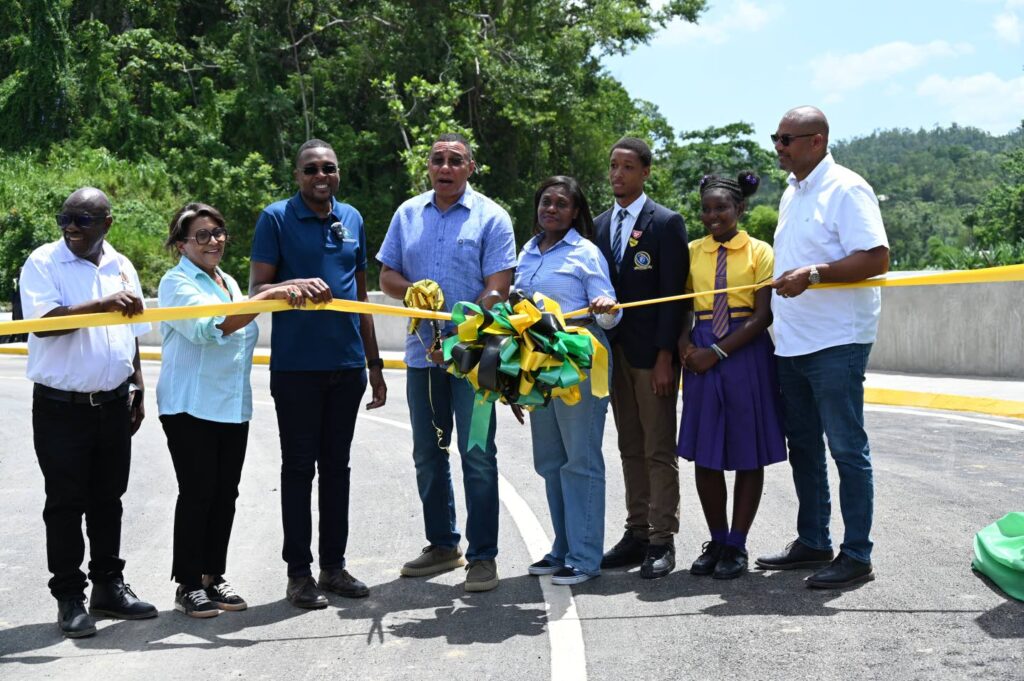
TROY, Trelawny — At the official inauguration of the new $230-million Troy Bridge last Friday, Prime Minister Dr Andrew Holness delivered a public reassurance to rural Jamaican residents, pushing back against widespread perceptions that deep-rural communities have been sidelined from national infrastructure investment and economic growth.
The span connects the Manchester North Western constituency, represented by Opposition Member of Parliament Mikael Phillips, to Trelawny Southern, making it a critical transportation link for thousands of cross-community residents, farmers, and commuters. During the opening ceremony, Phillips used the occasion to raise a longstanding concern from rural constituents: that major infrastructure spending has disproportionately focused on urban hubs and large towns, leaving marginalized deep-rural areas underfunded and disconnected.
“Kingston is not Jamaica alone, Mandeville is not Manchester alone, Falmouth is not Trelawny alone,” Phillips told the gathered crowd. He made a direct appeal to Minister of Works Robert Morgan to ensure deep-rural communities receive fair representation in national road development planning, urging policymakers to set aside the urban-centric approach to infrastructure investment: “Remember us in deep-rural Jamaica whenever you’re crafting that road programme, because we want some of it too.”
In response to Phillips’ appeal, Holness acknowledged that rural communities have long carried a sense of being overlooked by national governments, a feeling that erodes personal dignity, community respect, and public confidence in state institutions. He made clear the current administration’s policy priorities directly counter this trend. “It’s a loss of dignity, a loss of respect, a loss of confidence — and let me assure you, your Government does not forget the rural communities,” the prime minister stated.
Holness outlined the government’s core objective for rural infrastructure: to expand connectivity so rural residents can easily access jobs, open markets, and critical public services, while fully integrating these communities into the country’s core economic networks. “What Government is trying hard to do is to rapidly integrate the rural communities into the nerve centres of economic activities,” he explained. Improved rural road and bridge networks, he added, create flexible opportunity: they allow residents to make their homes in rural areas while accessing employment in urban hubs, and cut transit costs and time for agricultural producers moving goods to domestic markets. The $230-million investment in the Troy Bridge itself, he emphasized, serves as tangible proof of the government’s commitment, not just empty rhetoric: “We’re not forgetting rural communities — and the $230 [million]-odd spent here is a symbol that you are top of mind and not forgotten.”
Works Minister Robert Morgan, who himself represents a rural constituency, echoed Holness’ reassurance, noting that rural development remains a central priority for the administration. He shared details of two major upcoming infrastructure initiatives that will benefit rural Jamaica. First, last Monday, the Jamaican Cabinet approved the Accelerated Bridge Project, a multi-year plan that will replace more than 50 deteriorating or destroyed bridges across the island over the next two and a half years. The western region of Jamaica, which suffered the worst damage from Hurricane Melissa, will receive the majority of funding and support under the program. Second, the $280-million Troy to Warsaw Road full rehabilitation project will move forward under the government’s Shared Prosperity through Accelerated Improvement to our Road Network (SPARK) initiative. Unlike patchwork repairs, this project will deliver a full, long-lasting upgrade to the key rural thoroughfare that serves residents of Troy, Manchester, and Trelawny. Morgan added that more rural infrastructure projects will be announced for the region in the coming weeks.
Alongside broader policy announcements, the opening ceremony saw cross-party praise for the completed bridge. Opposition MP Phillips was joined by ruling Jamaica Labour Party representatives Trelawny Southern MP Marisa Dalrymple Philibert and Falmouth mayor Councillor Junior Gager, who represents the local Warsop Division, in welcoming the new span.
Gager, a Troy native who resides within walking distance of the bridge, recalled the widespread disruption that followed the original structure’s 2021 collapse, triggered by flooding from Tropical Storm Grace. For years after the collapse, the broken span created daily hardships for everyone who relied on it: local residents, commuting workers, farm producers, students traveling to school, teachers, and small business owners. He joked that the constant requests for repairs from frustrated constituents became a daily part of his life: “I live in this little district, I was born here. And when this bridge collapsed, many times you hear the people passing my place, Prime Minister, I hear dem bawl out, ‘Gager, yuh nah fix the bridge?’ So I am more than happy,” he said to laughter from the gathered audience.
Dalrymple Philibert highlighted the steady commitment the government demonstrated to see the project across the finish line, even in the face of significant headwinds: global supply chain-driven rising construction costs, unforeseen construction delays, and widespread damage from Category 5 Hurricane Melissa. This commitment, she argued, reflects the administration’s understanding of just how critical the bridge is to the daily lives and economic vitality of Troy and surrounding communities. “This morning as we cut the ribbon, we do so with gratitude to the engineers, contractors, workers, public servants, and community members whose work made this achievement possible to everyone gathered here today,” she said.
The new Troy Bridge opening comes as the Jamaican government moves forward with plans to consolidate road governance under a new One Road Authority, an institutional reform designed to modernize, streamline, and strengthen the management, regulation, and expansion of the country’s entire national road network.