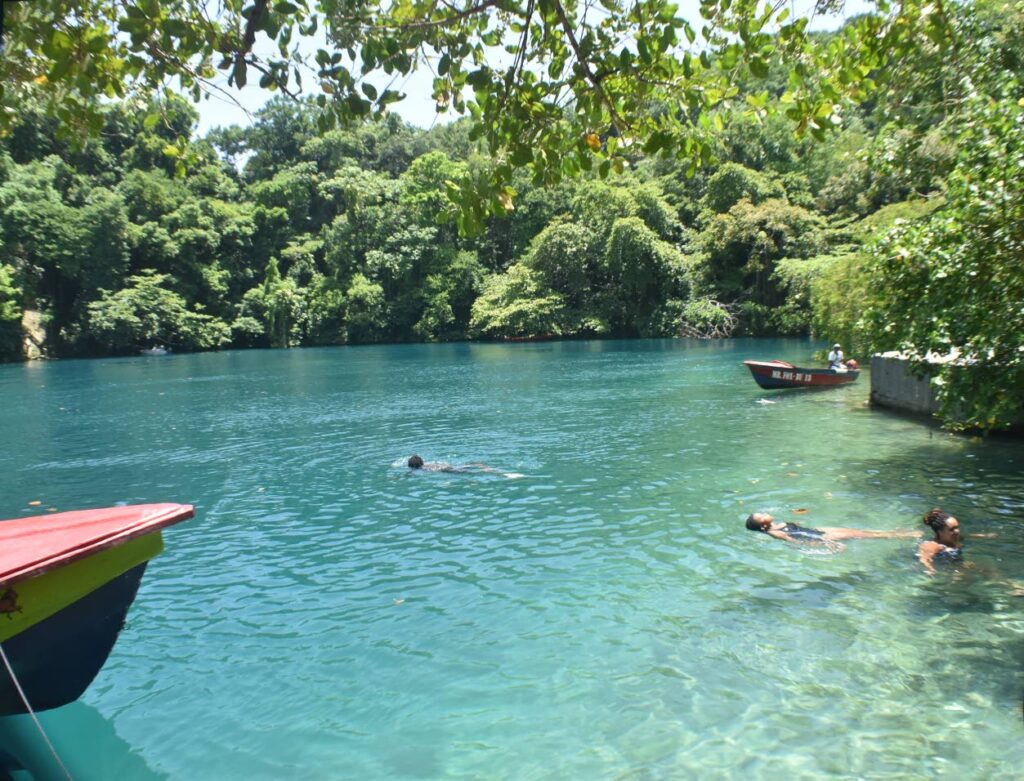
For years, circulating claims that Jamaican locals were barred from entering the iconic Blue Lagoon in Portland have divided public opinion and spurred legal action. Now, a newly surfaced social media video has directly contradicted these allegations, offering on-the-ground footage of local residents freely enjoying one of the island’s most beloved natural landmarks.
The identity of the videographer remains unconfirmed, but the narration in the clip, filmed in late 2024, aligns with the core goals of beach access advocacy groups. The creator explained he visited the site specifically to test claims of restricted entry, and met with a local Maroon leader with deep experience working on Portland coastal access issues during his trip. Walking through the property while filming groups of Jamaican visitors in swimwear, the narrator stated plainly: “I came here today because I was told that there is no access to Blue Lagoon, and as you can see there is full access.”
While the video confirms open entry to the lagoon itself, the creator did acknowledge longstanding infrastructure challenges: parking along the narrow access road remains unregulated and limited, leading to inconsistent informal control of the area that has left the space without formalized public management. Independent verification from Jamaica Observer found no evidence of official access fees being charged, noting any unauthorized fees that have been reported are likely collected by unlicensed touts operating outside legal frameworks.
Renowned globally as one of Jamaica’s most breathtaking natural treasures, Blue Lagoon holds a unique geographic and cultural appeal. Fed by a mix of fresh mountain runoff and Caribbean seawater, the 180 to 215-foot-deep lagoon shifts in hue from deep sapphire to bright turquoise over the course of the day, creating an otherworldly aquatic landscape that has drawn filmmakers, writers, and travelers from across the world for decades. As travel platform Pathculture notes, the unique blend of fresh and saltwater also creates a one-of-a-kind inviting temperature, making it a popular spot for swimming, boat tours, and quiet relaxation for both visitors and locals.
Debates over public access to the site stretch back years, and have even landed in court. In 2023, two local advocacy groups — the Jamaica Beach Birthright Environmental Movement (JaBBEM) and Portland Environmental Action (PEA) — launched a lawsuit over access, focused on reopening the Blue Hole road, the historic public entrance to the national monument. PEA spokesperson Wilbourn Carr explained at the time that the groups raised concerns after the Jamaica National Heritage Trust (JNHT), the managing body for the site, signed a three-year agreement that routed public access across private land. The lawsuit seeks to secure permanent public entry by reopening the original public road, regardless of future changes to the private land agreement. The case remains ongoing as of 2025.
Most recently, misleading social media claims in early 2025 alleged that the entire site would be sold to a private owner and entry restricted only to paying guests. In response, JNHT issued an official statement debunking these rumors, confirming that Blue Lagoon remains free and open to all members of the public. The trust noted that it has recently completed upgrades to the site, including renovated restrooms, improved landscaping, and new informational signage, and allows authorized craft vending along the shore.
JNHT did acknowledge the longstanding parking challenge: limited public space means many visitors choose to pay a small fee to park at adjacent private properties like the nearby Tropical Lagoon Resort Limited, and the trust does not provide on-site security. The organization also confirmed that all land surrounding the lagoon has been privately owned for more than 50 years, a detail that has shaped the site’s management challenges for decades.
In a March 2025 address to Parliament’s Standing Finance Committee, Culture, Gender, Entertainment and Sport Minister Olivia Grange outlined the government’s plans to upgrade the iconic site, confirming a proposed $20 million allocation to repair the Blue Lagoon dock as part of a broader rehabilitation project. Grange noted that designs and proposals for the work are complete, and repairs will move forward as soon as funding is finalized. She added that lifeguards are already stationed at the lagoon, but management remains complicated by the privately owned surrounding acreage.
Addressing public concerns over the access route barrier installed in recent years, Grange clarified that the barrier is intended to manage vehicle traffic — not block public entry. “The barrier that’s there still provides access to the Blue Lagoon,” she said, explaining the measure was necessary to stop vehicles from entering the area where no adequate public parking exists. To resolve long-term infrastructure issues, the government is developing a comprehensive development plan that would create a designated public parking lot, with shuttle service to transport visitors to the lagoon entrance. Grange also confirmed that motorized water sports will remain banned at the site to protect the sensitive ecosystem and respect the boundaries of adjacent private landowners.
The minister emphasized the government’s goal of striking a fair balance between preserving public access and supporting local communities that rely on the lagoon for income: “We will have to find a balance between the people having access and the people enjoying and earning from the Blue Lagoon.”
In the viral social media video, the creator echoed calls for accurate discourse around the site, pointing to the recently renovated restrooms as an example of progress that misinformation overlooks. He urged access advocates and government officials alike to avoid spreading unsubstantiated claims, warning that repeated misinformation erodes public trust when genuine concerns arise. “Sometimes we do a disservice when we say things that are not true… Sometimes people will say the wrong things and it’s almost like crying wolf. When things are very serious we don’t take it seriously because a lot of misinformation goes out to the public. I just came here a while ago and there is access, but it’s more organised. We need to stop this misinformation campaign. While I agree there is not access to a lot of different places, let us keep it real, let’s be honest.”