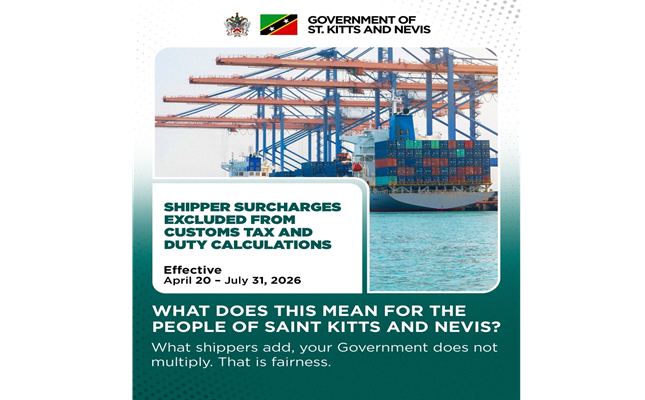
BASSETERRE, Saint Kitts – In a proactive push to shield local households and businesses from the global wave of soaring living costs, the Government of Saint Kitts and Nevis has publicly reaffirmed its ongoing customs relief measures, highlighted by a full waiver of bunker and shipper surcharges from customs duty and tax calculations.
Unveiled as a core component of the administration’s broader economic relief package rolled out in April 2026, the policy is intentionally structured to mitigate the ripple effects of spiking international fuel and freight expenses on the price of imported goods, which form a large share of everyday purchases for people across the island federation.
Under current rules, customs duties and taxes are calculated based on the CIF (Cost, Insurance, Freight) value of imported shipments. By excluding bunker and shipper surcharges – extra fees tied to sea and air transportation – from this valuation, the government has cut unnecessary tax liabilities that would otherwise be passed down to end consumers. This step directly addresses the reality that recent transportation cost hikes stem almost entirely from external economic forces outside the federation’s control: volatile global fuel markets and persistent international supply chain disruptions that have driven up living costs across nearly every region of the world.
Officials note that by reducing the overall tax burden on imported products, the waiver delivers immediate relief to local importers, creating clear incentives for these businesses to pass their savings along to shoppers at the point of sale. The customs surcharge exemption is not a standalone policy; it is one piece of a coordinated, multi-pronged strategy to soften the blow of international economic shocks, stabilize domestic prices, and cushion both household budgets and local business operations against global volatility.
Additional temporary relief measures currently in effect include a 50 percent cut to the excise tax on gasoline, a reduction in the Customs Service Charge on gasoline from 6 percent to 3 percent, and the full removal of Value Added Tax (VAT) on eligible alternative energy equipment. All of these targeted interventions are designed to deliver tangible, immediate relief to working families and business owners while bolstering the nation’s long-term economic resilience to external shocks.
All economic relief measures outlined by the government are scheduled to remain in effect through July 31, 2026. This public reminder comes as the administration continues to monitor global economic trends and adjusts its policy responses to protect the well-being of all citizens and residents of Saint Kitts and Nevis.