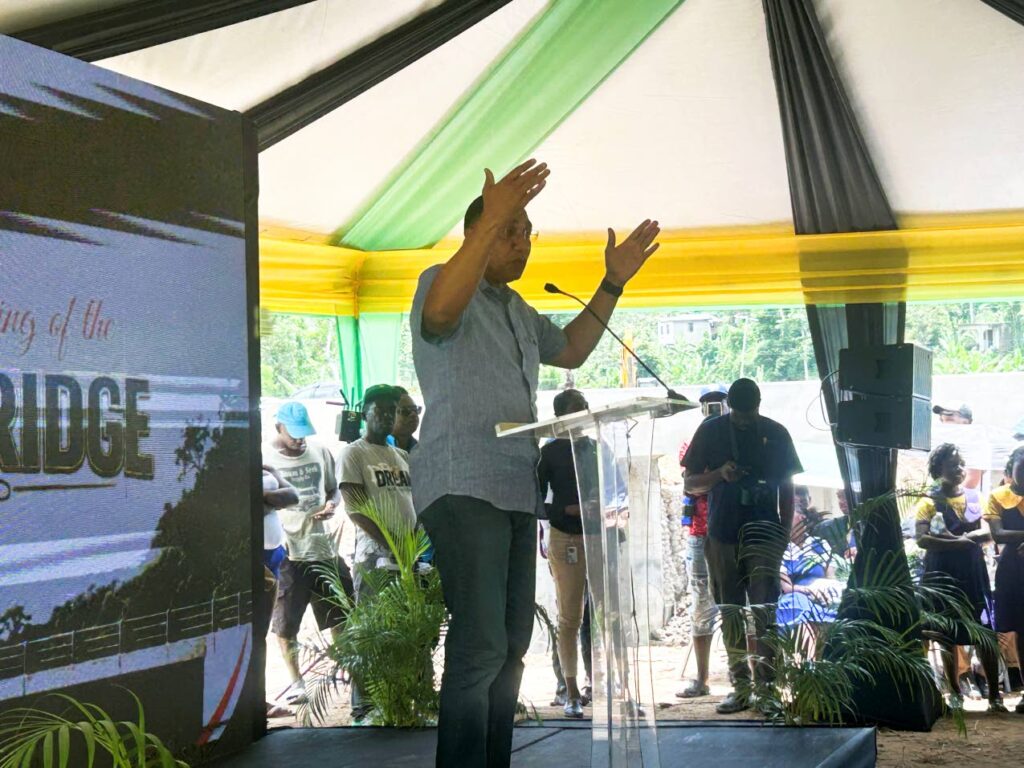
TRELAWNY, Jamaica — The long-awaited $230-million Troy Bridge officially opened to the public Friday, with Jamaican Prime Minister Dr. Andrew Holness using the milestone to call for sweeping public sector reform, arguing the five-year construction timeline drove unnecessary costs and exposed deep flaws in the country’s bureaucratic approval processes.
The new crossing replaces a 152-year-old bridge that was irreparably damaged when Tropical Storm Grace swept across Jamaica in 2021. For years after the original structure collapsed, residents of Troy and neighboring communities faced daily disruptions: students were forced to take longer, more costly routes to reach their classrooms, while local agricultural producers saw their transportation expenses surge when moving crops to regional markets.
In his opening address, Holness drew a clear, hard lesson from the half-decade-long project: the bridge would have cost taxpayers at least 30 percent less if construction had been completed just four years earlier. He told the gathered audience that overly rigid, process-obsessed bureaucracy had needlessly delayed what was a widely supported priority, noting that calls for a replacement bridge crossed political lines — with both Marisa Dalrymple Philibert, the then-Speaker of the House and MP for Trelawny Southern, and Mikael Phillips, MP for Manchester North Western, uniting behind the project.
Holness emphasized that while transparency and accountability remain non-negotiable pillars of good governance, the Troy Bridge project demonstrates that following procedural checkboxes is not enough. “Good governance must also be in delivering outcomes,” he said. “A modern State must be capable of asking the necessary questions without endlessly delaying the necessary answer. We’re not going to allow critical infrastructure to be tied up in procedures and processes that satisfy procedures and processes and don’t deliver. Let Troy be a lesson to Jamaica.”
Addressing the repeated public questions about why the project took so long to complete, Holness acknowledged the concerns were entirely legitimate. He argued that far too often, Jamaican public institutions prioritize process over the end results communities rely on, writing off the human cost of delayed action. “The people of Troy did not need an endless debate, they just simply needed a bridge,” he said. “Empathy requires us to reconsider not only the risk of action, but the cost of inaction.”
For local residents, Holness noted, the bridge’s value only became universally clear after it was lost. “Like much of our infrastructure, people scarcely note it when it was working, but when Tropical Storm Grace destroyed the bridge in 2021 everyone suddenly understood its value,” he said, framing the new crossing as far more than concrete and steel — it is a critical connection that will unlock economic opportunity for the region for generations to come. Holness added that he expects the new structure to remain a vital community link for at least 150 years, matching the lifespan of its predecessor.
Beyond the infrastructure itself, Holness positioned the Troy Bridge as a turning point for Jamaica’s approach to public investment. His administration has already launched the National Agency for Reconstruction and Resilience (NaRRA), a new body designed to cut through unnecessary red tape for critical projects while retaining strong safeguards for accountability, transparency, and procedural integrity.
“NaRRA will seek to structure projects, order them, cut unnecessary bureaucratic red tape, but at the same time gives a high level of accountability, transparency, and ensures the integrity of the processes,” Holness explained. “NaRRA will not only help us to recover from the hurricane and build resilience, but more importantly, NaRRA will show us that there is a better way to build Jamaica.”
The prime minister pushed back against the framing that Jamaica must choose between accountability and efficiency, arguing that both goals can coexist with smarter regulatory design. “The purpose of a process is to produce a result. When the process itself becomes an obstacle to result, then responsible leaders have an obligation to improve the process,” he said. “The objective is not to choose between accountability and efficiency. The objective is to achieve both. The objective is not to weaken safeguards. The objective is to make our safeguards smarter.”
Holness confirmed that the government remains fully committed to modernizing the country’s public investment and approval systems, cutting redundant layers of review, shortening approval timelines, and creating dedicated accelerated pathways for all critical infrastructure projects. “Because efficiency is not the enemy of accountability,” he stressed, closing by framing the new bridge as the first marker of a more effective, outcome-focused government for Jamaica.