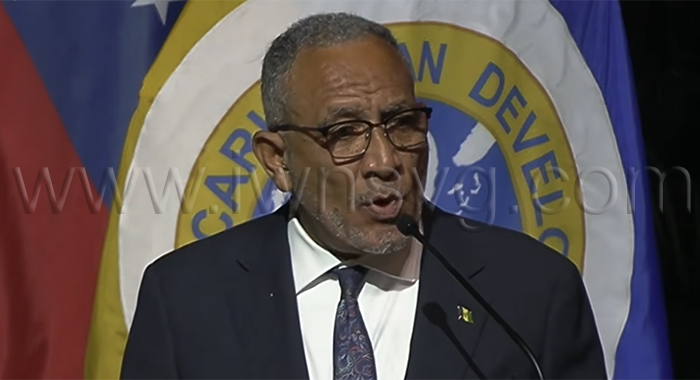
At the 56th Annual Meeting of the Caribbean Development Bank (CDB) Board of Governors held in Nassau, Bahamas, Godwin Friday, Prime Minister of St. Vincent and the Grenadines, delivered an urgent address on behalf of the bank’s borrowing member countries (BMCs), calling for faster, more decisive institutional reform and expanded investment in climate-resilient development amid cascading economic and environmental threats across the Caribbean region.
Friday warned that small open Caribbean economies are facing mounting systemic pressures that threaten long-term development prospects. The region carries legacy structural vulnerabilities it did not create, he noted, and these gaps have been widened by ongoing global economic turbulence. Most critically, central government debt across the region remains chronically high: nine of the CDB’s borrowing member countries hold debt-to-GDP ratios above the 60% prudential threshold, with St. Vincent and the Grenadines itself carrying a ratio exceeding 113%. This massive debt overhang, Friday emphasized, severely constrains governments’ ability to fund growth-driving infrastructure and social programs while protecting vulnerable populations, forcing regional states to achieve more development outcomes with limited fiscal resources.
Beyond high debt levels, the region is grappling with shrinking access to affordable financing. Tightening global supply chains, spiking shipping and fuel costs, and soaring cost of living have stretched public budgets, with underlying fragility predating recent conflicts in the Middle East that have amplified these pressures. At the same time, official development assistance from traditional global partners has seen a sharp decline, creating a critical financing gap for climate action. Friday noted that the Caribbean requires an estimated US$14 billion annually to implement comprehensive climate adaptation and mitigation measures, but currently mobilizes less than 10% of that target. “It is therefore imperative that our development partners become more adaptive, more responsive, and willing to provide highly concessional financing and dedicated resources for loss and damage that will not worsen a bad debt situation,” Friday said.
Framing the CDB as an indispensable institution for Caribbean development and regional integration, Friday argued that the bank holds a unique responsibility to lead targeted solutions for the region’s vulnerable small economies. As the only multilateral development bank owned and governed primarily by Caribbean stakeholders, the CDB carries unmatched legitimacy built on decades of on-the-ground experience, deep local knowledge, and specialized talent across the region. “Regional economic integration is sustainable only if partners all derive benefit from it, and economic disparities among member countries do not grow too wide. The bank is uniquely positioned to promote that end,” Friday noted.
To illustrate the impact of strategic CDB investment, Friday highlighted projects in his own country that have boosted national resilience after years of repeated climate shocks. Major bank-supported initiatives including the modernization of Kingstown’s port, school infrastructure upgrades, rural development programs, and road network improvements have shifted St. Vincent and the Grenadines’ long-term resilience trajectory, he said, adding that this model of targeted, comprehensive partnership should guide the CDB’s work across all borrowing member countries.
With the 2025 Atlantic hurricane season already underway and fresh memories of the devastating damage caused by 2024’s Hurricane Beryl and 2025’s Hurricane Melissa, Friday stressed that delays in climate action carry enormous economic and human costs. He called for a new regional climate strategy centered on adaptation and resilience, with priority investment in climate-resilient economic assets, upgraded coastal protection infrastructure, and expanded early warning systems for extreme weather. In particular, he highlighted the CDB’s Climate Change Project Preparation Fund as a critical tool for removing bottlenecks that block timely investment in climate action.
Turning to broader economic resilience, Friday called for support to help Caribbean states diversify their narrow, historically vulnerable economic bases while maintaining inclusive growth. He identified key priority areas for investment: digitalization of public services, transition to renewable energy—particularly large-scale solar development—to reduce fossil fuel import dependence, sustainable management of marine resources to grow the blue economy, and expanded value-added agro-processing to strengthen domestic food security, cut costly food import bills, and boost export earnings. Friday also emphasized that growth models that leave low-income and vulnerable populations behind are inherently “misguided and unsustainable.”
Resilience must ultimately be people-centered, Friday added, calling for strengthened investment in social resilience through expanded social protection, improved access to basic services, and targeted community development. He specifically highlighted the CDB’s flagship Basic Needs Trust Fund as a critical program that must be preserved and expanded to advance equitable development across the region.
Friday offered full endorsement of the CDB’s ongoing institutional reform agenda, known as CDB Forward, framing it as a necessary response to a long-standing implementation deficit in regional development. He stressed that borrowing member countries have issued a clear mandate for the bank to move beyond designing reforms and deliver tangible, accelerated implementation. “The bank must make its development impact felt with greater speed and with far more reach. The borrowing member countries have delivered a clear mandate. We must move swiftly to implement the transformative reforms to eliminate friction and drive our institution forward. The need is urgent, and therefore the time to act is now,” Friday said. He outlined key immediate priorities: faster project delivery, targeted efforts to reduce large undisbursed loan balances, and modernization of the bank’s procurement framework. He also encouraged the CDB to pursue expanded strategic partnerships with other multilateral development banks and bilateral donors to mobilize additional private capital and scale up co-financing opportunities.
In a direct appeal to CDB shareholders and non-regional partner states, Friday called for robust financial backing for the bank’s upcoming 10-year strategic plan covering 2026–2035, as well as the 11th iteration of the Special Development Fund (SDF 11), which provides concessional financing to the region’s most vulnerable member states. This support, he said, is essential to ensure Caribbean development is shaped by intentional policy and regional solidarity, rather than ongoing systemic vulnerability.
Closing his address, Friday drew on the legacy of Sir Arthur Lewis, the CDB’s founding president and a pioneer of Caribbean development thought, to frame the region’s path forward. He noted that while resistance, adaptation, and an unconquerable spirit have long defined the Caribbean people’s experience, the region must move beyond framing itself through vulnerability and claim agency over its own development. “Resistance, adaptation, and an unconquerable spirit define the historical experience of the Caribbean people. Despite our limitations, we continue to deliver better lives for our people,” Friday said. “However, the region’s development path must not be defined or be limited by our vulnerability. It must be shaped by our deliberate choices, our capable institutions, and by regional solidarity.” Echoing Lewis’ iconic words, he reminded delegates that “The Caribbean people can solve their own problems, but first they must find the secret that will put hope, initiative, direction, and an unconquerable will into the management of their affairs.” Friday closed by urging all governors to enter the meeting’s closed sessions with a clear commitment to advancing governance reforms, sustainable development pathways, and building a stable, inclusive, and thriving Caribbean for future generations.