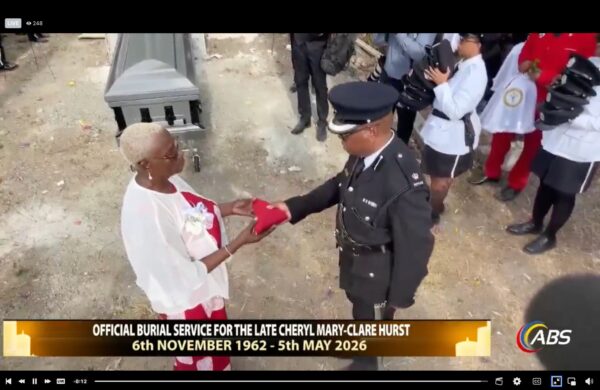
On Tuesday, hundreds of mourners spanning family, political leaders, loyal friends and community supporters filled the SJPC House of Restoration Ministries to lay to rest Mary-Clare Hurst, a pioneering Antiguan and Barbudan public servant who passed away on May 5 at 63. It was here that Apostle Dr. Stephen Andrews delivered a keynote sermon that balanced tribute to Hurst’s trailblazing career with a deeply theological reflection on mortality, grief, and Christian hope.
Andrews opened his remarks by honoring Hurst’s historic contributions to the nation’s political and labor landscape. As the first woman to hold the role of general secretary of the Antigua and Barbuda Labour Party, Hurst shattered gender barriers throughout her decades of public life, going on to serve multiple terms in the country’s Senate. During her tenure, she also held prominent leadership positions including Leader of Government Business and Minister of State for Tourism, leaving a lasting mark on the nation’s governance and public service.
Rather than dwelling exclusively on Hurst’s professional accomplishments, Andrews steered his sermon toward the universal human experience of death, drawing heavily on Christian scripture to frame its meaning and the hope that faith offers. Citing 1 Corinthians 15:26, he described death as “the last enemy to be destroyed” — an uninvited force that makes no exceptions for status or achievement, acting as “the great separator” that cuts short relationships, interrupts lifelong work, and leaves indelible pain in its wake. Andrews acknowledged that death strips people of their sense of control and certainty, and that humanity’s instinctive resistance to this loss drives centuries of progress in medicine, caregiving, and life preservation.
Yet he also noted that the inevitability of death carries a vital lesson: it compels people to prioritize the relationships that give life meaning, and to express love and appreciation to loved ones while they still have the chance. “It is death that forces us to cherish our time on the earth and to have a deep appreciation for relationship,” Andrews told the gathered crowd, urging attendees to live intentionally and not take time with loved ones for granted.
Returning repeatedly to biblical teaching, Andrews explained that Christian doctrine frames death as an intruder that entered the world through sin, but that its ultimate power was broken by the resurrection of Jesus Christ. Describing the resurrection as a verifiable historical event witnessed by hundreds of early followers, he argued that Christ’s victory over death transformed it from a final end to a transitional passage into eternal life for believers. “The Scripture emphasises the fact that through Christ, this enemy has been defeated, stripped of its power, and will one day be utterly destroyed,” he said.
Quoting the Apostle Paul’s famous challenge to death — “Where, O death, is your victory? Where, O death, is your sting?” — Andrews added that Christ’s sacrifice and resurrection frees believers from the lifelong fear of death. For followers of Christ, he explained, to leave one’s physical body is to enter immediately into the presence of God, a truth that offers profound comfort to grieving families. He pointed to the Book of Revelation’s promise of a future new creation where “God will wipe away every tear”, eliminating death, mourning, pain and suffering forever.
In closing, Andrews urged attendees not to view the funeral only as a moment of loss, but to reflect on their own lives and spiritual futures. “None of us knows our time,” he said. “But there is hope.” Following the sermon, he led a special prayer for Hurst’s surviving family, asking God to grant them strength, peace, and endurance through the difficult grieving process ahead, and that they would find comfort in their memories of Hurst and confidence in the Christian promise of eternal life.
Hurst’s funeral drew one of the largest public gatherings in recent Antiguan and Barbudan political memory, a testament to the respect and admiration the community held for a leader who dedicated her life to breaking barriers and serving the public good.