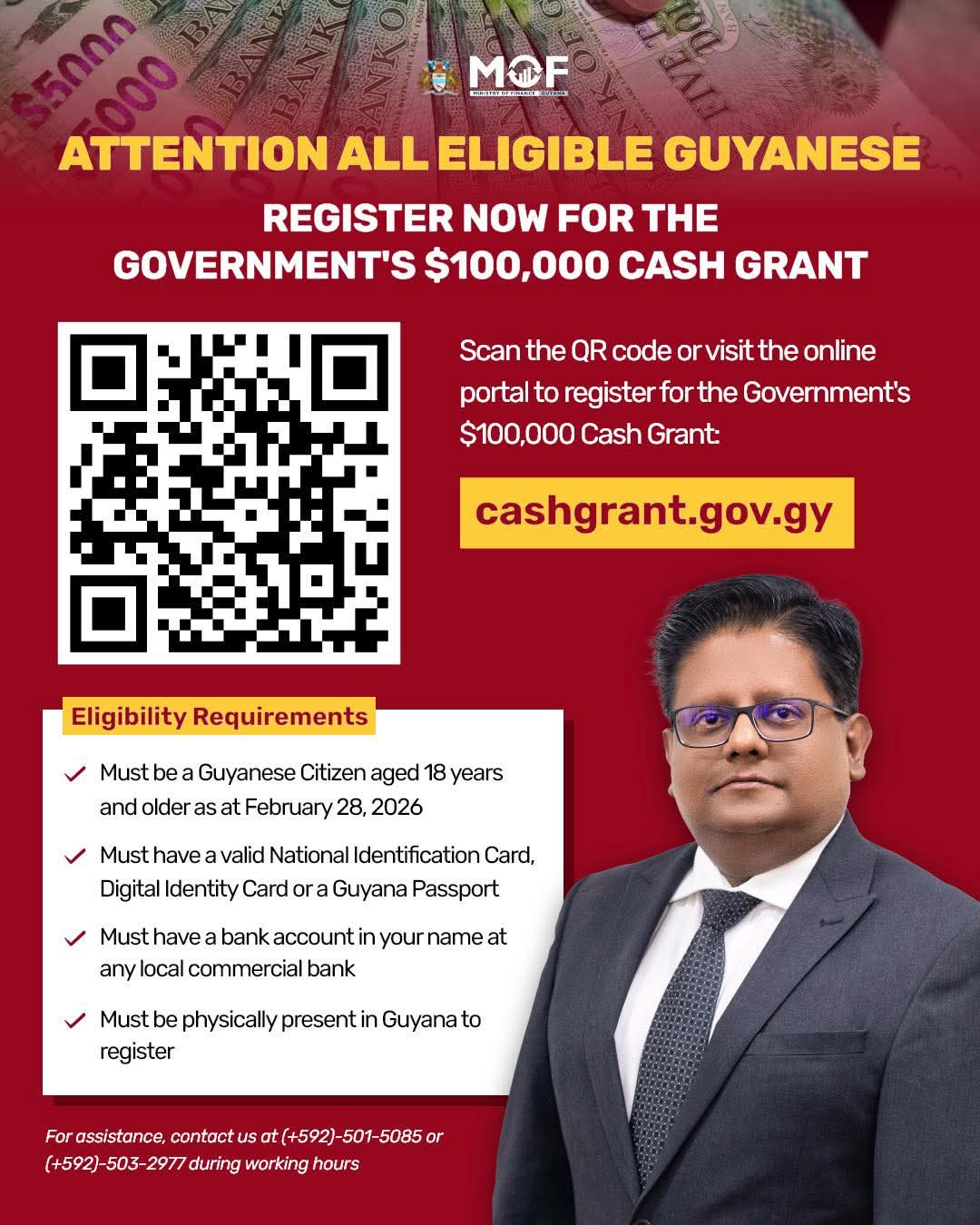
On Tuesday, June 2, 2026, Guyana’s Minister of Finance Ashni Singh provided an updated progress report on the country’s landmark universal cash grant initiative, announcing that close to 400,000 Guyanese have already received their one-time GY$100,000 payment, most through direct deposits to registered bank accounts. The government has also put in place tailored alternative distribution mechanisms to ensure no eligible resident is left behind, including those without formal bank accounts, disabled people, homebound shut-ins, and communities in remote hinterland regions.
Speaking to reporters on the sidelines of the national Local Content Summit, Singh emphasized that the program’s rollout has exceeded early expectations given the ambitious timeline and scale of the initiative. “I think we’ve done extremely well because we’ve been able to register and pay now close to 400,000 persons, which is quite a large number if you consider the speed with which this has been done,” Singh noted.
Funded by a GY$60 billion allocation earmarked in the 2026 national budget, this universal cash grant program marks the first time the Guyanese government has distributed public benefit payments through direct bank deposits to recipients who registered via a national online portal. According to Singh, direct bank transfers have emerged as the most efficient delivery channel, with the overwhelming majority of processed payments going through this method.
To address gaps in access, the government has launched targeted outreach campaigns for populations that cannot use direct bank deposits. Singh confirmed that inter-ministerial teams from the Ministry of Finance and Ministry of Human Services have already been deployed to hard-to-reach regions including Region 7 (Cuyuni-Mazaruni) and Region 9 (Upper Takatu-Upper Essequibo), where workers are conducting in-person registration and using alternative delivery methods to get grants to local residents. The two ministries are also collaborating closely to coordinate home delivery of payments for disabled people and people with severe illness who are unable to leave their homes.
Singni stressed that lack of a bank account, or even unwillingness to use a bank account, will not disqualify any eligible resident from receiving the grant. “We continue to try to explain to people that this [direct deposit] is the easiest way to get your cash grant, but we also assure you that if you don’t have a bank account and you don’t want a bank account, you’re not going to be denied your cash grant,” he said, noting that the government prioritized processing bank account holders first to streamline the early rollout.
The program did encounter some early technical challenges with the online registration portal, which Singh attributed to the unexpectedly high volume of users attempting to sign up in the first days of the registration window. However, he was quick to praise the work of local technology specialists at the National Data Management Authority, who built the registration portal endogenously and quickly resolved the early issues. After rolling out real-time adjustments to improve the system’s capacity to handle high traffic, Singh noted the portal has functioned smoothly, facilitating direct bank payments for more than 300,000 recipients to date.