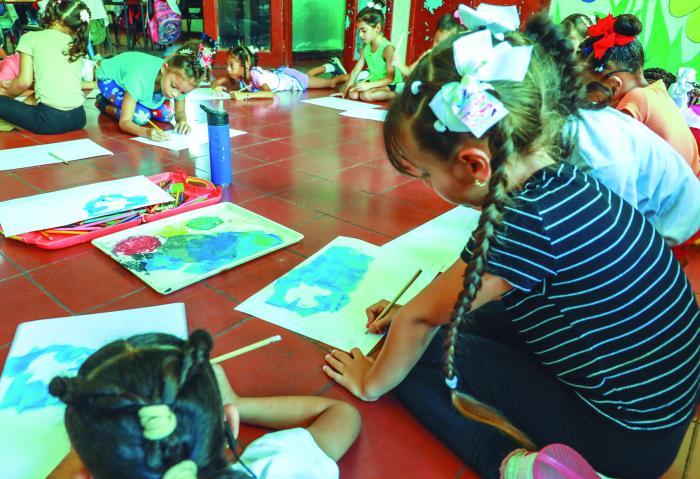
Every June 1, as the world marks International Children’s Day, a quiet, joyful scene unfolds in a local neighborhood park opposite a small elementary school in Cuba. Bathed in early morning light, the open space transforms into a living canvas, dotted with children in bright white shirts, vivid red skirts and shorts, and striking red and blue scarves. As the day stretches into afternoon, the park remains alive with laughter: whether it’s the same group of kids or new faces joining in, children fill the space with energy, chasing each other through generations-old traditional games and testing new pastimes. For generations, these community green spaces have been more than just playgrounds — they are fertile ground where childhood dreams take root, grow, and thrive alongside one another. It is impossible to imagine what this vibrant scene would become if a single, cruel stroke erased the peace that makes it possible.
Looking back at the generations of children who grew up running across this same park grass, many now-adult Cubans carry small, quiet marks of the care their country extended to them from birth: faint vaccine scars that stand as reminders of universal public health investment. They recall fond memories of school camping trips and special holiday assemblies, and many still credit their biggest life achievements to dedicated teachers, who despite limited resources, still opened the door to lifelong knowledge and opportunity for every child.
But this peaceful Cuban childhood stands in sharp contrast to the harsh realities faced by millions of children across conflict zones and crisis-hit regions of the world, realities Cubans only witness through news reports. In these forgotten corners of the globe, children have been forced to trade the soft weight of storybooks and plastic toys for the heavy burden of weapons. For them, accessible schools are nothing more than distant fairy tales, and functioning hospitals are mythical chimeras that do not exist in their broken communities. Where neighborhood parks should be, children wander across hot asphalt littered with rubble and the debris of missile strikes, surrounded by destruction instead of play.
Nowhere is this injustice more acute than in Palestine, where the youngest generation has grown up believing that learning the alphabet and mastering multiplication tables is a privilege they are not allowed to have. Conflict has not spared even the most vulnerable in other regions either: in areas of Iran and Ukraine, school buildings full of young students, backpacks, and dedicated teachers have been reduced to smoldering ash and crumbling rubble. In war, no bomb falls at random: cutting off an entire generation’s future, permanently, is a deliberate, calculated military strategy.
Even in wealthy, stable nations like the United States, childhood safety cannot be taken for granted. American media is flooded with repeated stories of children who leave for school in the morning, and never come home alive — gunned down by heartless attackers in school shootings that steal the lives of promising young students before they have a chance to build their futures. And on the U.S. southern border, another child rights crisis plays out: thousands of children separated from their parents by U.S. Immigration and Customs Enforcement make headlines regularly, the bitter, harmful legacy of harsh deportation and immigration policies inflicting lasting trauma on vulnerable young people.
Against this global backdrop, the simple, peaceful joy of the local Cuban park takes on deeper meaning. Even with all its imperfections, the park offers safety: a pregnant woman can sit calmly on a bench waiting for her prenatal appointment, and parents can drop their children off at the adjacent school knowing they will return home safe and alive at the end of the day. On this International Children’s Day, the quiet hum of playful laughter in this neighborhood park sends a clear message: even when weariness and hardship weigh on communities, there is no more important global duty than protecting children — our shared global future — for every child, no matter where they are born.