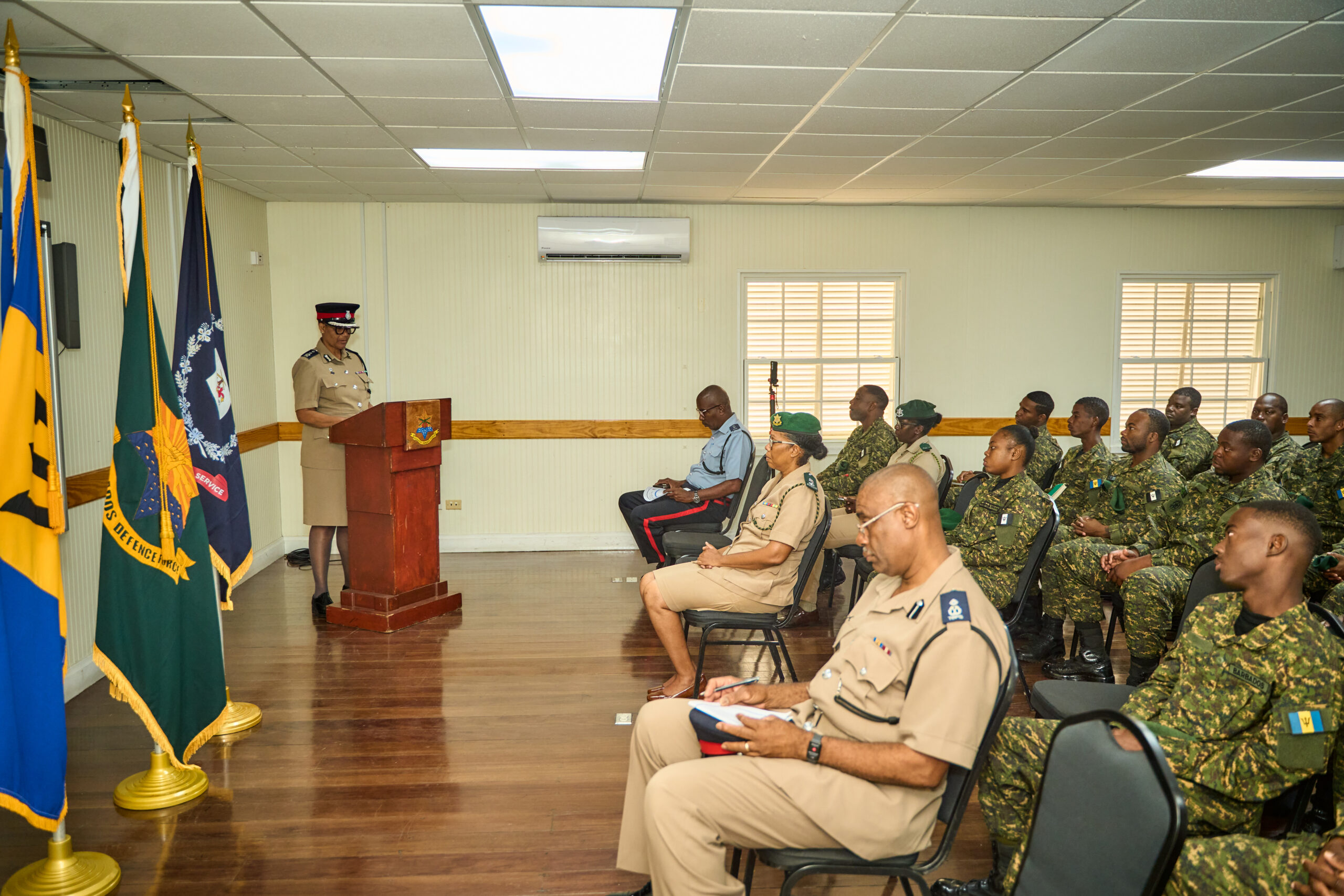
A new phase of specialized training kicked off Monday for Barbados Defence Force (BDF) personnel, preparing soldiers and sailors to exercise formal police arrest powers under newly enacted national legislation. The 26-member second cohort joins an earlier group of 30 BDF members who have already completed the program and begun active joint field operations with local law enforcement.
The expanded arrest authority for military personnel forms part of a broader legislative update approved by Barbados’ government last year. Codified in two amended pieces of legislation — Section 79A of the revised Police Act and Section 9(2) of the Defence Act — the new rules allow trained BDF personnel to assume full police arrest powers, privileges, and responsibilities in two specific scenarios: during coordinated land-based joint operations with the Barbados Police Service, and when officially deployed via a presidential directive.
Addressing the opening session of the new training cohort, Deputy Commissioner of Police Sonia Boyce, a senior leader of the island’s police high command, emphasized that arrest authority is one of the most consequential powers granted to any law enforcement official. She stressed that all exercises of this power must stay strictly aligned with Barbados’ constitutional framework, which enshrines every citizen’s fundamental right to personal liberty, a right that can only be legally restricted under clearly defined, lawfully prescribed circumstances.
The multi-module training curriculum covers a range of critical practical and legal topics, including constitutional law requirements for law enforcement, standard radio communication protocols, evidence-based conflict de-escalation strategies, modern electronic interviewing techniques, and other core operational skills. The program is specifically designed to bridge the gap between formal legal principles and real-world high-pressure operational contexts, giving trainees clear, actionable guidance for on-the-ground decision-making.
Boyce issued a stark warning to trainees about the severe consequences of misusing the new arrest authority. Improper or unlawful arrests, she explained, do not only violate individual constitutional rights — they also erode public trust in the country’s national security institutions and undermine the legitimacy of joint law enforcement operations. By contrast, she noted that consistent, lawful use of arrest powers directly strengthens public confidence in both police and military security bodies.
Trainees are instructed to master three core non-negotiable legal requirements for any lawful arrest: establishing reasonable grounds to justify the arrest, using only a proportional, reasonable level of force during the process, and clearly communicating the reason for arrest to the individual being taken into custody. Boyce emphasized these are not optional best practices, but binding legal obligations that form the foundation of professional law enforcement in Barbados.
Beyond technical training, the program also emphasizes the critical role of discretionary judgment in law enforcement. Boyce told participants that professional competence relies on the ability to differentiate between situations that demand immediate arrest and those that can be resolved through less invasive alternative measures. These alternatives include official warnings, clear firm direction to change behavior, or referrals to relevant social or government support agencies that are better equipped to address underlying issues.
Boyce added that modern Barbadian citizens are increasingly knowledgeable about their legal rights, and hold uniform expectations that all law enforcement agencies will exercise authority fairly, transparently, and in full compliance with the law. When the public observes arrest powers being used lawfully, proportionately, and with respect for individual dignity, she said, the entire community benefits from stronger, more trusted public institutions.