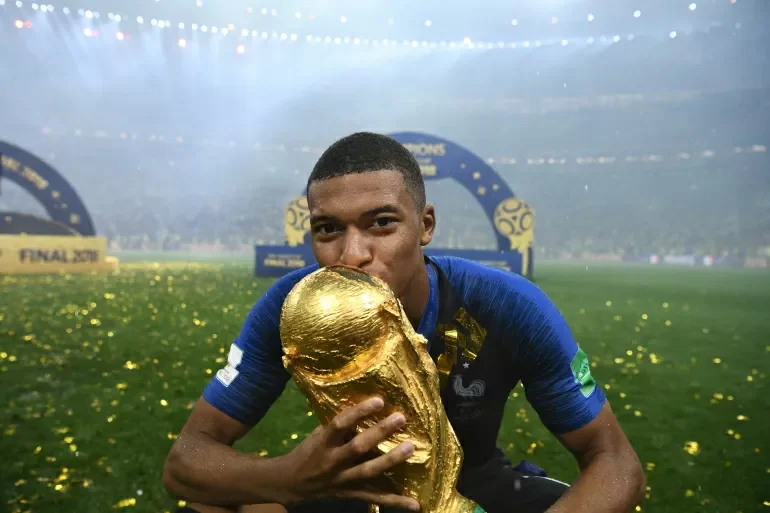
As the 2026 FIFA World Cup approaches, France has cemented its status as one of the tournament’s pre-tournament favorites alongside Spain, drawing global attention to its decades-long, unprecedented run of producing elite football talent. The depth of Les Bleus’ talent pool is so extraordinary that Belgian defender Thomas Meunier recently sparked widespread debate when he claimed France could field three separate World Cup-competitive squads capable of lifting the trophy.
While the idea that France’s second or third string would win the World Cup may be hyperbole, data backs up the sheer scale of the country’s talent depth. According to transfermarkt.com, a starting lineup composed entirely of French players who did not even make the 26-man 2026 squad has a combined market value that would rank among the top five highest in the world, outranking Portugal, Brazil, the Netherlands, and even defending champion Argentina. That unselected group includes talents such as Lucas Chevalier (€30 million), Pierre Kalulu (€32 million), Leny Yoro (€50 million), Eduardo Camavinga (€50 million) and Khephren Thuram (€40 million), boasting a total combined value of €418 million and an average player valuation of €38 million.
France’s current success is not an accident—it is the end result of a systematic overhaul born from decades of heartbreak. From the 1930s through the 1970s, French national teams consistently underperformed on the world’s biggest football stage. In the early 1970s, then-national team manager Georges Boulogne proposed a national network of youth training hubs called Centres de Formation to address the gap. “France had not won any major trophies, so a decision was made to create an entirely new structure,” Franck Bentolila, director of the prestigious INF Clairefontaine academy, explained to Al Jazeera.
The French government threw its full support behind the program, seeing it as a way to promote French values through sport while also building a competitive national program. Sixteen training centers were ultimately established across the country, with the first opening in Vichy in 1974. These hubs scouted young prospects from mainland France and its overseas territories, laying a foundational pipeline to prepare players for professional careers and eventual national team call-ups.
Early results were inconsistent. In the 1980s, France claimed both the European Championship and Olympic gold in 1984 and reached two World Cup semifinals, but failed to qualify for the 1990 and 1994 World Cups entirely. The program’s success finally clicked in 1998, when the iconic multi-ethnic “Black-Blanc-Beur” squad won the World Cup on home soil. That diverse team, which reflected the changing face of French society, confirmed the development model worked. Then-manager Aimé Jacquet dedicated the win to “all the amateur clubs and academies—this trophy is yours too,” Bentolila recalled.
Former French goalkeeper and 1990s captain Bernard Lama noted the 1998 generation had a key advantage over the talented but trophy-less 1980s group led by Michel Platini, Alain Giresse and Jean Tigana: “The difference with our generation was that everyone came through an academy, and we had the hunger to win a title. And we had one exceptional talent: Zinedine Zidane.”
Following the 1998 breakthrough, France went on to win the 2018 World Cup and finish as runners-up in 2006 and 2022. Lama credits the nation’s continued success to a combination of the academy system and the contribution of immigrant communities: “People coming from overseas territories—Africa, French Guiana, Martinique—bring us two things: music and sport. There is now a new generation that grew up entirely in France, like Ousmane Dembélé and Désiré Doué. They are French, not naturalized, most come from the Paris region, and they are hungry for success, above all because they have raw talent.”
Lama does warn of the risk of over-structuring youth development that can turn players into rigid “robots,” but notes France still produces more than enough exceptional difference-makers. “We are lucky to have players who can change a game, like Mbappé, Dembélé and Doué. They hate losing, they can make an individual difference physically and technically. That is the strength of the national team and clubs like PSG: our finishing ability. We now have maybe four or five players, like Akliouche and Cherki, who represent a completely different type of talent. When you have that explosion of talent, it gives a manager far more offensive options,” he said.
While most senior internationals came through the official academy system, talent development starts much earlier in French culture. “It is cultural,” Bentolila explained. “In America, kids have a basketball or football in their hands from a young age. In France, there is a football at your feet from birth, with free access to training facilities everywhere.”
Veteran coach and scout Stéphane Nado says France’s secret is a simple combination of hard work, structured organization and a player-first approach: “The player is at the center of the entire project. They get a formal education and get to stay close to their family, which is so important for their psychological development. That is why France is one of the best countries in the world at developing players for top leagues across the globe.”
Training at Clairefontaine, France’s elite national academy, blends the improvisational creativity of street football with structured team organization, with a heavy focus on small-sided 1v1 and 2v2 games. “You have to fight for every ball. If you are good at dribbling and first touch, we work on positional play in overloads like 5v2. As soon as you get the ball, you have to control it well—we drill that constantly,” Bentolila said. Today, Clairefontaine focuses primarily on younger age groups, with older prospects moving into the development systems of top professional clubs.
Bentolila added that development extends far beyond official academies, particularly in the Paris region: “Paris and São Paulo are the best places in the world for raw talent, because of the huge network of small private academies. Kids aged eight or nine play every single day. Amateur coaches don’t give them full meals, just a snack at 4 p.m., then they do homework and train. By the time they are 12, they play like Mbappé. There are amateur clubs in Paris no one has heard of that can beat Barcelona youth teams and top professional academy sides. They are better than the youth teams of PSG and Paris FC. Kids play football everywhere, all the time, from age 8 to 10. They are like soldiers, they fight every day and get good because they play under constant pressure.”
Back in the 1980s, Les Bleus were nicknamed the “Brazilians of Europe” for their free-flowing attacking style. After decades of development, France has lived up to that nickname on its own terms. “Brazilian coaches used to tell me: ‘In our country we are poor, but we can succeed in football or music, so we start the day with football,’” Bentolila said. “In France, we go to school first, then train after. We do it every day, and just like Brazil, we play a lot, and we play well.”
For the 2026 World Cup, France has been drawn into Group I alongside Senegal, Norway and Iraq, a group with a wide range of strength and international experience. Senegal, one of Africa’s strongest national sides, has qualified for multiple recent major tournaments and counts numerous top talents playing in Europe’s leading leagues. Norway is making its return to the World Cup after an 18-year absence, fielding a mix of experienced veterans and exciting young prospects who play across top European competitions. Iraq qualified via the inter-confederation playoffs and is making just its second World Cup finals appearance in history; while the side lacks deep international tournament experience, it still boasts a number of talented players competing domestically and abroad.
France’s group stage fixtures are scheduled as: June 16 vs Senegal at Metlife Stadium in East Rutherford, June 22 vs Iraq at Lincoln Financial Field in Philadelphia, and June 26 vs Norway at Gillette Stadium in Foxborough.
Didier Deschamps’ 26-man 2026 French squad includes goalkeepers Mike Maignan, Robin Risser and Brice Samba; defenders Lucas Digne, Malo Gusto, Lucas Hernandez, Theo Hernandez, Ibrahima Konaté, Jules Koundé, Maxence Lacroix, William Saliba and Dayot Upamecano; midfielders N’Golo Kanté, Manu Koné, Adrien Rabiot, Aurélien Tchouaméni and Warren Zaïre-Emery; and attackers Maghnes Akliouche, Bradley Barcola, Rayan Cherki, Ousmane Dembélé, Désiré Doué, Jean-Philippe Mateta, Kylian Mbappé, Michael Olise and Marcus Thuram. Notable absentees from the squad include Eduardo Camavinga, Randal Kolo Muani and Lucas Chevalier, a testament to the depth of talent available to Deschamps.
This 2026 tournament will mark Deschamps’ final World Cup as France’s manager, capping one of the most successful tenures in modern international football history.