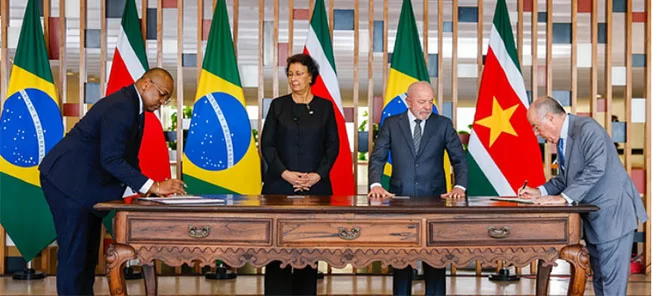
In a historic diplomatic gathering marking five decades of formal relations between the two South American nations, Suriname’s President Jennifer Simons and Brazil’s President Luiz Inácio Lula da Silva have announced a sweeping expansion of bilateral cooperation, with dozens of concrete agreements spanning political, economic, social, security and global policy domains.
The high-level meeting, held to commemorate the 50th anniversary of diplomatic ties, opened with both leaders expressing satisfaction with the progress of existing collaboration while emphasizing the vast untapped potential for deeper integration. To institutionalize the new expanded partnership, the two governments have established a joint bilateral commission composed of foreign ministry representatives from both sides, tasked with monitoring the implementation of signed agreements and identifying new areas for future collaboration.
One of the most significant outcomes of the presidential meeting is a shared commitment to negotiate a new, comprehensive trade agreement that modernizes and expands existing bilateral trade frameworks. The updated deal is designed to unlock greater cross-border investment, expand two-way trade flows, and deepen regional economic integration between the two countries. To support this goal, the nations will work closely to reduce non-tariff barriers for agricultural products through enhanced coordination between veterinary, sanitary and phytosanitary regulatory bodies, while streamlining procedures to facilitate the export of new agricultural goods to each other’s markets. Additional economic cooperation priorities include joint work on sustainable tropical agriculture, strengthened food security, and rural development across both nations.
Energy cooperation stands as a core pillar of the new strategic partnership, with major opportunities identified in both fossil fuel development and renewable energy transition. The state-owned oil companies of both nations, Suriname’s Staatsolie and Brazil’s Petrobras, will see their collaboration elevated to a more prominent strategic level, with agreements to expand joint activity in oil and gas exploration and production, while also ramping up joint investment in renewable energy generation. A key highlighted initiative is the revival of the Arco Norte project, which aims to create a regional interconnected electricity grid linking Brazil, Suriname, Guyana and French Guiana. The partners will also conduct feasibility studies for the development of shared cross-border natural gas infrastructure.
To support expanded trade and people-to-people ties, the two nations have committed to upgrading cross-border and regional transportation connections. Priority projects include the establishment of direct maritime shipping routes between Suriname and Brazil, upgrades to port infrastructure and operations, the strengthening of transportation corridors across the Guiana Shield, and technical and political support for the planned bridge across the Corantijn River that will connect Suriname and Guyana. The agreement also calls for improved regional road connections through Guyana and French Guiana, and new formal cooperation between the two nations’ civil aviation authorities.
Security cooperation forms another critical component of the expanded partnership, with a shared focus on combating transnational organized crime. The two nations will intensify joint efforts to disrupt drug trafficking, human trafficking, arms smuggling, illegal gold mining, cybercrime, and environmental crime. Multiple agreements have already been signed between Brazil’s federal police, the Suriname Police Corps, and other relevant law enforcement agencies. The new cooperation framework includes provisions for joint operational activities, accelerated cross-border information sharing, and strengthened border surveillance.
A particular focus of the security partnership is the coordinated crackdown on illegal gold mining, which both governments recognize causes severe ecological damage to protected natural areas and harms local Indigenous and traditional communities. Joint priorities include enhanced traceability controls for gold exports, increased transparency across the gold supply chain, crackdowns on gold smuggling networks, reduced mercury use in artisanal mining, and enhanced protection of the Amazon rainforest ecosystem. The two nations will also expand cooperation on satellite-based forest monitoring through partnerships between Brazil’s National Institute for Space Research (INPE) and Suriname’s Foundation for Forest Management and Forest Supervision (SBB).
Defense cooperation is also being expanded, with new agreements covering joint military training, air traffic management, border and airspace surveillance, and coordinated joint military patrols and operations along the shared bilateral border. The two governments have also reached a cooperation agreement with Brazilian aerospace manufacturer Embraer covering collaboration in civil aviation, defense, and public security domains.
In the knowledge and education sector, Suriname and Brazil have committed to expanding cross-border knowledge exchange, including new scholarship opportunities, expanded student exchange programs, joint diplomatic training initiatives, collaborative scientific research, and partnerships in digital innovation and technological development. Surinamese students will gain significantly expanded access to Brazilian exchange and study programs under the new framework.
Multiple new public health and social development agreements were also reached during the meeting. Brazil has agreed to provide technical and capacity-building support to Suriname to strengthen its national health system, train local medical personnel, improve infectious disease control, enhance cross-border health services, and expand health access for Indigenous communities. President Lula also formally congratulated Suriname on its recent certification by the World Health Organization as a malaria-free country.
On social policy, Suriname has expressed strong interest in Brazil’s successful national housing program Minha Casa, Minha Vida, and Brazil has agreed to share its decades of expertise in social housing development, including administrative frameworks, digital management tools, and implementation models that can be adapted to Suriname’s local context. Additional social policy cooperation priorities include coordinated poverty reduction, expanded food security, strengthened social protection systems, targeted support for women and youth, and capacity building for small family-owned agricultural enterprises.
Both leaders also reaffirmed their shared commitment to protecting the rights of Indigenous peoples and traditional communities. New joint initiatives will be launched to improve health access for Indigenous groups, protect their traditional territorial lands, expand knowledge exchange on Indigenous issues, and strengthen the participation of Indigenous communities in national policy decision-making processes that affect their communities.
On the global stage, Suriname and Brazil reaffirmed their commitment to close cooperation within multilateral frameworks including the Amazon Cooperation Treaty Organization (OTCA), the Organization of American States (OAS), the Community of Latin American and Caribbean States (CELAC), and the United Nations. Both leaders issued a joint statement in support of strengthening multilateralism, advancing reform of the United Nations Security Council, and increasing the representation and decision-making influence of developing countries in global governance institutions.
The sweeping joint declaration signed at the conclusion of the meeting marks a clear shift in the bilateral relationship, transforming what has long been a positive neighborhood relationship into a full strategic partnership that covers almost every major policy domain, from trade and energy to security, infrastructure, health, education, science, defense and social development. For Suriname, the partnership opens new avenues to access Brazilian expertise, advanced technology, foreign direct investment, professional training opportunities, and expanded market access for its exports. For Brazil, the deepened cooperation strengthens its regional influence and strategic position across the Guiana Shield and northern South America.