Suriname’s living, breathing language is offering a revealing window into how the nation navigates its colonial past, blends diverse cultural identities, and reshapes meaning for a modern, multiethnic society, writer Wilfred Leeuwin argues in a new commentary.
The conversation starts with a recent observation: a radio advertisement for Suribet, a local gambling platform, aired in Sranan, Suriname’s widely spoken Creole language, carrying the line: “Soso bigisma e teri, gi pikin-nengre Suribet ne seri.” Directly translated, the phrase uses the term “pikin nengre” to reference minors, stating that Suribet only sells to adults. What caught Leeuwin’s attention was not the responsible gambling messaging, but the history carried by that specific phrase.
Historically, “pikin nengre” originates from the colonial and slavery era, with a literal meaning of “little black child” that carries unmistakeable racist connotations tied to Suriname’s exploitative past. Today, however, the term has shifted dramatically in everyday Surinamese speech: in the advertisement, it is not used as an ethnic label at all, but as a general reference to all children and minors, regardless of their ethnicity or skin color.
This shift is not driven by dictionary updates or academic linguistic theory, Leeuwin notes. It is organic language evolution, shaped by daily use among ordinary people. Popular platforms from advertising and street slang to music, radio, and social media often reshape language far faster than formal regulatory bodies can.
Language is a living entity, after all. It shifts alongside new generations, cultural exchange, broader societal change, and the evolving ways people connect with one another. Terms that were once widely accepted can become hurtful and offensive over time, while other words lose their original sharp negative connotations and expand to take on new, broader meanings. Sometimes, the original historical meaning fades entirely from collective public memory.
At the same time, these linguistic shifts reflect how societies process and engage with their own history. Some terms shed their harmful baggage, while others pick up negative connotations they never originally carried. Leeuwin offers another well-known example to illustrate this dynamic: the Dutch phrase “indianenverhalen”, which today is commonly used to dismiss claims as nonsense, exaggerated fantasy, or untrustworthy tales. But the phrase’s origins are very different.
As far as linguistic research records, the term originally referenced the rich oral storytelling tradition of Indigenous communities, where elders gathered around campfires to pass down tales of creation, nature, culture, spiritual figures like the great Manitou, traditional wisdom, warnings, and spiritual experiences to younger generations. These stories were never “nonsense” — they were a core pillar of cultural transmission and communal identity. Yet over time, the phrase gained the dismissive negative connotation it carries today. This shift says less about Indigenous culture itself, Leeuwin argues, and more about how broader societies have historically marginalized less powerful, underrecognized cultural groups.
Language is far more than just a tool for communication, he emphasizes. It carries the weight of history, pain, humor, prejudice, identity, and existing power dynamics. Words change because societies change: sometimes terms evolve as a society grows more inclusive, and sometimes old harmful stereotypes persist unconsciously in everyday speech.
These evolving linguistic blends also highlight what makes Suriname uniquely diverse, Leeuwin notes. He shares a recent personal encounter that drove this point home: a few weeks before writing the commentary, he heard a customer speaking Sranan with a distinct Aucaan accent at a building supply store. Assuming the speaker was an inland resident with African roots, he was surprised to learn the man was a young Hindustani Surinamese. Striking up a conversation, Leeuwin learned the man had spent part of his childhood in Suriname’s interior and had friends from every major ethnic group in the country. Though he identifies as Hindu, he does not feel culturally boxed in by his background.
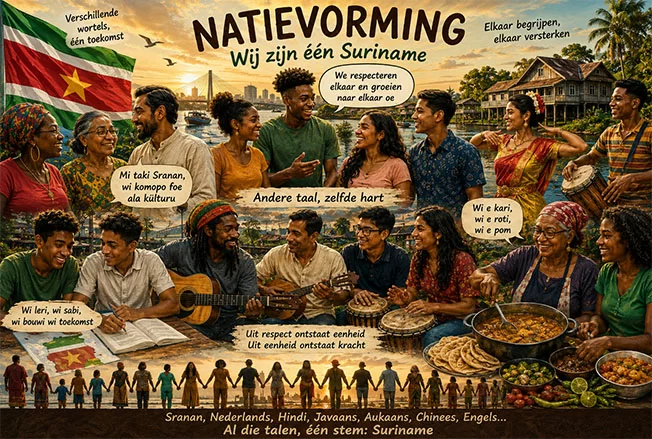
That encounter reinforced a truth about Suriname that language makes plain: different cultural and linguistic traditions blend into one another constantly and naturally, a dynamic that is rare in many other parts of the world. In many nations, language, culture, and ethnicity remain strictly segregated. In Suriname, those boundaries are constantly overlapping. A Hindustani young man speaks Aucaan and Sranan. A Javanese Surinamese person regularly uses Creole phrases. Maroon youth switch seamlessly between Dutch, Sranan, and English in daily conversation. This is not a loss of individual or cultural identity — it is a source of extraordinary cultural richness.
Leeuwin argues that this is where Suriname’s true national strength lies: in the everyday reality where people adopt one another’s language, humor, customs, and expressions, without losing their own core identity. This is natural nation-building at its most organic, because language tells a more honest story of a country than any official government report or policy document ever could.
In Suriname’s overlapping languages and evolving terms, you can hear the full scope of the nation’s history: the trauma of slavery and colonialism, the waves of migration, the constant cultural blending, street culture, religious diversity, and widespread communal solidarity. You can also hear a society actively working to let go of old harmful meanings and co-create new, inclusive shared meanings together.
That is what makes language evolution far more than just a linguistic process — it is a cultural and societal project. And perhaps that is Suriname’s most beautiful strength: that all of its languages, accents, expressions, and meanings continue to mix, shift, evolve, and thrive side by side.