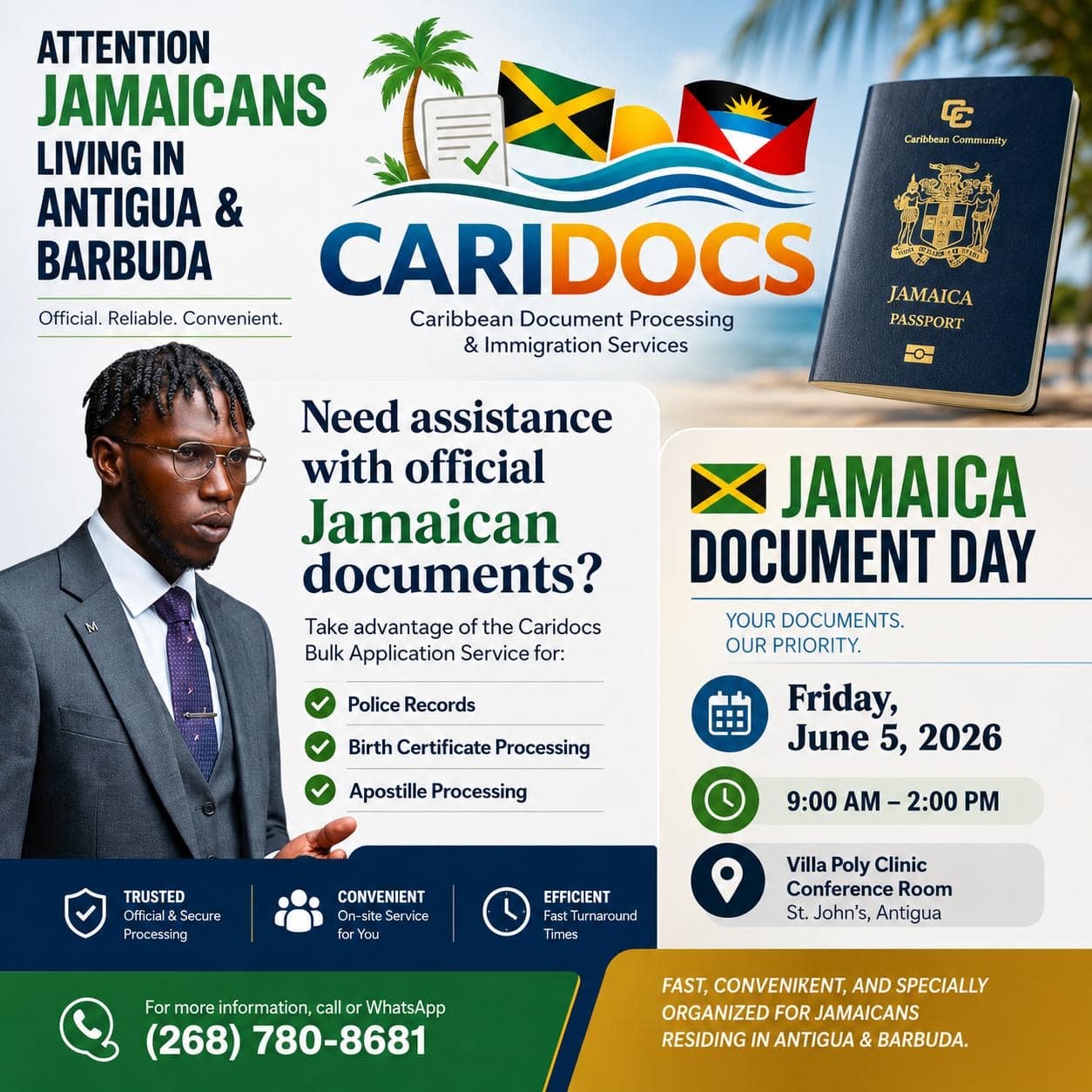
For Jamaican citizens building lives in Antigua and Barbuda, securing and processing official home-country documents has long been a source of mounting frustration. Exorbitant processing fees, weeks and even months of unexplained delays, and widespread confusion over mandatory eligibility requirements have thrown critical life processes into chaos, blocking progress on immigration applications, residency approvals, job offers, and other key legal proceedings.
To tackle this widespread, underreported issue, Caribbean-founded document facilitation and immigration support firm Caridocs has launched a targeted new program aimed at cutting red tape, clarifying rules, and speeding up access to properly processed official documents for Jamaican nationals living across Antigua and Barbuda.
Operating strictly as an intermediary support service rather than a replacement for government agencies, Caridocs fills a long-unaddressed gap: it bridges broken communication lines and procedural mismatches between applicants living abroad and the official Jamaican institutions that handle document requests. The organization’s core role is to guide clients through preparing and submitting documents that meet all standards for international use, ensuring compliance with official rules from start to finish.
Nevoy Morrison, Principal Consultant at Caridocs, explained that the crisis stems from two overlapping root causes: crippling financial burdens for low and middle-income applicants, and a total lack of accessible, clear guidance on proper authentication protocols. “Too often, applicants submit documents without the required legal authentication for international use, and they don’t even realize they’ve made a mistake until their application gets rejected,” Morrison noted. “That sets off a chain reaction: more delays, more fees, and a months-long setback to whatever goal they’re trying to achieve.”
One critical step that is consistently overlooked by applicants navigating the process independently is the apostille or legalization certification, a mandatory step that must be processed through Jamaica’s Ministry of Foreign Affairs and Foreign Trade for any Jamaican document to receive official recognition outside the country. “Most people have no idea that an apostille is required before they submit their documents abroad,” Morrison added. “They end up having to scrap their entire application and start from scratch, which brings unnecessary stress, wasted time, and extra costs that many can’t afford.”
Caridocs’ solution is a streamlined, low-cost system built to help applicants get every requirement right on their first submission, cutting down on avoidable processing errors while improving transparency and communication between applicants and official bodies. The firm reiterates that it never issues official government documents itself; instead, it acts solely as a facilitator to ensure every application aligns with official regulations and procedural standards before submission.
As the kickoff for this new initiative, Caridocs will host a dedicated Jamaica Document Day on Friday, June 5, 2026, running from 9:00 AM to 2:00 PM at the Villa Polyclinic Conference Room in St. John’s, Antigua. This in-person event is tailored exclusively to Jamaican residents of Antigua and Barbuda who need hands-on support with document processing, step-by-step application guidance, and clarification of confusing official requirements. Attendees will be able to access on-site support for three of the most commonly requested document services: police record applications, birth certificate processing, and apostille authentication processing.
In addition to launching its support initiative, Caridocs is issuing a urgent public warning about unregulated “back-door” services that market themselves as fast-track solutions for document requests. The organization warns that these unlicensed operations are almost always fraudulent, working outside all official protocols and exposing applicants to severe legal risks including rejected applications, identity fraud, and criminal penalties. Any legitimate official document for international use must always go through authorized official channels and complete the required authentication process to be valid.