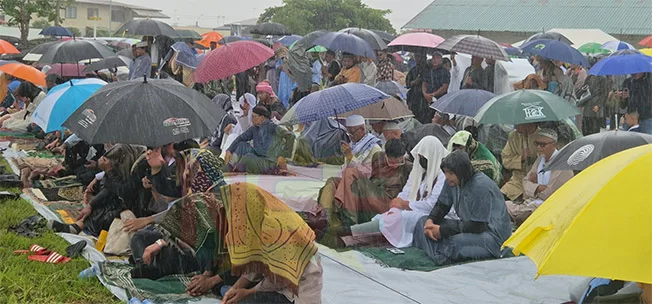
On the morning of May 27, hundreds of Muslim worshippers gathered on the large open field of Nabawi School in northern Paramaribo, the capital of Suriname, to hold a collective Eid al-Adha prayer, kicking off the annual four-day religious festival. Torrential downpour soaked the entire gathering, turning the open ground damp and muddy, but the crowd of believers remained steadfast, completing both the sermon and scheduled prayer without leaving early.
This year, the celebration of the festival has come with unique financial pressure for local communities: the price of sacrificial animals has surged to unprecedented levels, putting core religious traditions out of reach for many low-income households. Local authorities confirmed that a single sheep now costs roughly 20,000 Surinamese dollars, while a full bull can exceed 100,000 Surinamese dollars, a burden that many local families cannot absorb. Industry observers predict that far fewer animals will be slaughtered for the ritual this year than in previous years.
Against this backdrop, the sermon delivered during the collective prayer emphasized that the core meaning of Eid al-Adha extends far beyond the ritual slaughter of animals. Rather, the festival centers on obedience to Allah, willingness to sacrifice, communal brotherhood, and inner spiritual purification. Believers are called to draw closer to their faith by sacrificing negative personal traits including ego, pride, and jealousy, rather than focusing solely on the material requirement of animal sacrifice.
Nasir Eskak, director of the Ministry of Home Affairs, who also participated in and completed the prayer alongside other worshippers in the pouring rain, echoed this message. He referenced the foundational story of the Prophet Ibrahim and his son Ismail, a narrative that anchors the festival’s emphasis on obedience and devotion to faith. Eskak stressed that sacrifice in the context of the festival can take both material and non-material forms.
“When God asked Ibrahim to sacrifice his son, that was a sacrifice that could never be measured in monetary terms,” he explained, noting that particularly amid difficult economic times, the most meaningful sacrifice comes from setting aside personal ego and negative traits to support neighbors and care for one another. He added that even with the steep price hikes, he expected believers who can afford the cost of a sacrificial animal will still carry out the traditional ritual as their faith calls.