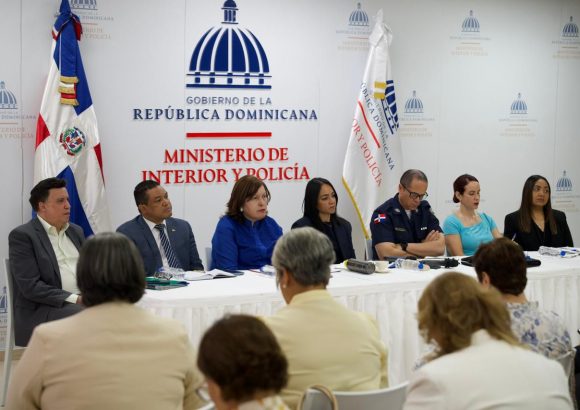
In a key gathering focused on shoring up public safety across the Dominican Republic, Interior and Police Minister Faride Raful convened governors from all 32 of the country’s provinces in Santo Domingo to align cross-regional strategies targeting a suite of pressing criminal threats. The high-level meeting operated under the umbrella of the national security framework advanced by sitting President Luis Abinader, bringing together local and national authorities to map out coordinated responses to challenges ranging from drug micro-trafficking and illegal street motorcycle racing to rampant cattle rustling and frequent traffic accidents that have eroded community safety.
During the day-long discussions, provincial leaders opened up about the tangible harm that persistent crime has inflicted on their local populations, and outlined critical unmet needs for frontline security and emergency services. These gaps included updated equipment for police and fire departments, additional operational vehicles, and upgrades to aging institutional infrastructure that hampers effective response.
Minister Raful centered part of her remarks on the urgent need for formal reporting of cattle rustling incidents, a crime that hits agricultural communities particularly hard in provinces like La Altagracia. She stressed that official complaints are the foundational first step that allows law enforcement to launch thorough investigations and successfully prosecute offenders who steal livestock, a crime that costs rural producers thousands of dollars in losses annually. Echoing this focus on cracking down on livestock crime, Deputy Minister Angela Jáquez called for tighter, more consistent regulatory controls over both livestock transportation and commercial slaughter operations, noting that weak oversight creates open pathways for illegal rustling rings to operate undetected.
On the topic of long-term security system reform, Andrés Modesto Cruz Cruz outlined steady progress in the administration’s flagship police expansion initiative, which has set a target of adding 20,000 new uniformed officers to national ranks by 2028. To date, he confirmed that nearly 13,000 new recruits have already completed training and joined active duty, with a cohort of more than 2,500 additional trainees on track to graduate in the near future to boost security presence across every region of the country. Attendees also dedicated time to reviewing a newly designed motorcycle regulation plan, which specifically targets the dangerous, unauthorized illegal street racing events that have become a public safety hazard in many urban and suburban areas.
Beyond violent and organized crime, the agenda also covered less high-profile but equally disruptive community issues: excessive public noise and permitting protocols for large public events. Officials from the southwestern province of Barahona brought forward a proposal to enforce stricter time limits on outdoor events and amplified music to reduce quality of life disruptions for local residents. Separately, Delsa de Óleo, governor of La Altagracia, raised urgent alarms over rising youth violence in the resort area of Verón, specifically pointing to the presence of unsupervised foreign minors who have been tied to local criminal activity in the region.