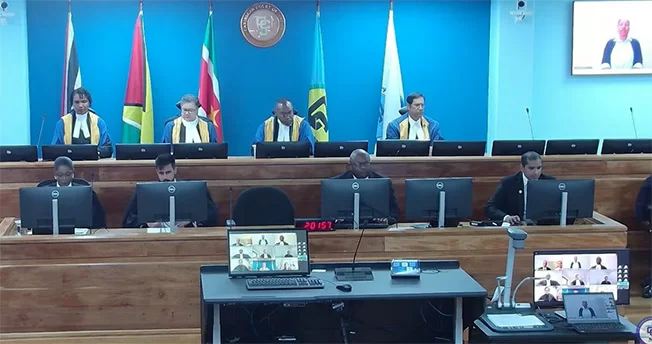
In a landmark regional ruling issued on May 25, the Caribbean Court of Justice (CCJ) has found that the government of Suriname violated the free movement rights of Trinidadian political analyst Derek Anand Ramsamooj, stemming from his extended 2020 detention without guaranteed access to legal counsel. The regional court has ordered Suriname to pay Ramsamooj $30,000 in damages for the severe breach of his rights as a citizen of the CARICOM community.
The case, brought forward by Ramsamooj against the State of Suriname, centers on events that unfolded in October 2020. Ramsamooj, a national of Trinidad and Tobago who had regularly worked in Suriname as a political consultant for the former Bouterse administration, was first approached by Surinamese police at Paramaribo’s Hotel Krasnapolsky on October 6, 2020. Officers seized his passport and ordered him to report for questioning the following day, after which he was taken into custody as part of a criminal investigation into alleged corruption and fraud linked to the previous Surinamese government.
CCJ’s findings confirm that Ramsamooj was held in two separate 8-day detention periods under Article 40 of Suriname’s Code of Criminal Procedure, during which he was denied effective access to legal representation. All interrogations were conducted in Dutch with the assistance of a translator, and a Dutch-language statement obtained during this period was later used as evidence against him. His pre-trial detention was ultimately extended until December 22, 2020, when he was granted release due to a sharp decline in his health. Formal criminal charges—including participation in a criminal organization, fraud, and money laundering—were filed against him in March 2021, and his passport remained seized until September 2022, when he was finally permitted to leave Suriname to seek urgent medical treatment abroad.
At the core of the legal challenge was the question of whether restrictions on access to legal counsel violated the rights guaranteed to CARICOM citizens under the Revised Treaty of Chaguaramas, a framework that enshrines the right to free movement across the regional bloc. In its ruling, the CCJ emphasized that fundamental human rights are a prerequisite for the effective exercise of CARICOM citizen rights, holding that access to legal representation from the first point of interrogation is a minimum standard of legal protection that all member states must uphold within the community.
The court further found that Article 40 of Suriname’s criminal procedure code fails to provide adequate safeguards for suspects who are denied effective access to a lawyer during the investigation phase, referencing binding international human rights standards and prior rulings from the European Court of Human Rights to support its conclusion. The application of Suriname’s domestic legislation in this case, the CCJ ruled, created an impermissible restriction on Ramsamooj’s right to free movement within CARICOM. The court made clear that member states cannot invoke domestic legal procedures that conflict with the community’s minimum human rights standards to justify rights violations.
Notably, the CCJ stressed that its ruling does not bar Suriname from moving forward with its underlying criminal prosecution of Ramsamooj. It did, however, note that any statements or evidence obtained during the period in which Ramsamooj’s rights were violated cannot be used in future proceedings if such use would once again conflict with CARICOM community law.
The court dismissed a portion of Ramsamooj’s additional claims: it declined to issue a separate ruling on his right to provide professional services within CARICOM, finding insufficient evidence that he was actively providing services at the time of his detention in line with the treaty’s definitions. It also ruled that a full causal link between his claimed medical expenses and the rights violation had not been established. Even so, the court accepted medical expert reports confirming that Ramsamooj developed severe health complications during his detention, including cardiovascular issues and a stroke, and that the conditions of his detention contributed directly to these health outcomes.
Legal observers across the Caribbean have framed the ruling as a pivotal legal milestone for the CARICOM bloc. The CCJ’s explicit confirmation that fundamental human rights form an integral part of regional community law sets a new precedent, reinforcing that core rights such as regional free movement cannot function meaningfully without minimum protections for fundamental legal principles.