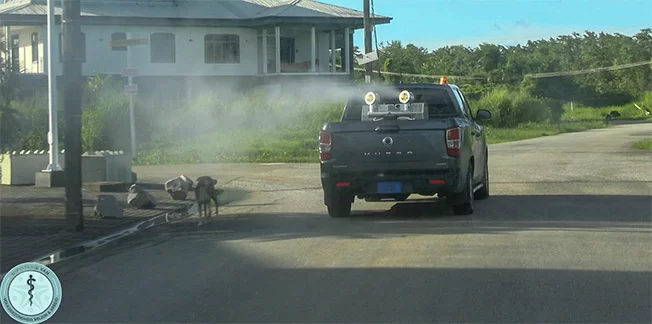
Public health authorities in Blauwgrond are ramping up mosquito-borne disease response, launching a targeted chikungunya control initiative across residential districts of the region next week. The Bureau for Public Health (Bureau voor Openbare Gezondheidszorg, BOG) will deploy specialized spraying vehicles, commonly referred to as dengue trucks, to treat affected areas during the operation, scheduled to run from May 25 to May 29.
Chikungunya is a viral infection transmitted almost exclusively by Aedes aegypti mosquitoes, the same vector that carries dengue and Zika viruses. Common symptoms of the disease include sudden high fever, severe joint pain that can persist for weeks or months, debilitating headaches, and extreme fatigue. Public health officials emphasize that vector control remains the most effective measure to slow transmission, particularly during wet seasons when standing water creates ideal breeding grounds for Aedes mosquitoes. Rainy periods amplify transmission risk, making proactive intervention critical to preventing larger outbreaks.
All spraying operations will be conducted between 5:00 PM and 9:00 PM local time, with a pre-planned route covering different neighborhoods each day to ensure full coverage of high-risk areas. On Monday, May 25, teams will treat Surivillage 3, the Sabaku Project area, the Zusterproject district, Papayafowrustraat, Morgenstondstraat, Anton Drachtenweg, Powisistraat, Bonistraat, Tweekinderweg, Mr. R.W. Thurkowstraat, and all connecting side streets in these zones. The following day, Tuesday May 26, crews will move to the district surrounding Kleinestraat, Wolframstraat, Granietstraat, and Kristalstraat. On Thursday, May 28, operations will return to Granietstraat, Wolframstraat, and Kristalstraat, adding the districts of Johannes Vermeerstraat and Picassostraat to the schedule. The final day of spraying, Friday May 29, will cover Picassostraat, Johannes Vermeerstraat, Leo Heinemanstraat, Plutostraat, Aidastraat, and all adjacent side streets.
To protect resident safety during the spraying operation, BOG has issued a series of clear precautionary guidelines for local communities. The agency advises residents to leave windows and doors open during spraying to ensure maximum penetration of the treatment into outdoor-adjacent spaces, while covering all human food and drinking water stored in open areas and securing caged pet birds to avoid exposure. After spraying is complete, all remaining food and drinking water intended for household pets should be discarded and replaced with fresh supplies. BOG also recommends that infants and people with pre-existing respiratory conditions stay in fully enclosed indoor spaces during spraying operations, and that all clothing left outside be brought indoors and stored away before treatment begins.
The operation remains weather-dependent: all scheduled spraying will be canceled if heavy rain occurs, as precipitation negates the effectiveness of insecticide treatment. Residents are advised to monitor local updates for schedule changes in case of adverse weather.