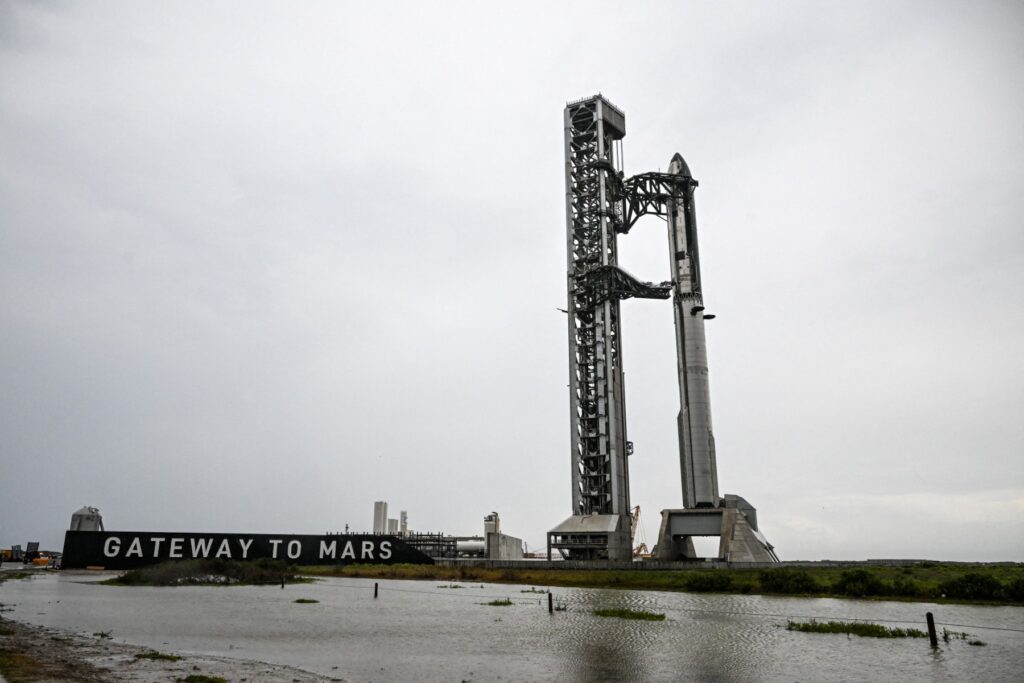
At its launch facility on South Padre Island in southern Texas, aerospace giant SpaceX is gearing up for a second attempt to launch its next-generation Starship rocket on Friday, just one day after technical issues forced a last-minute cancellation of the initial test flight.
The company announced the new launch timeline via its official account on X, noting that forecasters give an 85% chance of favorable weather conditions throughout the 90-minute launch window, which opens at 5:30 pm local time (2230 GMT). This highly anticipated test marks the debut of SpaceX’s third-generation Starship design, coming at a pivotal moment for the company as it prepares for what analysts project will be a record-breaking initial public offering as early as June 2025.
Thursday’s aborted launch featured multiple pauses and restarts of the countdown clock before teams called off the attempt. Shortly after the scrub, SpaceX CEO Elon Musk took to X to explain the root cause of the delay: a hydraulic pin designed to hold the launch tower’s supporting arm in place failed to retract, a glitch that could not be resolved within the remaining window on Thursday.
The launch attempt comes on the heels of SpaceX completing its regulatory filing with the U.S. Securities and Exchange Commission for its public debut, a move that has already generated massive excitement across global capital markets. When the flight finally proceeds, it will be broadcast live to the public, offering a transparent look at the company’s progress developing the 407-foot (124-meter) reusable rocket – a system central to both SpaceX’s long-term commercial goals and NASA’s Artemis program, the U.S. government’s initiative to return astronauts to the lunar surface.
This test will be the 12th overall Starship flight, and the first in seven months. The fully stacked third-generation vehicle stands slightly taller than its predecessor, capping out at just over 124 meters. SpaceX has designed Starship to be a fully reusable launch system, a breakthrough that the company says will drastically cut the cost of access to space and enable ambitious missions ranging from large satellite deployments to future crewed flights to Mars. The primary objective of this test is to prove that the rocket’s redesigned systems perform as expected in real flight conditions.
The stakes for this test could not be higher. NASA has awarded SpaceX a multi-billion dollar contract to develop a human-rated modified version of Starship to serve as the lunar lander for the Artemis program, which aims to land the first woman and person of color on the Moon. As China advances its own independent lunar program, which targets a crewed landing by 2030, officials within the current Trump administration have grown increasingly concerned that schedule delays in the private sector could allow China to beat the U.S. back to the lunar surface.
While recent Starship test flights have been marked as successful by SpaceX, the program has not been without high-profile setbacks. Previous test articles have ended in dramatic explosions: two mid-flight tests broke up over the Caribbean Sea, one test ended in an explosion shortly after reaching space, and a 2024 ground test of the rocket’s upper stage resulted in a destructive blast. That last incident, which occurred last June, is what pushed this third-generation test back seven months. Now, all eyes are on southern Texas as SpaceX attempts to prove its latest design is ready to move the program forward.