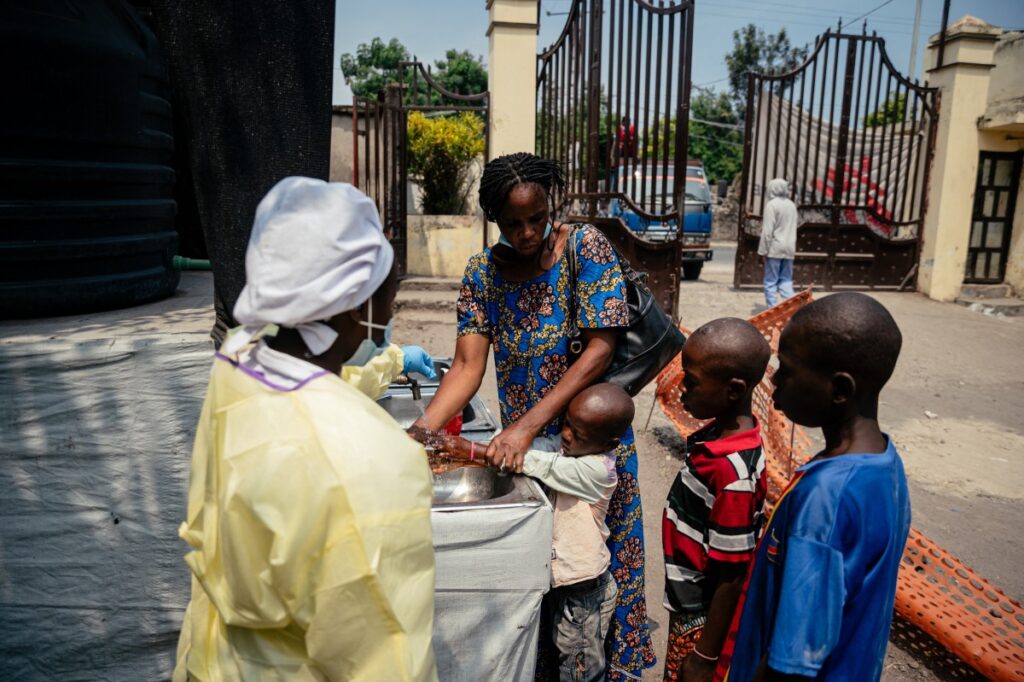
KINSHASA, DR Congo – A fast-expanding Ebola outbreak in eastern Democratic Republic of Congo has triggered global alarm, with the World Health Organization (WHO) upgrading the crisis to an international public health emergency amid rising fatalities, limited treatment options, and persistent conflict blocking response efforts. As of Tuesday, Congolese health officials report approximately 131 deaths and 513 total suspected cases, marking a sharp jump from last week’s count of 91 deaths and 350 suspected cases.
The outbreak, centered in the conflict-battered gold-mining region of northeastern Ituri province bordering Uganda and South Sudan, is driven by the Bundibugyo strain of Ebola – a variant for which no approved vaccines or targeted therapies currently exist. Unlike the more common Zaire strain, which has been responsible for the DRC’s deadliest past outbreaks and has authorized vaccines, the Bundibugyo strain previously caused smaller outbreaks in Uganda (2007) and the DRC (2012), with a recorded mortality rate between 30% and 50%.
Compound the crisis is the fact that the epicenter of the outbreak is a remote region roiled by decades of inter-militia clashes, making it extremely difficult for responders to reach affected communities. Only 30 cases have so far been confirmed through laboratory testing, with the vast majority of counts based on suspected symptomatic cases. The virus has already spread beyond Ituri, with suspected cases detected in North Kivu province’s commercial hub of Butembo – more than 120 miles from the outbreak’s origin – and one confirmed case in Goma, the province’s capital, which is currently controlled by Rwanda-backed M23 rebel forces. Cross-border spread has also been confirmed: Uganda has reported two confirmed cases in its capital Kampala linked to travel from the DRC, including one fatality.
Local misinformation has also delayed response efforts. Congolese Health Minister Samuel Roger Kamba told national television that many residents initially mistook Ebola symptoms for a mystical illness, delaying care-seeking and allowing the virus to spread unchecked. “The deaths we are reporting are all the deaths we have identified in the community, without necessarily saying that they are all linked to Ebola,” Kamba clarified.
WHO Director-General Tedros Adhanom Ghebreyesus told the agency’s annual governing body meeting in Geneva on Tuesday that the decision to declare a Public Health Emergency of International Concern (PHEIC) – the second-highest global alert level under international health regulations – was not made casually. “I’m deeply concerned about the scale and speed of the epidemic,” he said. The WHO is currently evaluating all candidate vaccines and treatments to identify options that could be deployed to curb the surge of the new strain.
The Africa Centres for Disease Control and Prevention has already designated the outbreak a continental public health emergency, reflecting fears of wider spread across the African continent. Humanitarian groups warn that ongoing conflict between Congolese government forces and armed groups in the region remains one of the biggest barriers to an effective response. “Humanitarian access and coordination between the various stakeholders, particularly the parties to the conflict, could be one of the challenges for the response,” said Francois Moreillon, DR Congo representative for the International Committee of the Red Cross, earlier this week. Moreillon called on all warring parties to guarantee safe, unimpeded access for response teams and aid workers.
Congolese President Felix Tshisekedi has urged the public to remain calm while adhering to precautionary measures, and has ordered the national government to scale up its response to the crisis. This is the 17th Ebola outbreak the DRC has faced since the virus was first identified in the country in 1976. The Central African nation of more than 100 million people has a long history of Ebola outbreaks, with the deadliest between 2018 and 2020 claiming nearly 2,300 lives from 3,500 confirmed cases.
The outbreak has already prompted precautionary measures around the globe. Germany announced Tuesday it is preparing to receive and treat a U.S. citizen who contracted the virus while working in the region. The American patient is a doctor with Christian aid organization Serge, which confirmed he was exposed through his work treating infected patients; two other doctors who assisted with care remain asymptomatic. The United States has already implemented entry screenings for air travelers arriving from Ebola-affected regions and temporarily suspended routine visa services in the DRC.
Ebola, a highly contagious viral hemorrhagic fever first discovered in 1976 and thought to originate in bat populations, spreads through direct contact with infected bodily fluids. The disease can progress rapidly to severe internal bleeding, organ failure, and death in a large share of cases.