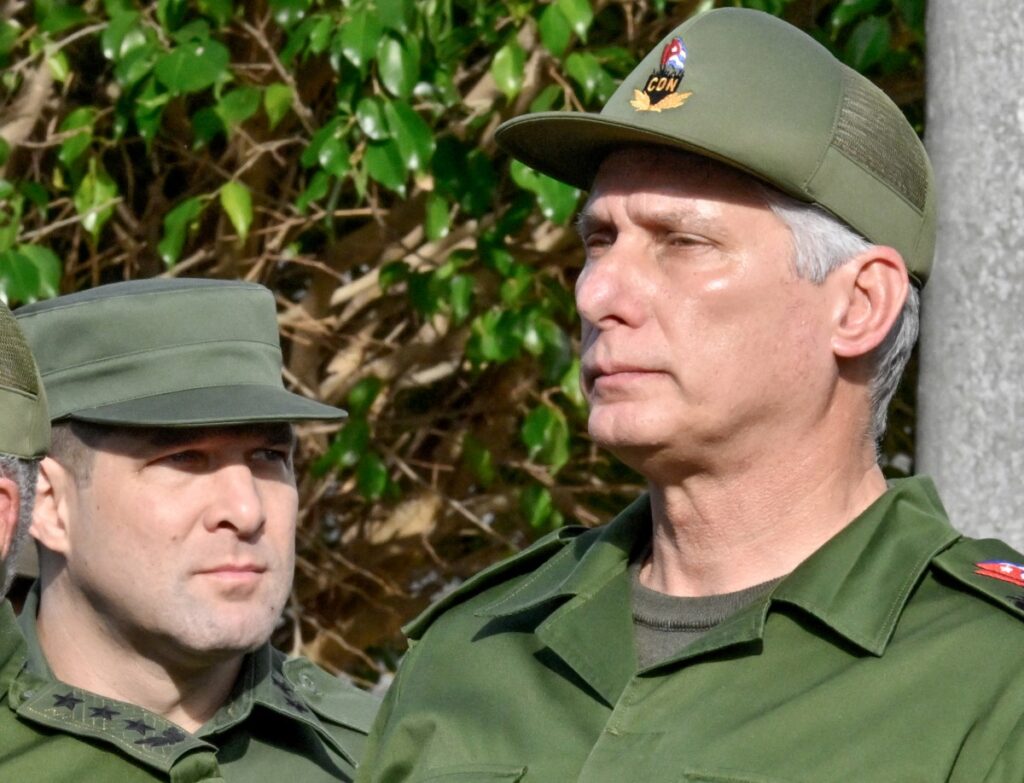
HAVANA, Cuba — Long-standing geopolitical tensions between the United States and Cuba erupted into open escalation on Monday, as the U.S. Department of the Treasury unveiled new punitive sanctions targeting the Caribbean nation’s top intelligence service and most senior government officials, while Cuban President Miguel Diaz-Canel issued a stark warning that any American military incursion would unleash an unprecedented “bloodbath.”
Diaz-Canel’s comments came 24 hours after U.S.-based news outlet Axios published an exclusive report citing unnamed American intelligence officials, which claimed Cuba had acquired more than 300 military-grade drones from Russia and Iran, and was evaluating plans to deploy these unmanned systems against targets including the U.S. Navy’s Guantanamo Bay base on Cuba’s eastern coast, U.S. military vessels operating in the region, and even parts of Florida. The unconfirmed report has fueled already rampant speculation across Washington that the Trump administration is actively considering large-scale military action to overthrow Cuba’s communist government, a path it took against the sitting government of Venezuela just months earlier.
Responding to the claims on the social media platform X, Diaz-Canel pushed back firmly on accusations that Cuba poses any offensive threat to the U.S. or any other nation. While he did not directly confirm or deny the report of a stockpiled drone arsenal, he emphasized that Cuba holds an inalienable, legitimate right to build up its defensive capabilities to fend off any foreign military attack. “That cannot be wielded, logically or honestly, as an excuse for imposing war on the noble Cuban people,” he wrote. He added that any unprovoked U.S. attack would trigger a bloodbath with consequences that cannot be reasonably calculated.
Hours after Diaz-Canel’s statement, the U.S. Treasury’s Office of Foreign Assets Control formally announced the new round of sanctions, placing prohibitions on Cuba’s primary intelligence agency and nine high-profile Cuban nationals. The sanctioned list includes the country’s cabinet ministers for communications, energy, and justice, alongside multiple senior leaders of the Communist Party of Cuba and at least three active-duty generals.
This latest escalation is part of a steady ramp-up of American pressure on Cuba that began in January, when former President Donald Trump openly floated the possibility of removing Cuba’s sitting leadership, mirroring the U.S. military operation that ousted the Venezuelan government earlier that same month. Soon after, Washington cut off one of Cuba’s last remaining critical economic lifelines by halting all Venezuelan oil shipments to the island — Venezuela had long been Cuba’s primary fuel supplier — and threatened to impose punitive tariffs on any third country that moved to cover the resulting fuel gap.
That American oil blockade has dramatically worsened an already severe humanitarian and energy crisis across Cuba. Widespread, increasingly frequent blackouts have become a daily reality for Cuban citizens, as the country’s aging, poorly maintained power plants cannot generate enough electricity to meet basic demand. Cuban government officials have repeatedly accused Washington of intentionally sabotaging the country’s economy through the crippling fuel blockade to create a pretext for full-scale military intervention.
The controversial Axios drone report was published just days after Central Intelligence Agency Director John Ratcliffe traveled to Havana for closed-door negotiations with Cuban officials. It also coincides with widespread U.S. media reports that the Trump administration is pursuing criminal indictments against 94-year-old Raúl Castro, the younger brother of iconic revolutionary leader Fidel Castro and former Cuban president, as another tool in its broader pressure campaign against the island.
Cuban authorities say the fuel blockade has left the country with critically low stockpiles of diesel and fuel oil, which are required to power backup generators that supplement the output of the country’s crumbling power infrastructure. Even amid the rising geopolitical standoff, Cuba received a new 1,700-ton shipment of humanitarian aid from Mexico on Monday, marking the fifth such delivery from Mexico’s left-wing administration since February. Unlike earlier aid shipments, which were transported by Mexican navy vessels, this consignment was carried by a Panamanian-flagged merchant ship, according to on-the-ground reporting from Agence France-Presse journalists. Cuba’s Minister of Food Industry Alberto Lopez confirmed that the shipment includes powdered milk and beans earmarked for children and elderly residents, two of the island’s most vulnerable populations.