The exit of U.S.-based low-cost carrier Spirit Airlines from the Dominican aviation market will bring only a moderate shock to the country’s budget flight segment, according to Héctor Porcella, president of the Dominican Civil Aviation Board (JAC). Porcella emphasized that existing carriers are already positioned to absorb all the routes and passenger volume Spirit is leaving behind, easing fears of widespread disruptions or sudden price hikes.
Spirit’s exit from the Dominican market comes after the collapse of a $500 million rescue financing deal for the airline in the United States, forcing the carrier to wind down its cross-border operations between the U.S. and the Dominican Republic. Porcella acknowledged that any airline exit from a market is never ideal for the aviation sector, regardless of the underlying causes, but stressed that the Dominican market’s existing competitive landscape has the capacity to offset the gap.
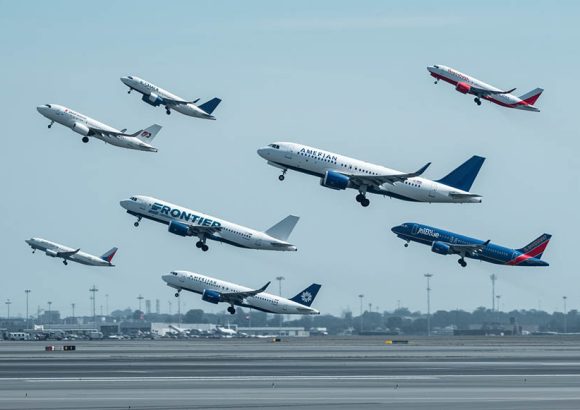
Currently, the Dominican low-cost aviation segment is well-served by a mix of international and domestic carriers including Frontier Airlines, Southwest Airlines, local low-cost leader Arajet, and JetBlue — which Porcella classifies as a moderately low-cost operator. Even non-low-cost carriers such as American Airlines are also expected to pick up additional capacity to cover Spirit’s abandoned routes, he added.
New data on Spirit’s market presence shows the carrier held a measurable but not dominant share of key travel routes between the U.S. and the Dominican Republic. In 2025, Spirit carried 470,147 passengers, equal to 4% of the 10.15 million total passengers traveling between the Dominican Republic and Washington D.C. For popular U.S. departure points including Florida, Philadelphia, Boston, Newark, and Baltimore, Spirit held a 20% total market share on routes to the Dominican Republic, a volume that Porcella says can be quickly absorbed by remaining operators.
Looking ahead to 2026 capacity projections, Spirit had planned to offer 276,000 total seats for arrivals and departures in the Dominican market. All of this seat capacity will be taken up by other active carriers, Porcella confirmed, addressing widespread concerns that reduced competition in the low-cost segment would drive up airfares for travelers.
A closer look at Spirit’s key markets in the country shows the carrier had already been scaling back its presence long before its full exit. In Fort Lauderdale, one of Spirit’s largest hubs for Dominican routes, the carrier held between 10% and 20% of the market, per local reporting from outlet Acento. On the high-traffic Philadelphia-Punta Cana route, Spirit closed out 2025 with a 20% market share, but that share had plummeted to just 1% by the first quarter of 2026, with American Airlines and Frontier already stepping in as the primary operators on the route.
On the Fort Lauderdale-Santiago route, Spirit was the undisputed market leader in 2025, but its share had already fallen to 61% by early 2026, while JetBlue’s share climbed to 39% as the carrier expanded to capture growing demand. Porcella noted that Spirit had steadily expanded its operations in the Dominican Republic starting in 2022, but overall passenger volumes on the U.S.-Dominican routes Spirit served have remained stable even as the carrier wound down its operations, meaning no sudden drop in service is expected for travelers.