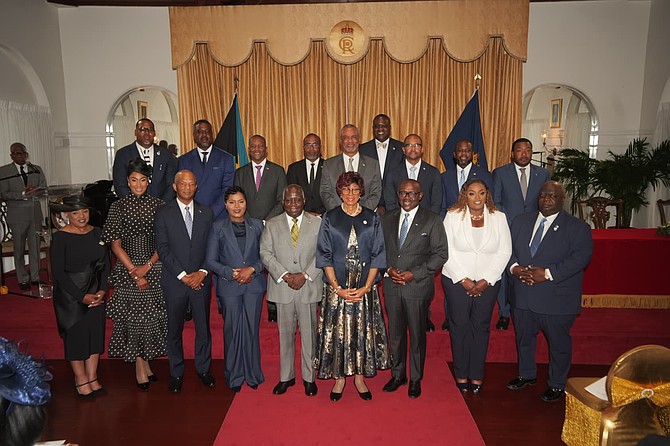
Following a decisive landslide victory in the country’s general election, Bahamas Prime Minister Philip Davis has formally inaugurated one of the largest executive administrations in Bahamian history, installing a 28-member team of Cabinet and state ministers in multi-day ceremonies at Government House.
Led by Davis, who secured a rare second consecutive term as prime minister – the first Bahamian leader to achieve this milestone in nearly 30 years – the new government comprises 21 full Cabinet ministers and 7 state ministers. Among the high-profile appointments, Deputy Prime Minister Chester Cooper has taken on the additional role of Minister of Education, Science and Technology. Wayne Munroe, previously the national security lead, has shifted portfolios to serve as Senator, Attorney General and Minister of Legal Affairs, while veteran politician Fred Mitchell returns to lead the Ministry of Foreign Affairs. Michael Halkitis has been sworn in as the new Minister of Finance.
The full roster of Cabinet appointments covers every major government portfolio: Clay Sweeting leads Works and Family Island Affairs, Michael Darville takes charge of Health and Wellness, and Glenys Hanna-Martin returns to head the Tourism Ministry. Keith Bell serves as Minister of Housing and Land Reform, Jobeth Coleby-Davis leads Energy, Utilities and Aviation, and Mario Bowleg oversees Youth and Sports. Jomo Campbell holds the Agriculture and Marine Resources portfolio, Pia Glover-Rolle leads Labour, Public Service and National Insurance, and Zane Lightbourne heads Environment and Natural Resources. Ginger Moxey returns as Minister for Grand Bahama, while Lisa Rahming takes on Urban Renewal and Community Development. Myles Laroda fills the vacant National Security portfolio, Leon Lundy leads Transport, and Leslia Miller-Brice takes charge of Culture, Arts and Heritage. Two new senators were appointed to Cabinet: Jerome Fitzgerald as Senator and Minister of Economic Affairs, and Barbara Cartwright as Senator and Minister of Social Services. Rounding out the Cabinet is Sebas Bastian, who serves as Minister of Innovation and National Development.
Alongside the full Cabinet, seven state ministers were also formally installed: Bacchus Rolle as State Minister of Social Services, Leonardo Lightbourne as State Minister for Agriculture and Marine Resources with oversight of the Bahamas Agricultural and Industrial Science Institute (BAMSI), Kirk Cornish and Mckell Bonaby as state ministers based in the Office of the Prime Minister, Wayde Watson as State Minister for Innovation and National Development, Darren Pickstock as State Minister for Immigration in the Ministry of Foreign Affairs, and Owen Wells as State Minister in Health and Wellness.
The size of the new administration has already drawn comparison to Davis’ first term, when his 2021 22-member Cabinet (including state ministers) faced public criticism. At that time, Davis defended his decision to expand the executive branch, arguing that the country’s complex, large-scale challenges demanded additional capacity. “I know everyone is trying to distract from our job at hand. The enormity of the task at hand is what caused me to select the number of persons that I have,” Davis stated in 2021, a position he is expected to reaffirm for this larger 28-member administration.
The size of the Davis-led administration stands in sharp contrast to the previous Minnis administration, which took office after the 2017 general election with an initial 13 Cabinet ministers and just 3 state ministers, less than half the size of the current executive team.