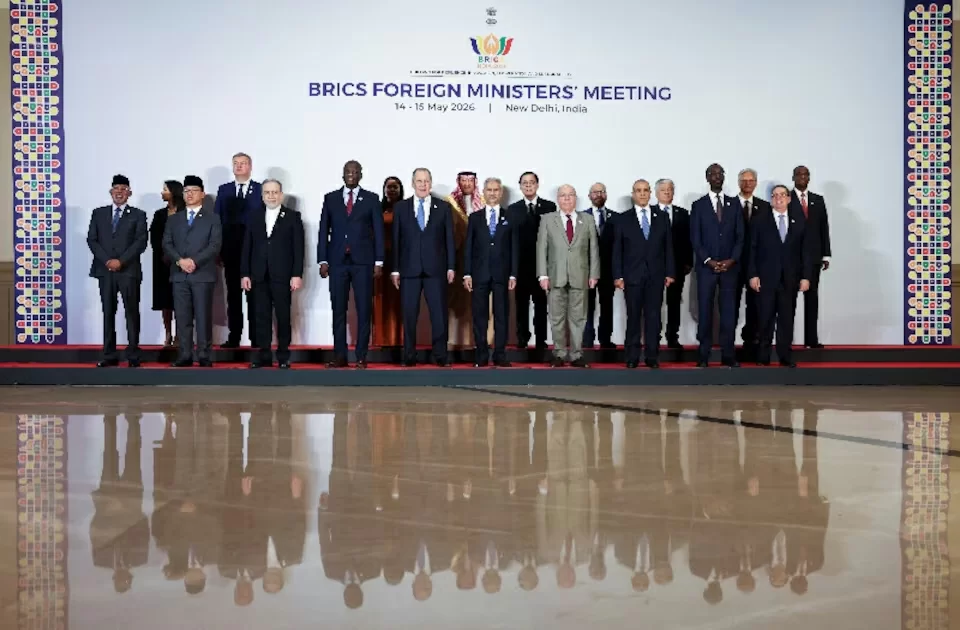
A high-stokes 2026 BRICS gathering hosted by New Delhi has wrapped up its two-day deliberations without the bloc’s traditional joint closing statement, laid bare by deep internal divisions over the ongoing conflict involving Iran that have pitted new bloc members against one another.
The 9-nation bloc, which expanded in 2024 to include both Iran and the United Arab Emirates (UAE), could not overcome irreconcilable disagreements over how to frame the regional war that has spilled into cross-border attacks. Iran pushed the bloc to formally condemn military operations conducted by the United States and Israel against the country, and publicly accused the UAE — a key U.S. regional ally — of direct involvement in offensive military actions against Tehran. Since the conflict erupted in late February, Iran has launched repeated drone and missile strikes targeting UAE territory, a response that has ratcheted up tensions across the Persian Gulf.
Speaking after the talks, Iranian Foreign Minister Abbas Araqchi confirmed that a single BRICS member state had blocked the finalization of a shared statement, stopping short of explicitly naming the UAE. He clarified that Iran’s strikes on UAE soil have exclusively targeted U.S. military assets positioned in the country, adding that he holds out hope for greater consensus on the need for regional peaceful coexistence when the bloc holds its next full summit later this year.
As the 2026 chair of BRICS, India released a chair’s summary to wrap up the meeting, a document that openly acknowledged the divergent stances held by member states on the escalating Middle East crisis. Despite the core rift, all members reaffirmed shared commitments to open dialogue, respect for national sovereignty, adherence to international law, unimpeded access for global shipping through key international waterways, and the protection of civilian infrastructure and civilian lives.
In a notable point of near-consensus, the bloc collectively reaffirmed the Palestinian people’s inalienable right to self-determination and the establishment of an independent Palestinian state. Even this position, however, faced pushback, with one member state objecting to specific clauses of the summary related to the ongoing crisis in Gaza.
Beyond the regional conflict, the meeting reaffirmed the bloc’s collective commitment to maintaining unity among emerging market and developing economies to address shared global challenges. These challenges include rising geopolitical tensions, global economic slowdown, rapid technological transformation, rising trade protectionism, and growing global migration pressure.
For host nation India, the conflict carries immediate tangible economic and human costs. As the world’s third-largest importer of crude oil, India is heavily exposed to disruptions in Persian Gulf energy supplies. Iran’s effective de facto blockade of the Strait of Hormuz — the global chokepoint through which roughly 20% of the world’s oil and liquefied natural gas supplies pass — has directly impacted India’s energy security. This week alone, Iranian strikes have left at least three Indian seafarers dead and sank one Indian-flagged commercial vessel in the region.
During a recent brief stopover in the UAE, Indian Prime Minister Narendra Modi publicly condemned Iranian strikes on Gulf nations, and praised the UAE for its restraint and courage amid the ongoing period of heightened regional tension.