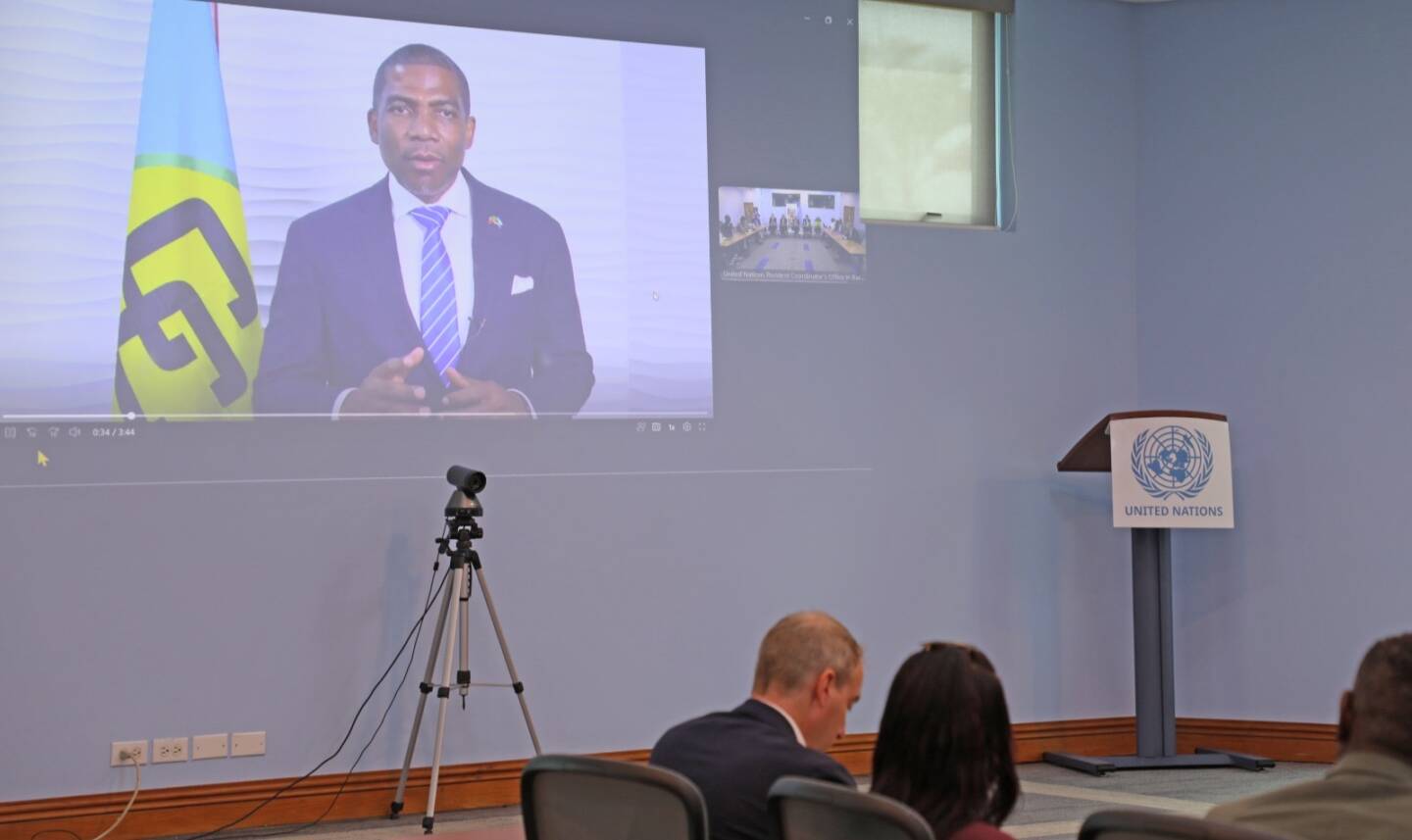
The United Nations has officially launched its 2025 Annual Results Report covering Barbados and the Eastern Caribbean subregion, detailing how coordinated multilateral action has delivered tangible development gains across the area amid mounting climate, economic, and social headwinds. Over the course of 2025, the UN mobilized a total of US$73.7 million to advance national development priorities set by local governments across the subregion.
The report launch was held at a formal press conference attended by senior UN leadership and the Chair of the Caribbean Community (CARICOM), the Hon. Dr. Terrance Drew. During the event, UN representatives reaffirmed the organization’s long-term commitment to supporting Caribbean Small Island Developing States (SIDS) through three core pillars: resilience-building, inclusive economic growth, and people-centered development solutions that align both with national development agendas and the global UN Sustainable Development Goals.
In his opening address to the conference, UN Resident Coordinator Simon Springett emphasized that climate vulnerability and economic volatility are not distant hypothetical risks for SIDS in the Eastern Caribbean, but daily lived realities that shape local livelihoods, food security, public health systems, and community safety. “This report tells a story—not just of programmes and numbers—but of people, partnership, and resilience. It shows clearly that when strong national leadership is matched with effective multilateral cooperation, real progress is possible, even in the most challenging global environment,” Springett said. “This is also a powerful statement about multilateralism. For Small Island Developing States, multilateral cooperation amplifies Caribbean voices, unlocks financing, strengthens regional systems, and helps transform vulnerability into resilience.”
Climate action emerged as a top scaling priority for the UN in the subregion in 2025, with more than US$36 million mobilized for climate adaptation projects, ecosystem restoration, climate-smart agricultural practices, and disaster risk reduction initiatives. A key milestone highlighted in the report was the launch of a new Regional Logistics Hub based in Barbados, which has already improved regional disaster response surge capacity and tracking for over 440 metric tons of emergency relief supplies spread across nine participating countries, cutting response times and boosting the effectiveness of disaster relief operations.
Springett stressed that all UN programming is designed in close collaboration with national governments, rooted in local priorities and structured as integrated solutions that address the interconnected nature of risks facing SIDS. “The United Nations remains fully committed to walking this path with governments and partners across the Eastern Caribbean — delivering together, listening to communities, and ensuring that development progress is resilient, equitable, and lasting. One message stands out above all: partnership matters. Whether responding to hurricanes, mobilizing climate finance, supporting national reforms, or investing in digital transformation, progress has been driven by cooperation — at the national, regional, and international levels,” he added.
Delivering virtual remarks on behalf of CARICOM, Chairman Dr. Drew praised the UN for its consistent, robust support to Barbados and the Eastern Caribbean at a time when the region has been battered by overlapping external shocks, including climate-fueled natural disasters, persistent economic uncertainty, growing national debt burdens, widespread food and energy insecurity, and the lingering aftereffects of the COVID-19 pandemic.
Dr. Drew noted that “The 2025 Annual Results Report reinforces what CARICOM has long recognised that multilateral cooperation is most effective when grounded in local realities and aligned with regional priorities.” He further emphasized that for SIDS, development progress cannot be separated from addressing the climate crisis, and welcomed the UN’s tailored approach to programming that centers this connection in 2025. “The UN, under the Multi-country Sustainable Development Cooperation Framework (MSDCF), demonstrated the value of linking climate action, disaster risk reduction, financing and social protection to build practical resilience. This report also underscores the importance of people-centred development and regional collaboration. Investments in health system, youth and women’s empowerment, governance and institutional strengthening are investments in stability, dignity and opportunity for our citizens,” Dr. Drew said.
The CARICOM Chair also addressed ongoing United Nations reform efforts, specifically the UN80 Initiative, issuing a clear call for reforms to be balanced with the need to preserve targeted, context-specific support for Caribbean SIDS. “While we support efforts to modernise and strengthen the United Nations, we remain concerned that efficiency-driven reforms must not weaken in-country presence or reduce context-specific technical expertise critical to the Caribbean, including support for the Antigua and Barbuda Agenda for SIDS (ABAS). Reforms must strengthen local capacity and ensure predictable, responsive financing for vulnerable states,” he asserted.
Senior representatives from across multiple UN specialized agencies joined the press conference to outline key results from their 2025 programming in the subregion. Brian Bogart, Representative and Country Director for the WFP Caribbean Multi-country Office, provided an overview of collective UN work on climate resilience and sustainable natural resource management. Stephanie Ziebell, Deputy Resident Representative for UNDP Barbados and the Eastern Caribbean, highlighted progress on advancing peace, public safety, and accessible justice systems. Roberto Telleria, Policy Officer with the FAO Subregional Office of the Caribbean, discussed UN support for expanding economic resilience and shared prosperity across the subregion.
Amalia Del Riego, PAHO/WHO Representative for Barbados and the Eastern Caribbean Countries, outlined progress in strengthening local health systems and expanding social protection to advance health equity and ensure no community members are left behind. Cleveland Thomas, Area Office Representative for the International Telecommunication Union in the Caribbean, covered UN-backed efforts to advance digitalization and innovation, including projects to expand school connectivity, improve maritime safety, and boost disaster preparedness. Patrice Quesada, IOM Regional Coordinator for the Caribbean and Chief of Mission for Barbados, shared updates on UN support for regional migration governance and policy coordination.
Following formal presentations, journalists from print, broadcast, and online outlets engaged UN personnel in a question-and-answer session to discuss the practical, on-the-ground impact of 2025 results for ordinary citizens across Barbados and the Eastern Caribbean.
Consistent with the UN’s people-centered approach to programming, direct support for vulnerable communities remained a core priority in 2025. For example, the UN provided emergency cash assistance to more than 7,700 people displaced or impacted by Hurricane Beryl, helping to protect food security, preserve livelihoods, and uphold human dignity for affected households.
Looking ahead to 2026, the UN has outlined three key priorities for the subregion: finalizing a new five-year Multi-country Sustainable Development Cooperation Framework, scaling up anticipatory action ahead of the annual Atlantic hurricane season, and deepening alignment between UN programming and the Antigua and Barbuda Agenda for SIDS.
The full 2025 Annual Results Report is available for public access at easterncaribbean.un.org.