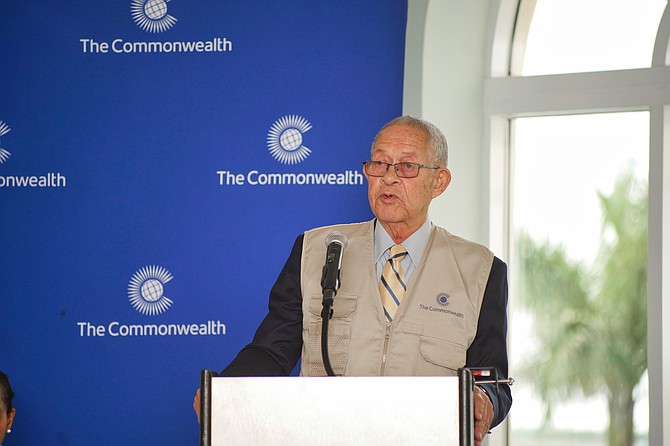
Unaddressed gaps in campaign finance regulation have left Bahamian elections persistently vulnerable to undue monetary influence, according to Bruce Golding, former Jamaican Prime Minister and head of the Commonwealth Observer Group. In a public press conference held at the British Colonial Hotel, where the group released its preliminary evaluation of the upcoming 2026 Bahamian general election, Golding issued sharp criticism of successive Bahamian governments’ failure to advance long-promised reform despite repeated warnings from international observer missions.
Golding noted that the need for updated campaign finance rules has been flagged by international monitoring teams for years, with no meaningful legislative action ever following these repeated calls. During his remarks, he joked that even if global monitoring bodies continued sending observer delegations to the Bahamas for another 100 years, the same unheeded recommendations would be repeated year after year. He emphasized that international bodies alone lack the leverage to force the necessary changes. “The people of The Bahamas need to make this their business. It is their democracy. It is their future,” Golding said. “Politicians can afford not to listen to the Commonwealth Secretariat, but they cannot refuse to listen to their own constituents. That is why real progress depends on the level of civic activism Bahamian citizens choose to exercise.”
The push for campaign finance reform is not a new conversation in Bahamian politics: major parties from across the ideological spectrum have repeatedly promised to advance the policy when campaigning, but have never followed through on those pledges once in power. Most recently, current Prime Minister Philip “Brave” Davis confirmed in 2024 that campaign finance reform was not a priority for his administration, despite earlier commitments to move the legislation forward. Golding observed that this pattern—opposition parties embracing reform with great urgency, only to abandon the issue once they win power—is a common trend across many Commonwealth nations.
This election cycle has brought the absence of regulation into sharp relief, as reports have emerged of widespread candidate distribution of gifts and vouchers to voters, a practice critics widely characterize as explicit vote buying. Off the record, sources from the opposition Free National Movement (FNM) have alleged that the ruling Progressive Liberal Party (PLP) poured massive amounts of unregulated campaign funding into outreach across the country.
Golding warned that small jurisdictions like the Bahamas, which have relatively small voter rolls per constituency, are particularly susceptible to this kind of monetary influence and illicit vote buying. Wealthy candidates or well-funded parties can easily calculate the exact number of votes they need to secure a win, then deploy unrestricted financial resources to buy that support directly, he explained. “This is something that worries us,” Golding added.
To address these systemic gaps, Golding outlined a series of key policy recommendations. First, he called for mandatory registration of all political parties, arguing that these organizations wield enormous public influence and cannot be allowed to operate with anonymous backing. He also proposed legally mandated caps on individual and corporate political donations, binding limits on overall campaign spending for both parties and individual candidates, and significant enforceable sanctions for any violations of these rules. Additionally, Golding recommended adopting a formal code of conduct for all political parties and candidates to regulate campaign behavior, particularly to curb the spread of personal attacks against opponents that have become increasingly common on social media platforms.