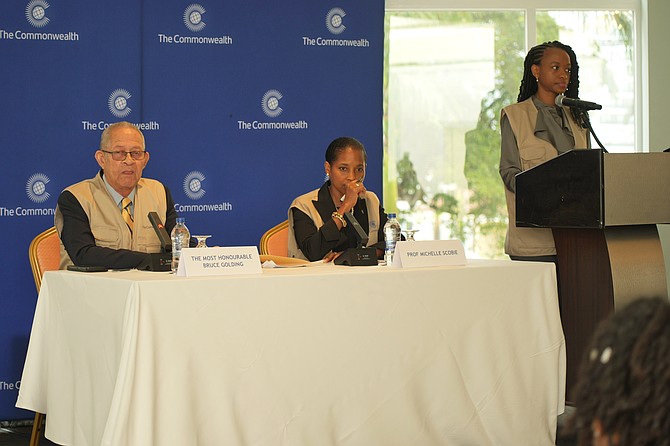
The Commonwealth Observer Group, which has monitored Bahamian electoral processes since 2017, has issued a stark call for comprehensive, long-overdue reform of The Bahamas’ election infrastructure, a day after releasing its preliminary findings from the most recent national vote. Though the current Davis administration has taken incremental steps to modernize the country’s electoral system, the international monitoring team argues far deeper changes are needed across three critical areas: election management frameworks, digital voting technology, and national media coverage rules.
Leading the observer mission is former Jamaican Prime Minister Bruce Golding, who emphasized that many key reform recommendations put forward after previous observation missions have sat unaddressed for years. Golding pushed for the creation of a permanent domestic oversight body tasked with systematically reviewing findings from international observer groups and implementing actionable changes, a core recommendation the Commonwealth has put forward for decades.
One of the most high-priority proposals the group has reintroduced is the establishment of an independent national election management body. Golding noted that 24 years have passed since the last national referendum on the issue, a timeline that he says makes it long past time to revisit the question for Bahamian voters. This call comes on the heels of weeks of formal complaints from Bahamian opposition parties, which have raised widespread concerns about the Parliamentary Registration Department’s management of the recent electoral process, including doubts over the accuracy and integrity of the national voter register and inadequate pre-election consultation and preparation.
While Golding praised multiple elements of the recent election — including the peaceful conduct of voting on election day, the professionalism of political party agents, and robust security arrangements across polling sites — the mission documented a series of persistent operational failures. These included widespread reports of voters being incorrectly assigned to constituencies, omitted entirely from voter rolls, and significant logistical breakdowns during last month’s advance polling period.
Golding outlined a series of immediate adjustments for the Parliamentary Registration Department, urging officials to apply lessons learned from the advance poll to all future electoral events. Key fixes include revising the number of voters assigned to individual polling stations, improving crowd control protocols, adjusting staffing deployment, adding clearer directional signage, accelerating the distribution of certified voter lists to political parties and returning officers, and strengthening proactive communication with both the public and political stakeholders about operational changes.
When asked about the potential for fixed election dates to resolve some scheduling and planning challenges, Golding noted the mission had not thoroughly evaluated the policy, but explained that the reform carries both benefits and drawbacks. “A situation may arise in a country which demands a return to the electorate and it may not necessarily be a good thing for that necessity to be imprisoned by the fact that the election date is fixed,” he said, “At the same time, a fixed election date does provide some predictability so that people can plan.”
Additional procedural reforms recommended by the group include publishing preliminary voter lists online to enable public verification and correction of errors, and moving from optional to mandatory biometric voter identification cards for the next national election. Golding commended the Davis administration’s rollout of optional biometric cards as a positive step toward modernization, but said full mandatory adoption is needed to eliminate roll inaccuracies.
One of the most concerning trends the mission identified is a persistent drop in voter turnout, a shift from The Bahamas’ historical record of high voter participation before the dual shocks of Hurricane Dorian and the COVID-19 pandemic. “This time around, there’s no COVID. We don’t have a hurricane and based on the preliminaries of the turnout, it seem to be somewhere in the region of 56 percent. That worries me,” Golding said. He noted that declining turnout is a regional trend across the Caribbean, and urged Bahamian political parties to investigate the root causes of growing voter alienation. To reverse the decline, Golding proposed launching a robust cross-platform public information campaign that uses both traditional and social media months ahead of the next election to boost voter awareness and engagement.
On media issues, the group acknowledged that press freedom is generally respected across The Bahamas, but documented significant public unease over the governing administration’s arrangements at the state-owned Broadcasting Corporation of The Bahamas (BCB) in the lead-up to the election. The Commonwealth restated its long-standing recommendation that ZNS, the national public broadcaster, provide equal access and balanced, impartial coverage to all registered political parties and candidates, regardless of incumbency.
The mission also received multiple reports of close, overlapping ties between private media outlet owners and the country’s major political parties, raising concerns about widespread implicit and explicit biased coverage. To address this, the group recommended that private media organizations collaborate to create an independent self-regulating media association for industry professionals, alongside a formal code of ethical conduct to guide political coverage.
Golding also flagged issues around the recent redistricting process that created two new parliamentary constituencies, arguing that the final boundary map was drawn to benefit the incumbent Davis administration. “The delimitation of constituencies under this arrangement has the potential to confer an unfair advantage in election outcomes,” he said.
Closing his presentation of preliminary findings, Golding congratulated re-elected Prime Minister Philip Davis on his victory, and commended all Bahamian voters for turning out and casting their ballots in a peaceful, orderly manner. A full, detailed final report from the Commonwealth observer mission will be published at a later date.