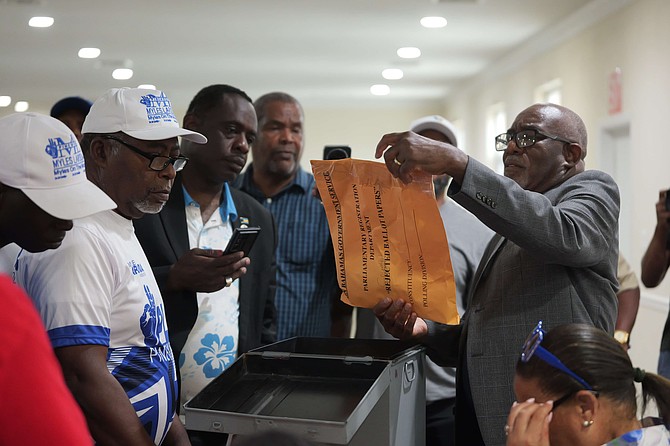
Fresh off Tuesday’s general election in The Bahamas, unofficial vote counting reveals a mixed political landscape where long-serving and sitting parliamentarians have largely held onto their seats, while a rising third party has gained significant traction across multiple constituencies. According to preliminary data compiled and reviewed by The Tribune, many incumbent MPs from both the Progressive Liberal Party (PLP) and the Free National Movement (FNM) not only retained their electoral districts but also grew their raw vote shares compared to the 2021 general election. At the same time, the Coalition of Independents (COI) has recorded substantial gains in nearly every constituency tracked, marking a notable shift in voter sentiment toward alternative political options.
One of the clearest examples of incumbent growth can be found in the Elizabeth constituency, where PLP incumbent JoBeth Coleby-Davis secured a decisive re-election victory. Across 14 polling divisions, Coleby-Davis captured 2,308 votes, a 22 percent increase from her 2021 total of 1,893 votes when she first ousted then-FNM incumbent Duane Sands. This cycle, she defeated FNM challenger Heather Hunt, who finished with 1,285 votes. Even in this solidly PLP-held seat, the COI saw its support more than double: candidate Donna Dorset Major took 544 votes, up from just 204 votes the party earned in Elizabeth in 2021.
In Bamboo Town, PLP incumbent Patricia Deveaux successfully defended her seat against FNM chairman Duane Sands, though her vote total dipped slightly to 1,716 from 1,790 in 2021. Deveaux defeated Sands, who earned 1,352 votes, in a high-profile contest that pitted the sitting MP against the FNM’s top party official. For the COI, candidate Maria Daxon — who ran in the constituency in 2021 — saw her support jump nearly 80 percent, rising from 378 votes to 677 this cycle.
Veteran PLP politician Glenys Hanna Martin secured a historic sixth consecutive term in Englerston, capturing 1,913 votes across 10 polling divisions. While her total was down from 2,249 in 2021, she still won by a wide margin over FNM candidate Heather McDonald (348 votes) and COI contender Faith Percentie (385 votes). The FNM’s vote share in Englerston fell from 498 in 2021, while the COI more than doubled its support, growing from 163 votes to 385 in this election.
Across multiple FNM-held constituencies, incumbents also grew their support, matching the trend seen in PLP-held seats. In St Anne’s, FNM incumbent Adrian White retained his seat with 2,346 votes, up from 2,007 in 2021. PLP challenger Keno Wong earned 1,402 votes, an increase from the 1,253 votes the PLP took in the district in 2021, while the COI’s Graham Weatherford earned 346 votes, nearly doubling the party’s 2021 total of 172. In Sea Breeze, PLP incumbent Leslia Miller-Brice boosted her vote total from 2,448 in 2021 to 2,911 this cycle, defeating FNM challenger Trevania Clarke-Hall, who earned 929 votes (down from the FNM’s 1,090 in 2021). The COI’s William Knowles took 565 votes, more than doubling the party’s 2021 total of 276 in the district.
This pattern of growing incumbent support and rising COI support also extends to Grand Bahama, the country’s second-most populous island. In East Grand Bahama, FNM incumbent Kwasi Thompson increased his vote total from 2,090 in 2021 to 2,342 this cycle, edging out PLP challenger Monique Pratt, who earned 1,912 votes — an increase from the PLP’s 1,686 votes in 2021. COI candidate Dexter Edwards earned 498 votes, up from 372 for the party in 2021. In Marco City, FNM leader Michael Pintard secured re-election with 2,534 votes, up from 2,340 in 2021. His PLP challenger Edward Fields II earned 1,399 votes, down from the PLP’s 2,021 in 2021, while COI candidate Jillian Bartlett increased the party’s vote total from 298 in 2021 to 365 this cycle.
As unofficial counting continues, the preliminary results highlight two key takeaways from the 2024 general election: sitting MPs from both major parties have largely retained their hold on their constituencies, even as the COI has emerged as a competitive alternative that has expanded its voter base across every region of the country.