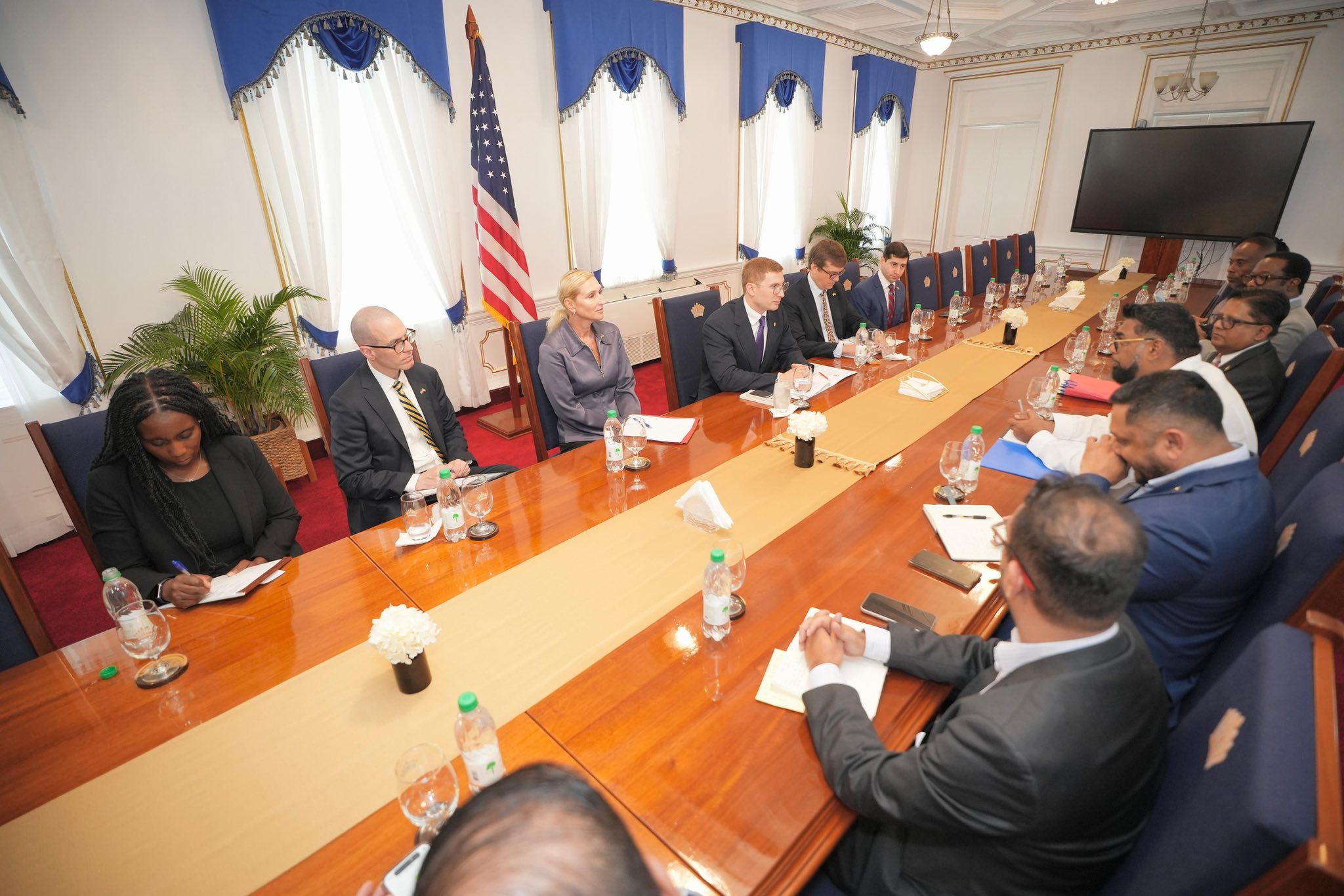
On Wednesday, May 13, 2026, a high-stakes bilateral meeting between Guyanese President Dr. Irfaan Ali and visiting U.S. Under Secretary of State for Economic Affairs Jacob Helberg opened a new chapter in bilateral economic cooperation, with plans for deepened engagement on targeted investments spanning multiple key industries. The diplomatic gathering, held at Guyana’s State House, included senior delegations from both sides: Helberg was accompanied by U.S. Ambassador to Guyana Nicole Theriot, while President Ali was joined by cabinet ministers Dr. Ashni Singh, Hugh Todd, Vickram Bharrat and Zulfikar Ally, alongside Foreign Secretary Robert Persaud and National Intelligence and Security Agency Director Colonel Sheldon Howell.
Shortly after the closed-door talks, during a press briefing at the U.S. Embassy ahead of wrapping up his one-day official visit to the South American nation, Helberg outlined the tangible outcomes of the discussions, revealing that detailed technical working-level talks will follow the high-level dialogue, with a potential permanent bilateral working group under consideration to maintain consistent progress and accountability on cooperation commitments.
A core focus of the talks was expanding private investment in Guyana’s already established bauxite mining sector. Currently, two operators—China’s BOSAI Minerals and U.S.-owned First Bauxite—run active production operations in the country, while Russian firm RUSAL is on track to restart its Guyanese activities later this year, after suspending operations in 2018 amid a major labor dispute. Helberg noted that discussions centered on expanding bauxite output and market access, with new U.S. investment targeting two key enablers: critical transportation infrastructure, particularly road networks, and cutting-edge autonomous trucking technology. These upgrades, he explained, would act as a catalyst to move more Guyanese bauxite to global markets faster and more efficiently.
Beyond the bauxite sector, Helberg highlighted a wide range of untapped investment opportunities for U.S. firms in Guyana. Pointing to the $55 trillion in liquid assets held by the U.S. private sector—what he called the world’s largest single pool of investment capital that would deliver mutual benefits to both Guyana and the United States—he identified promising sectors including data center development, tourism expansion, agricultural and food technology, and broader digital innovation. A key highlighted area of potential cooperation is partnership between Guyana and Silicon Valley, the global epicenter of high-tech innovation. Helberg noted that Guyana offers unique advantages for Silicon Valley firms, from testing new emerging technologies to establishing permanent local operations. He also outlined a transformative potential for artificial intelligence integration: AI-powered logistics infrastructure could position Guyana as a key regional hub that cuts transit times for northern Brazilian goods accessing Caribbean markets.
Closing his remarks, Helberg offered strong praise for the Guyanese government’s approach to economic growth, noting that he left the meeting confident in President Ali’s decisive leadership. “I can confidently say after this trip that President Ali does bring a level of decisiveness that really avails an opportunity to be transformative for the country of Guyana,” he said.